

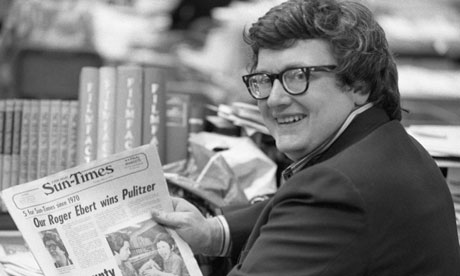
 Everything started with Roger Ebert. The only reason I knew to start watching the films of a
director named Martin Scorsese is because Roger Ebert wrote so lovingly of his
work. When I was eleven years old, I began reading Ebert's reviews. I quickly
became a compulsive viewer of Ebert & Roeper, setting my VCR to record the
program every Saturday night. And his work became an indelible part of my life.
I would wait by my computer on Thursday nights, counting down the minutes until Ebert’s
reviews of the new releases would trickle in.
Everything started with Roger Ebert. The only reason I knew to start watching the films of a
director named Martin Scorsese is because Roger Ebert wrote so lovingly of his
work. When I was eleven years old, I began reading Ebert's reviews. I quickly
became a compulsive viewer of Ebert & Roeper, setting my VCR to record the
program every Saturday night. And his work became an indelible part of my life.
I would wait by my computer on Thursday nights, counting down the minutes until Ebert’s
reviews of the new releases would trickle in.
In April of 2002, I remember breathlessly reading his four-star review
of Changing Lanes, a film I was
eagerly anticipating, and I rejoiced in the fact that Ebert thought it was a four-star
film. I rushed to see Changing Lanes opening weekend, and it
is one of the first instances where I can recall going to see the movie with
Ebert’s words in my mind as I watched it. Leaving the cinema, I was alive with
excitement, to know that I felt the same way Ebert did. It was in that way that
I first came to feel like a member of a film society.
I started seeing certain types of films that hitherto I had only
examined with curiosity at video stores or seen in giant advertisements in
newspapers. I felt almost too young and too unsophisticated to approach many of
the great works of cinema, but Ebert’s reviews brought these giant films down
to earth for me. In 2002 and 2003, I made ventures to see films such as City of God, Owning Mahoney, Raising
Victor Vargas, Nowhere in Africa
and The Quiet American in Austin
cinemas. This was back when many of the larger multiplex cinemas in Austin –
the Gateway and the Westgate, specifically – would screen art-house films for a
few weeks alongside the other major releases. It’s telling that the world Ebert
introduced me to – a world where American
Splendor played alongside American
Wedding at the Gateway in 2003 – would eventually morph into a world where The Descendants was banished to mostly
“art-house” screens only years later.
A few months before I turned twelve, I began writing weekly film
reviews for The West Austin News in April of 2002. Only weeks later, my father
passed away. I don’t think I knew how to deal with that kind of pain at such a
young age, and I believe I ran away from it by immersing myself in movies more
than ever. Through his criticism, Ebert acted as a kind of guide into this new,
frightening world that I was entering.
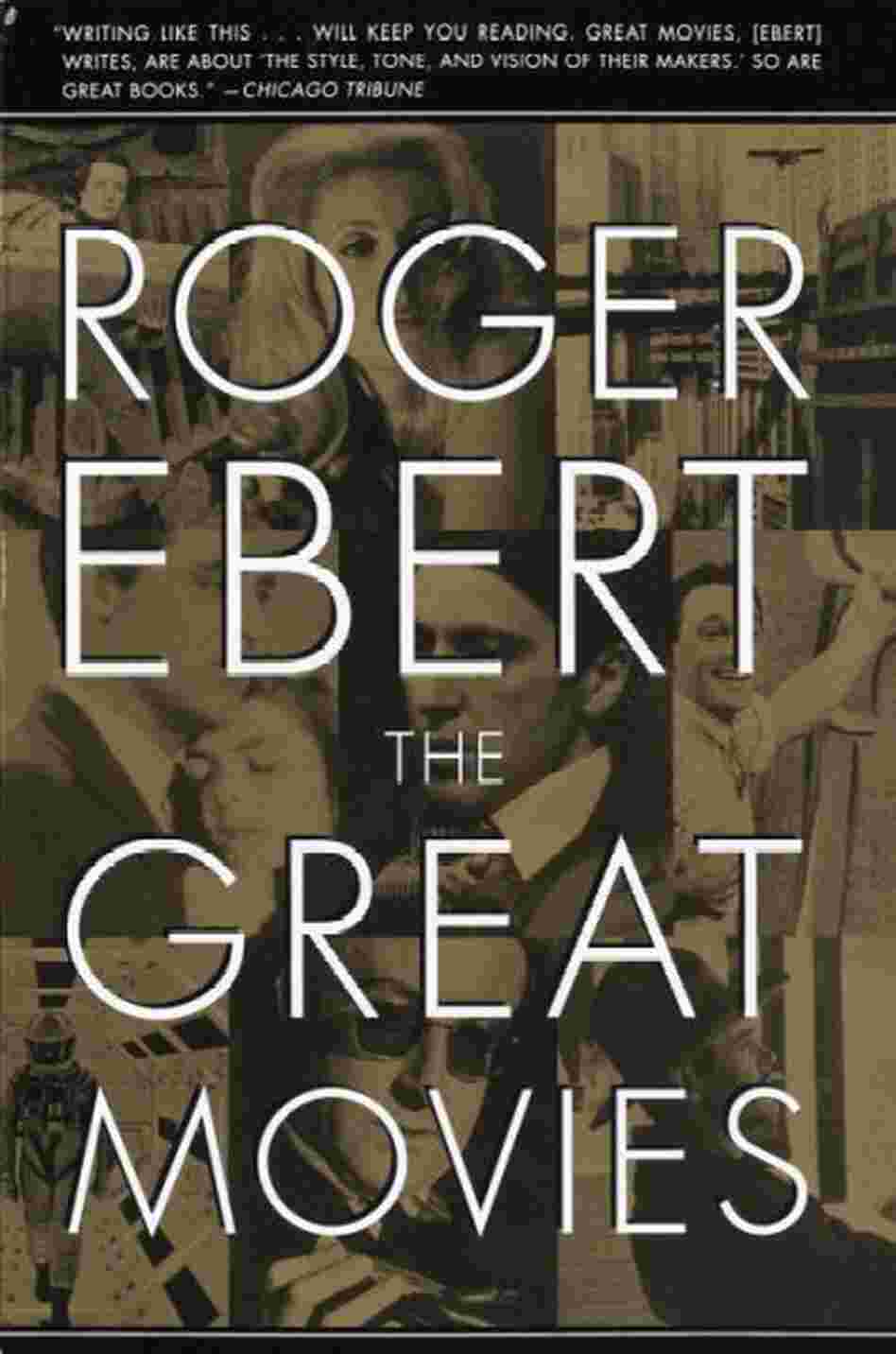
I religiously watched my way through Ebert’s Great Movies list, and I can proudly tell you his favorite film from every year he worked as a critic
(for many of the years, I can even recite his entire top ten list by memory).
On my computer, I bookmarked every list I could find from both Siskel and Ebert
(their end-of-the-decade top ten lists are especially worth obsessing over).
I bought Ebert’s annual Movie Yearbooks and read them
compulsively. Whenever I was in the car with my mom, I would bring my copy of
his original Great Movies book with me. As she drove, I read his reviews and
articles aloud – sometimes on a film we had just watched at home the night
before, other times on a film that I was trying to convince her to let me see.
She might argue that a particular film sounded a little too mature for an eleven
year-old, but by reading Ebert’s reviews to her, I was trying to demonstrate
that I was ready to watch these works. I wanted to feel and experience for
myself what Ebert so articulately presented in his prose. Just before my
twelfth birthday, I finally got permission to watch Raging Bull and Goodfellas
for the first time. I can tell you just about everything Ebert has to say about
both films, as I viewed them for the first time almost entirely with his review
in my mind – what to watch for, what certain sections might mean.
 On his website, I constantly entered the Movie Answer Man
forum, hoping that Ebert would answer one of my film-related questions (all of
the questions that he answered in his Movie Answer Man column were later
printed and published in his annual Movie Yearbook – and it was my dream to be
included in one).
On his website, I constantly entered the Movie Answer Man
forum, hoping that Ebert would answer one of my film-related questions (all of
the questions that he answered in his Movie Answer Man column were later
printed and published in his annual Movie Yearbook – and it was my dream to be
included in one).
As a 'film critic' in the Austin circuit, I was invited to advance
press screenings days or sometimes weeks before new films were officially
released in theaters, which meant I would have to form an opinion on my own
without first consulting Ebert, which was a large step for me as a critical
thinker. Days after finishing my own review, I would read Ebert’s piece
when it was published, and I was always giddy when he felt the same way I did
about a film. My
first official press screening as a film critic for the West Austin News was
for Adaptation in December of 2002. I
thought it was one of the best films of the year, and I hoped Ebert would agree
with me. Just days later, he posted his four-star review, and placed the film
at #3 on his end-of-the-year top ten list.
I was also thrilled to discover that Ebert had relationships
with many of the filmmakers he adored, including Scorsese, Werner Herzog and
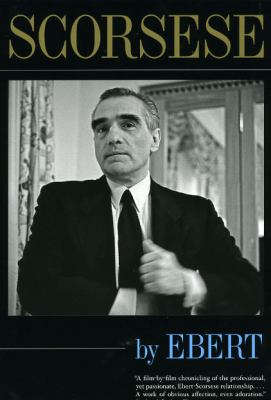
Errol Morris. I’ve read his masterful book “Scorsese by Ebert” more times than
I’d care to mention (you only need to read the inside cover of “Scorsese by Ebert” to see a thank-you letter written by Scorsese – on New York
University stationary in 1970 – to Ebert, thanking him for championing his
work, to get a sense of the personal bond between the two). Even when Ebert
occasionally hasn’t been crazy about one of Scorsese’s works, he still
understands where the piece is coming from and what it means in the context of
Scorsese’s obsessions and concerns as a filmmaker.
I remember being very disappointed that Ebert only gave Gangs of New York three-and-a-half stars
when it was released in December of 2002, as I thought it was the best film of
the year. Richard Roeper agreed with me – but then, in their annual Oscars segment
“If We Picked the Winners” on Ebert and Roeper in early 2003, Ebert said that
he felt he had been too harsh on Gangs of
New York in his initial review – and of the five films nominated for Best
Picture that year, he believed it deserved the Oscar. Ebert was always willing
to look back on a film and reconsider it. He only gave 25th Hour three-and-a-half stars upon its original
release in 2002, but he then placed it in his end-of-the-decade top ten list
years later.

After doing a quick search in my computer, it looks I’ve quoted Ebert or at least mentioned him in at least every other review I’ve written. And there’s no competition – rogerebert.com is the most visited website on my computer by a mile.
“A movie is not about what it’s about, it’s about how it’s about it.”
When you revisit a film after several years, you also revisit Ebert’s review. Most recently, I returned to his Great Movies article on Nashville, one of my favorite films, and it’s impossible for me now to talk about Nashville without mentioning Ebert’s beautiful words on the film. The meaning of the movie itself is tied to his prose – in a sense, without his words, the picture is not really complete.
 I came to understand so much about Ebert through his blog
the past few years – including the fact that he was a recovering alcoholic, and that he intimately
understood the teachings of Alcoholics Anonymous (which came across so
understandingly and well in his review and appreciation of last year’s Flight).
I came to understand so much about Ebert through his blog
the past few years – including the fact that he was a recovering alcoholic, and that he intimately
understood the teachings of Alcoholics Anonymous (which came across so
understandingly and well in his review and appreciation of last year’s Flight).
I have to confess that I oftentimes like to pretend I have a
successful movie career, and I invent Roger Ebert reviews in my head – of what
he might say about a film I directed, or in which I acted. This game is immensely satisfying, mostly because I like to think I've read enough of Ebert's work to formulate realistic-souding make-believe reviews in my head. Not that it would likely have ever happened (receiving an Ebert review means you've probably 'made it' as a director, and I'm pretty far from that), but I am now faced with the fact that there's not going to be an opportunity to read an actual Ebert review of one of my films.

Reading his last blog post just two days before his death –
“A Leave of Presence” – I was deeply troubled to read of the return of his
cancer, but I didn’t imagine for a moment that we would lose Ebert. It’s never
registered with me that Ebert would ever cease being.
As I learned of Ebert’s passing at my internship last Thursday, a small part of me died inside. When I open my mouth from now on to
inform someone of the master’s opinion – “Well, Ebert has consistently written
that Nicolas Cage is one of our finest actors…” – my excitement about the
conversation will give way to immense sadness. I’m prone to depressive bouts
with nostalgia, and Ebert, who occupies the role of narrator when I think
about anything related to film, will now be another person tucked into the
past. The voice of reason is gone.
 As one of my roommates said, as Ebert dies, so do hundreds of future
films that will be forgotten without his efforts to spotlight and appreciate
them. He championed the films that were forgotten, both large and small, and
was responsible for the careers of many great filmmakers who, without someone
like Ebert behind them, likely would not have achieved a great deal of their
success.
As one of my roommates said, as Ebert dies, so do hundreds of future
films that will be forgotten without his efforts to spotlight and appreciate
them. He championed the films that were forgotten, both large and small, and
was responsible for the careers of many great filmmakers who, without someone
like Ebert behind them, likely would not have achieved a great deal of their
success.
A world without Roger Ebert is something with which I’m not very
comfortable. Gone is the generosity, the warmth and the understanding. I
keep checking his website to see what Roger Ebert has to say about the death of
such a great human being, and it’s only then that I remember. As a 'film
critic,' I am at a loss for words. There are other critics I admire, but none
in whom I can take comfort like Roger Ebert. As an aspiring filmmaker, I
wonder, for whom will we make movies anymore?
A sample of some of my favorite Ebert reviews:
Almost Famous - Original 2000 Review
Minority Report - Original 2002 Review
Nashville - Original 1975 Review and Great Movies Review
Raging Bull - Great Movies Review
Wonder Boys - Original 2000 Review

 When watching Martin Scorsese’s new film Hugo, it’s as if my love for Scorsese has come full circle. I first fell in love with him – in obsession with him, really – when I was eleven years old, when I watched VHS copies of Raging Bull (1980), Goodfellas (1990) and Taxi Driver (1976) almost back-to-back. On a visceral and emotional level, I had never seen anything like these pictures. These first encounters with Scorsese occurred only a few months after the death of my father, and in a way, the events are forever linked in my mind. My eyes were opened to a different kind of world – a place where pain, obsession and guilt were always present, and the only way to express this pain was through cinema.


