During a dark week at
The Daily Show last month, I had the rare opportunity to spend a whole week charting out a new screenplay with my dear friend, Lucas Loredo, back in Austin (Lucas is currently in the MFA program at UT's Michener Center for Writers). We relived past glory years in the service of creating something new, spent time with our beloved theatre directors Annie and Billy Dragoo (who changed the course of our lives) and reminisced on the formative years that made us who we are. We had an excellent time looking back, and more importantly, ahead.

The screenplay, which recounts our wonderful experiences performing in Austin High School's renowned theatre department, is something Lucas and I have been talking about writing for a long time. We finally decided we weren't going to make any headway unless we took a full week and bunkered down to structure the piece. During that time, we charted out the events and character arcs in the film, and mapped out the entire movie and its events on foam boards attached to the wall. In the evenings, we cooked dinner and watched coming-of-age films which have inspired us over the years, including
Almost Famous (2000),
Lady Bird (2017),
Dazed and Confused (1993) and
The Spectacular Now (2013), taking notes for our script along the way.
Leading up to our self-imposed writing "residency," I spent the last several months working on a quite long document in which I recall every single thing that happened to me in high school. Even though I've only made it about halfway into my junior year, the document is already over 150 pages long. It's a bit overwhelming, but the document has provided a wonderful well of memories from which to cherry-pick for our film. Lucas is particularly talented at story structure and the hero's journey, and I think his discipline, combined with many of the specific memories and ideas I've written down over the last few months, make us a great writing team (we've already made one short film together,
Jack and Lucas Go To A Wedding, in 2014).
A final script is a long way away, but we're finally on the beginning path to a dream project that means a great deal to me. On its tenth anniversary, here’s Lucas and me in action back in high school, in the Red Dragon Players' seminal 2008 production of
Someone Who’ll Watch Over Me, directed by Billy Dragoo and filmed here by Paul Schattenberg. One day I'll put up the whole show in its entirety.
Someone Who'll Watch Over Me - Scene Seven from
Jack Kyser on
Vimeo.
Someone Who'll Watch Over Me - Scene Eight from
Jack Kyser on
Vimeo.
Speaking of
Jack and Lucas Go To A Wedding - this is a bit belated, but the film had its festival debut at the 2016
Black Cat Picture Show, followed by a screening at the
Hudson Valley International Film Festival! I was thrilled to screen the film at the Black Cat Picture Show, only one year after my film
You Can't Put Your Arms Around A Memory won their Best Student Film prize. You can see a clip from our film in
the trailer for the festival.

In a bit of related news, I applied last fall to the University of Texas at Austin's MFA Film and Media Production program, which was a great experience in and of itself, as I was able to obtain letters of recommendation from my advisors and mentors and write about my interests and aspirations as an artist in detail. I had been considering applying to UT's MFA program for some time (it was the only graduate program to which I applied), but I certainly didn't expect to get into the school (they accept twelve students every year). In February, however, I was delighted to learn that I was offered admission, and for a time, I did not know what the immediate future held in store for me. When I was in Austin for my writing retreat, I also had my official UT campus visit, and I was astonished by the school's facilities, professors and classes - it had everything I could possibly want in a graduate school program. It was a very difficult decision. Ultimately, I decided that I was enjoying my current job too much and should stay in New York for the immediate future - but I was beyond honored to have been accepted to the program, and it was a wonderful experience touring the campus and imagining what my life would be like as a University of Texas graduate student.

Still, just being in Austin for a short period time makes me long for the opportunity to make movies there - specifically, one about growing up with my mother and father in the 1990s, and then the aforementioned film about the Red Dragon Players I'm currently writing with Lucas. They're both dream projects of mine, and ones I intend to make in the coming years.
I’ve been revisiting all kinds of wonderful memories from those glorious high school years lately. Nearly ten years after it first premiered, I re-watched the Red Dragon Players’ production of Jim Merillat's original musical
Radio Eyes, in which I played the wildly erratic Inspector Riley. I received a copy of the musical from Jim (my DVD copy of the play was scratched), and it was a tremendous joy viewing the show with fresh eyes (it was one of my favorite musicals we performed at Austin High). I’ve also been looking at our productions of
Round and Round the Garden (UIL),
Over the River and Through the Woods (UIL), the aforementioned
Someone Who’ll Watch Over Me,
Willy Wonka,
Seussical: The Musical,
Into the Woods,
Urinetown: The Musical,
High School Musical and others. There’s an overwhelming amount of material from which to pull for our film, and I’m thrilled to have recordings of many of our productions (although I wish we had recorded our productions of George Bernard Shaw’s
Major Barbara, Carson Kreitzer’s
The Lovesong of J. Robert Oppenheimer and Jason Milligan's
…And the Rain Came to Mayfield).
The memorable writing retreat in Austin has been surrounded by a welcome succession of what I'll call art weekends in New York, mainly spent with my wonderful girlfriend Sophia. After the production of our short play
White Castle Valentine’s Day 2018 in February, she and I have embarked upon a series of escapades on the weekends, hoping to take advantage of what New York City has to offer.
On March 16th, we saw Kenneth Lonergan’s
Lobby Hero on Broadway, which was, honest to God, one of the best plays I’ve ever seen. Then again, it was written by Lonergan, so what did I expect? Michael Cera, Bel Powley, Chris Evans and Brian Tyree Henry were all exceptional – I’ve since bought a copy of the play, and I’m in the midst of learning one of the many outstanding monologues from the show. The next night, on St. Patrick’s Day, we screened one of my favorite films of all time, Martin Scorsese’s
The Departed (2006), at my apartment – I mean, how else was I supposed to spend St. Patrick’s Day? Scorsese’s film has lost none of its immediacy and power in the now twelve(!) years since its release, and the picture still stands as the defining cinema release of my lifetime (seriously). On Sunday, I treated myself to a double-feature of Francis Lawrence’s riveting
Red Sparrow, which way exceeded my expectations, and Ryan Coogler’s
Black Panther, one of the first Marvel movies actually about something. The immensely talented Coogler also gives us the best and most complex superhero villain in some time, with Michael B. Jordan excelling as Eric Killmonger.
This is a bit of a brief tangent, but in the fall of 2016, I had the pleasure of seeing Kenneth Lonergan in person three times within a two-week period. The first time was at the Museum of the Moving Image, where Lonergan spoke after an early screening of his new film
Manchester by the Sea, which was the second-best film of 2016 (after Martin Scorsese’s
Silence). I saw him again shortly thereafter at the opening night screening of Nancy Buirski’s
By Sidney Lumet, on which I was an associate producer and assistant editor.
By Sidney Lumet opened on October 28th at Lincoln Plaza Cinema (which has sadly now closed after thirty-five years of business) and
received rave reviews. On opening night, there was a Q&A after the film with Nancy and Christine Lahti (who starred in Lumet’s
Running on Empty), followed by a great after-party at the Tisch WNET Studio in Lincoln Center. Lonergan joined us for the after-party, as well (our editor, Anthony Ripoli, edited the Director’s Cut of Lonergan’s masterpiece
Margaret), but I didn’t actually get to meet him until after a screening of
Margaret the next weekend (also at the Museum of the Moving Image). MOMI screened the Director’s Cut of the film (they were doing a retrospective of all of his films), and Lonergan held yet another fantastic Q&A. After the screening, I shared with him my adoration for both
Margaret and
Manchester by the Sea (not to mention his first film,
You Can Count on Me). It’s always an honor to get to meet your heroes, and I’ve truly enjoyed familiarizing myself with his work as a playwright this year.
But back to the present! The next weekend, Sophia and I went to the
David Bowie Is exhibit at Brooklyn Museum, which was astonishing – an aural and visual experience like no other. On Saturday, I saw
The Panic in Needle Park (1971) at the Quad Cinema as part of the
Pacino’s Way retrospective. I could have lived at the Quad during this run of films, screened mostly on 35mm. At this particular screening of
The Panic in Needle Park, director Jerry Schatzberg introduced his film, and discussed working with Pacino in depth. He also directed the masterful
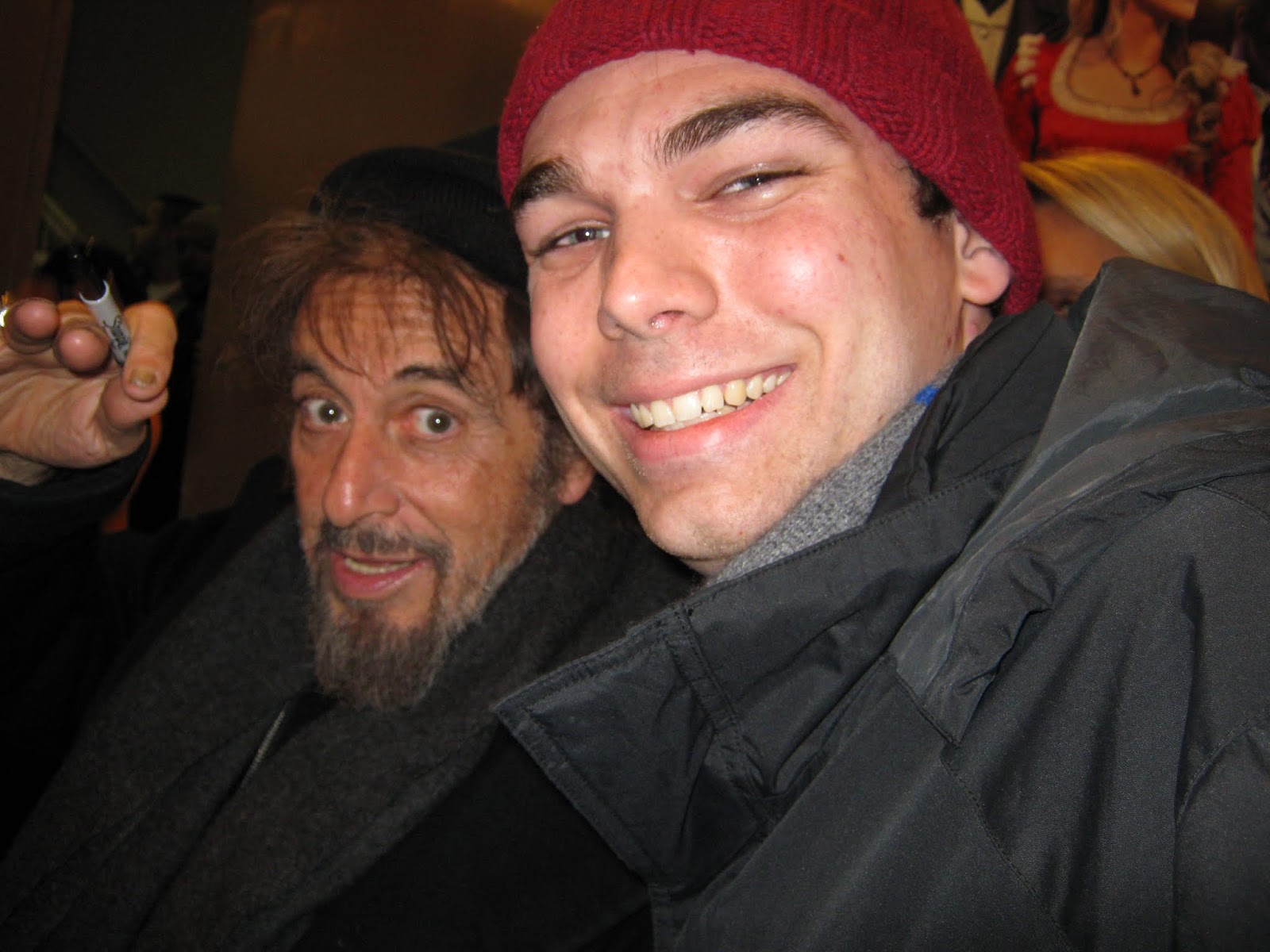
Scarecrow (1973), with Pacino and Gene Hackman, which has long been one of the unheralded highlights of 1970s cinema. I was sad to be working during Pacino’s visits to the Quad, where he screened his passion projects
Salome and
Wilde Salome – but I cherish my memories of seeing him onstage in
The Merchant of Venice (2010) and
Glengarry Glen Ross (2012). Pacino recently turned seventy-eight, and he continues
to inspire and amaze – most recently in his magnificent performance in Barry Levinson’s
Paterno on HBO (less than a year after Levinson’s great
The Wizard of Lies with Robert De Niro, also on HBO).
And then, on Sunday, Sophia and I saw Wes Anderson’s new film
Isle of Dogs, which filled me with joy. It’s an emotional, beautiful movie – I was smiling the entire time. You can read
my full review of Isle of Dogs for Austin Family Magazine here.
In Austin, in addition to my residency with Lucas and my UT campus visit, my mom and I saw Steven Spielberg’s
Ready Player One, which was a total blast (and just flat-out mind-boggling that Spielberg released the film within the same three-month period as
The Post). We also saw John Krasinski's
A Quiet Place, which I wish I could say I viewed in a very quiet place. I loved the movie (between this and 2016’s
The Hollars, Krasinski is one talented director), and I think filmmakers should slowly start conditioning audiences to this level of silence in more movies. It is a truly effective dramatic tool – and it requires audiences to shut the hell up.
When I returned from Austin, the art weekends continued. Lynne Ramsay’s
You Were Never Really Here was a strange, beautiful and mesmerizing movie with one of the world’s greatest and most interesting actors, Joaquin Phoenix, at its center. Ramsay strikes gold once again, after her masterful
We Need to Talk About Kevin (2011) - there was no scene in this film that unfolded how I expected. And this picture could have been so violent, reveling in the brutality of our protagonist's methods - but Ramsay isn't interested in close-ups of hammers bludgeoning heads. She's interested in more specific details, and the effects trauma has on the human body.

Seeing the film a second time, I was struck even more by the connection between Joe (Phoenix) and Nina, the young girl he rescues from a New York City brothel. Subtly over the course of the movie, they recognize each other as having both experienced abuse and trauma in their lives. Both characters use counting mechanisms to cope with their suffering – as a child, Joe held a cellophane bag over his head and counted down in order to repress the brutality exacted upon him (and his mother) by his father. Likewise, Nina counts down in her head when she is preyed upon by men inside the brothel. These elements are beautifully woven together in an underwater sequence in which Joe attempts suicide, and as he counts down, he begins hearing Nina’s voice counting instead of his own, leading him to abandon his suicide attempt and attempt to rescue her. When I was in Austin, the Alamo Drafthouse South Lamar had a
You Were Never Really Here promotional photo booth, and you can bet I spent some time in there. Very well done, Amazon Studios.
The next weekend, I travelled down to Charlottesville with Sophia, where we stayed with her family and had a truly great time, as always. We even held a photo shoot with her friends Ivy and Clara, in which Sophia’s mom Maiya took some fine and truly strange portraits of us – you can see some of them throughout this post (I’m smoking a fake cigarette, by the way). While we were there, we spent time at a nearby reservoir, held a lavish banquet with friends, ate outside near the Blue Ridge Mountains, and, on our final night, watched Sam Peckinpah’s
Pat Garrett and Billy the Kid (1973) with Sophia’s dad Walter (I first saw this film when doing research for
Blood and Thunder, and it remains one of the best and most original westerns I’ve ever seen).
Once back in New York, Sophia and I ventured to the Tribeca Film Festival the next weekend. On Friday, April 27th, I had my first virtual reality experience at Tribeca’s
Horizons program. I was mainly attending because the program featured a short VR film by Terrence Malick, and it was beautiful (it’s telling that I finally tried out VR only because of Malick’s involvement). The next day, Alexander Payne spoke at Tribeca, with fellow Nebraskan Dick Cavett moderating the Q&A. What an amazing filmmaker and human – I sat in the front row and took notes, as every piece of filmmaking wisdom Payne offered was so valuable. Afterward, he told attendees he’d be around to talk in the lobby, and so I got to speak with him and share my adoration of
Downsizing (2017). I could tell I was among devoted Payne loyalists, as much of the audience was quick to share that they loved
Downsizing, too (which I maintain will be considered an ambitious modern classic in due time). I wish there were more like Payne – humble, Midwestern, authentic voices who make soulful movies about real people.
That evening, Sophia and I watched the recently released Criterion Blu-Ray of Martin Scorsese’s
The Age of Innocence (1993), which is just as astonishing and powerful as ever. I saw a restoration of this film at the 2013 New York Film Festival with Scorsese in attendance, and it’s taken this long for that stunning transfer to make its way to DVD and Blu-Ray. Thankfully, the Criterion Collection has given the movie a welcome home.
Sunday, April 29th was the sixteenth anniversary of my dad's passing. I know I share a lot of the same videos of him, but here's something he shot on our family's 1996 trip to New York. He was a wonderful soul, and over the years I've been overjoyed to transfer more and more of his home video recordings as a way of remembering him.
The Kyser Family in New York - 1996 from
Jack Kyser on
Vimeo.
In the midst of all of this, I caught a screening of
Avengers: Infinity War before going to my evening shift one day, and I was surprised by the film’s effectiveness – particularly Josh Brolin’s performance as villain Thanos. You can read
my full review for Austin Family Magazine here.
The next weekend, we saw Jason Reitman’s
Tully, which was a delight, reuniting the dream team behind
Young Adult (2011) – Reitman, writer Diablo Cody and star Charlize Theron. It’s exactly the kind of interesting film that rarely gets made anymore. Reitman never ceases to surprise and engage me – he never makes the same film twice (I remain a fan of his slightly un-loved
Labor Day and
Men, Women and Children).
Tully is also a movie that I heard people dismissing before it was even released. I’m irked every time I hear people talking about a film they haven’t seen, prejudging it and having no real interest in what the picture might have to say – instead reducing the movie to its most basic elements. This happens with older films, too, as social mores change and folks want to reevaluate certain films based on a new set of criteria and whether it aligns perfectly with today’s ideas. What they don’t seem to understand is that the capturing of a certain time and place is precisely what makes a film interesting, and in time, today’s seemingly evolved values and ideas are going to seem outdated, too.
On Friday, May 11th, we saw Carl Theodor Dreyer's astounding film
Ordet at the Quad Cinema, followed by a Q&A with one of the greatest of all filmmakers, Paul Schrader. He gave great insight into
Ordet and its influence on his new film
First Reformed. The impact Dreyer's film had on our audience was palpable - it's a thoughtful examination of the role religion plays in our lives, and it takes on a kind of meditative quality as it goes on. There's something nearly God-like in its slow pans and long takes, creating a truly spiritual feeling I haven't experienced since Martin Scorsese's
Silence.

There is a shot near the end of the film in which the camera does a slow, nearly-360° rotation around Johannes (Preben Lerdorff Rye) and his niece (as her mother lays dying) that simply took my breath away. It was one of the most profound and haunting marriages of dialogue and camera movement I have seen in some time, and it will not leave my mind any time soon.
On Saturday night, Sophia and I saw one of my all-time favorites, Martin Scorsese’s
After Hours (1985) in 35MM at IFC, as part of their Waverly Midnights: Scorsese program. It’s as much of a delightful and exhilarating ride as it was when I first watched it on VHS as a kid – frenetic, thrilling and truly bizarre. Over the past year, there have been a lot of terrific opportunities to see Scorsese’s work on the big screen – I saw
Alice Doesn’t Live Here Anymore (1975) and
The Last Waltz (1978) at the Museum of the Moving Image last year during their amazing Scorsese exhibit, and IFC has been screening much of his filmography over the last few weeks (I’m going back in June to catch another favorite,
Bringing out the Dead, in 35mm). Soon enough, I’ll have seen most of Scorsese’s films in cinemas (so far, I’ve seen nineteen, including the ones that were released in my lifetime).
When back in Austin more recently, I watched Woody Allen’s
Husbands and Wives (1992) for the first time. This is perhaps the most formally fascinating film of Allen's career, and yet beyond all of the breathtaking handheld one-takes and jarring jump cuts, there's something truly unsettling here, both thematically and in the masterful performances.
Husbands and Wives also has some very memorable set pieces - Sydney Pollack's drunken, rage-fueled visit to Judy Davis's house in the middle of the night is downright haunting (and, as more and more characters enter, it becomes one of Allen's best-directed group scenes ever). Meanwhile, two sequences with Allen and Juliette Lewis (when they retrieve his manuscript from a taxi driver, and then later share a kiss at her birthday party) will both linger in my memory for some time to come. This film is a scorcher.
My job at Comedy Central is going well – it’s always a joy to work on an interview clip with a guest I truly respect and admire. Here’s Sean Penn on
The Daily Show with Trevor Noah this past March – with a (hopefully good) still I picked out for him. I’m currently reading his first novel,
Bob Honey Who Just Do Stuff, and it is a wild ride – a truly original and fascinating peek inside Penn’s mind. I miss seeing him onscreen these days, but
Bob Honey is holding me over until his next film.
I also got to work on a great interview clip with Matt Damon and Gary White of water.org, which
you can find here.
The film I directed last October,
Four Play, is officially finished, and the film’s writer and producer, Ben Krevalin, is busy submitting the movie to film festivals. I think we made a pretty strong movie, with four really charming lead performances and some creative blocking in there. I suspect it will be some time before it’s available online, but if you’re interesting in seeing it, please let me know. And, yes, I’m still editing
Harvey’s Last Night on the Avenue. I’m getting closer and closer, and more and more excited with each passing day as it comes together. I’ve never taken this long editing a film (in fact, I used to pride myself on making and releasing new films with great regularity), but this one feels like it needs my full attention and focus. It’s already been in the works for two-and-a-half years – what are a few more months? Anyway, by the next time I post here, I’ll have a trailer ready – and a full film (and web series) shortly to follow.
A few extremely talented artists have passed away since I last wrote. Milos Forman was one of the greatest filmmakers of all time – and, in his incredible career, directed two films pretty much everyone can agree are among the finest ever made,
One Flew Over the Cuckoo’s Nest (1975) and
Amadeus (1984). Actor R. Lee Ermey (
Full Metal Jacket,
Seven) was such a presence onscreen – he will be missed. I had the opportunity of meeting him when I was a volunteer at Dennis Quaid Charity Classic Golf Tournament in high school, and he was extremely kind.
I don’t think I’ve written anything about this year’s Academy Awards. There’s really not much to say – they got nearly everything right except the biggest prize of them all. I suppose it doesn’t matter in the end –
Three Billboards Outside Ebbing, Missouri was always a little dangerous, and the film (thankfully) didn’t play by the rules of what’s expected in cinema nowadays. But I can’t imagine anyone in his or her right mind looking back years from now and thinking
The Shape of Water was a superior film. But the fact that Sam Rockwell, Roger Deakins, Gary Oldman and Allison Janney are now Oscar winners is heartening (not to mention Frances McDormand receiving her extremely well-deserved second Oscar). It’s not every year that your favorite film has a shot at the big prize (see
Silence last year), so I was certainly rooting for
Three Billboards in a big way. But now the noise of awards season is gone, and the greatness of McDonagh’s film remains.
Lastly, I never thought it’d happen, but I’m going to
Springsteen on Broadway with Sophia in July! I haven’t been this happy since the last time I saw Bruce Springsteen during
The River tour and made
something of a tribute video here.




 There is a shot near the end of the film in which the camera does a slow, nearly-360° rotation around Johannes (Preben Lerdorff Rye) and his niece (as her mother lays dying) that simply took my breath away. It was one of the most profound and haunting marriages of dialogue and camera movement I have seen in some time, and it will not leave my mind any time soon.


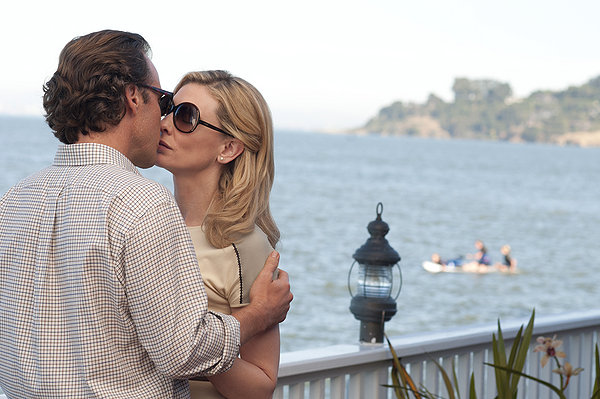


 The joy of this film is discovering all of this for yourself, and so I’ll refrain from saying anything else, except that Allen’s work with the Surrealists (including Adrien Brody as Salvador Dali) is brilliantly absurd. With the playful and fantastical premise, Allen is free to wrestle with large ideas in a very funny manner (not dissimilar to his work in 1985’s wonderful The Purple Rose of Cairo).


