Showing posts with label Peter Sarsgaard. Show all posts

Sunday, August 4, 2013

Film Reviews - Blue Jasmine and The Spectacular Now

Spoiler warning for both films reviewed below.

Blue Jasmine

Blue Jasmine is writer/director Woody Allen’s best film since his incredible Crimes and Misdemeanors (1989). Like Crimes and Misdemeanors, this new film is closer to tragedy than comedy. Allen has made some extraordinary films in the past few years, including Midnight in Paris (for which he won an Academy Award), Match Point and Vicky Cristina Barcelona, and Blue Jasmine is the crowning achievement of his recent work.

Jasmine (Cate Blanchett, in one of the finest performances of the year) has lost everything – her husband (Alec Baldwin), an investment banker arrested for fraud; her wealth, including her Park Avenue mansion, taken by the government in the aftermath of the scandal; and her sanity. She arrives in San Francisco to stay with her sister, Ginger (Sally Hawkins, also amazing), telling a million lies to everyone in sight. The film hauntingly intercuts Jasmine in present-day San Francisco attempting to rebuild her life with scenes from her life as a wealthy New Yorker, almost as if we’re reliving her past with her.

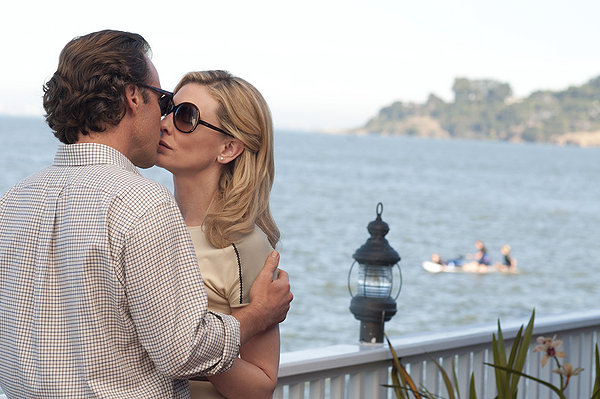
Blue Jasmine has one of the most inspired ensemble casts of any recent movie. Some of the most underrated actors currently working are used here to perfection, including Peter Sarsgaard as an aspiring politician who genuinely loves Jasmine, Bobby Cannavale as Ginger’s passionate boyfriend Chili (how our ideas about Chili shift throughout the movie is a testament to the genius of Allen’s writing), and Andrew Dice Clay, who gives the film an unexpected heart as Ginger’s ex-husband.

Jasmine may make mistakes and lie about her past, but the film isn’t afraid to acknowledge when she’s right, which makes her downfall even more tragic. What’s remarkable about Allen’s film is how it neither condemns nor endorses the moral failings of these complex characters. Blue Jasmine defies expectations at every turn, and my evaluation of every character was challenged with each new scene.

At the same time, Jasmine is responsible for nearly everything that ends up destroying her, and watching her lose her mind, muttering to herself and reenacting moments from her past, is pretty devastating – especially since Allen gives us such a vivid sense of the darkness that consumed her perfect life in Manhattan. In a film full of characters who delude themselves into happiness, Jasmine is the least successful of them all.

The Spectacular Now

The Spectacular Now features two of the most complex teenage characters I've ever seen in a film, played by Miles Teller and Shailene Woodley in two of the year's best and most natural performances. Filmed largely in unbroken two-shots, which allow for performances built by posture and body language as much as they are by close-ups, this is a film full of scene after scene that does everything right – there isn’t a moment in the film that rings false.

Sutter (Miles Teller) is a semi-alcoholic underachiever who is the life of every high school party. His longtime girlfriend, the beautiful and popular Cassidy (Brie Larson), breaks up with him near the beginning of the film, and, drinking his sorrows away, Sutter wakes up one morning on the front lawn of wallflower Aimee (Shailene Woodley). The two start spending time together, despite not being part of the same crowd.

There’s a scene early on in the film in which Sutter takes Aimee to an outdoor party, attended by what you might call the more popular crowd (when offered a beer, Aimee says she doesn’t drink, and it’s clear that she doesn’t feel entirely comfortable with this crowd at first).

As soon as they arrive at the party, Sutter looks across the crowd and sees Cassidy talking to her friends. As he instigates a conversation between Aimee and a few other people, his attention is focused squarely on Cassidy, who he still hopes to win back. Once Aimee is comfortably engaged in a conversation with the others, Sutter has done his job, so to speak, and he heads over to Cassidy, knowing from their online chat the previous evening that she’s still interested in him. Sutter and Cassidy talk and flirt a little bit, as Sutter seems certain that he is the master of his domain – he has not one but two potential romantic conquests at the party, and, for the time being, he can leave Aimee aside and focus on Cassidy.

Suddenly, Cassidy’s new boyfriend walks up to them, and asks her to leave the party. As Cassidy leaves with this new guy, Sutter is devastated. But he thinks, okay, no worries – I’ll just go to my back-up girl. But when he finds Aimee, she’s hitting it off with another young man! Sutter interrupts their conversation and asks Aimee to walk away with him.

His assumption – that Aimee is a fish out-of-water and will be lost at this party without him as her guide – backfires quickly. There is such an amazing power shift that occurs so naturally in this scene. Sutter feels that he has the power to pick and choose between his multiple romantic conquests, only to realize that he was deluding himself with his first option. So, he scrambles to the “back-up” girl – only to see that she has become engaged with someone else in the interim. I don’t know that I’ve ever seen scenes that understand the whims and anxieties of young people in ordinary but often overwhelmingly painful social settings so well.

There are many scenes in The Spectacular Now that similarly moved me. At their high-school graduation, Sutter and Cassidy have a conversation in the bleachers that evokes an indescribable kind of sadness. She’s not mad at him after their break-up and subsequent almost-getting-back-together – in fact, she jokes that he will always be her favorite ex-boyfriend. For Sutter, though, you almost get the sense that it would be less painful and easier for him to move on from Cassidy if she simply never wanted to speak to him again, and that would be it. But instead, it’s something a little more melancholy. She’ll remember him as kind of a joke – Oh, Sutter, that guy I once dated, he’s funny ­– and move forward with her life. As she leaves him standing alone in the bleachers, his graduation robe open, I felt an immense amount of sadness for these characters.

The film defies every expectation, never once following the expected path. In a lesser film, for instance, Aimee would try to get Sutter to stop drinking and perfect his behavior, but here, she actually starts drinking, too. She develops a dependency on alcohol and gets “worse,” in a sense (and, ultimately, Sutter realizes this and wants her to stay away from him, knowing that he’s bad news for her). 

There’s also the expectation that Sutter and Aimee’s relationship will be tested by Sutter cheating on Aimee with Cassidy. Wrong again. The film instead presents a real impulse – at first, maybe Sutter does want to get back together with Cassidy, and Aimee is simply a temporary rebound relationship. We aren’t meant to judge Sutter because of that – the film presents this in an honest and understanding way. If he had his way in the beginning of the movie, he probably would forget about Aimee entirely and get back together with Cassidy. But the fact of the matter is, he can’t win her back. And, once he accepts that, he ends up falling in love with Aimee. You can think what you want about him, but, like an actual human being, Sutter is complex and has contradictory feelings about multiple people (The Spectacular Now allows every one of its characters to exist with these kinds of contradictions, just like this year’s Frances Ha and Before Midnight).

In perhaps the most powerful scene of the film, Sutter’s boss – who loves him as dearly as anyone else and turns a blind eye to his drinking habit – meets with Sutter in his office. The boss says he can only keep one employee at his store, and he wants Sutter to be his main employee. However, he asks Sutter to promise that he will not come to work under the influence of alcohol ever again. Sutter honestly tells him that he cannot make that promise, and you watch as the boss, who cares and loves Sutter deeply, wants to tell him to get it together, but he can’t – he’s not the young man’s father, and ultimately, he almost admires Sutter for his honesty. This is a tough scene. My heart breaks for both of these characters.

What works so well about all of these scenes is that we’re able to read the intentions and desires of each of these young people so clearly, as they try so hard to appear cool and act natural. The not-always-obvious social violence and exclusion that happens right before our eyes is articulated with such grace and complexity, and the oversimplification of social ostracization that occurs in even the best recent coming-of-age films (The Perks of Being a Wallflower) is completely absent from this film.

I’m not mentioning the wonderful passages of the film that involve Sutter visiting his father (the great Kyle Chandler), but suffice to say that The Spectacular Now never missteps. The director is James Ponsoldt, and I'll be first in line for his next film. 

Friday, October 30, 2009

I Am The Master Of My Fate, I Am The Captain Of My Soul...

Alongside Martin McDonagh's The Pillowman and David Mamet's Glengarry Glen Ross, Arthur Miller's brilliant A View from the Bridge is my favorite play. Unfortunately, I've never acted in any of the aforementioned plays, although I have consistently used monologues from each of them for audition material throughout high school. I first read A View from the Bridge as required summer reading for Mr. Billy Dragoo's Theatre II class the summer before my sophomore year of high school. As soon as I read the play, I picked out a particular monologue by the antihero Eddie Carbone, which I would use early on during my sophomore year for an audition for The Lovesong of J. Robert Oppenheimer. Last fall, I performed the same monologue at the 2008 Texas Thespian Festival in Fort Worth, and advanced to the Nationals competition in Solo Acting.

I mention A View from the Bridge because the extraordinary play, more than ever, is appearing everywhere around me. First and foremost, I am using Miller's work as my narrative text for my latest critical essay, which is an assignment for my class Writing the Essay: Art and the World. Secondly, it was announced only a few days ago that a revival of A View from the Bridge will open on Broadway beginning December 28th, starring Liev Schreiber as Eddie Carbone and Scarlett Johansson as his niece Catherine. Even if these two terrific actors weren't attached to the production, I'd still be first in line to see the play (as I've yet to see a professional production of this particular Miller work, nor have I seen Sidney Lumet's 1962 film adaptation). Schreiber is an actor I admire tremendously both onstage and on-camera - he won a Tony Award in 2006 for his performance as Richard Roma in a revival of Mamet's Glengarry Glen Ross, and so naturally I can't wait to see what he does with Eddie Carbone.

This past Thursday evening, I once again used Eddie Carbone's signature monologue from A View from the Bridge - this time, to a large crowd at Third Avenue North. My performance was one of seventeen acts competing in Third North's Ultra Violet Live (UVL) talent competition, a talent show featuring musical acts, spoken word poetry, original songs, interpretive dancing, stand-up comedy, and my solo acting performance. I performed two contrasting monologues - one dramatic piece, from Miller's A View from the Bridge as Eddie Carbone, and one comedic piece, from Alan Ayckbourn's A Small Family Business as Jack. After the judges deliberated, I was thrilled to be named the Third North UVL Runner Up, coming in second place behind a musical act performed by freshman Phoebe Ryan. As it turns out, Phoebe and I both advanced to the English Speaking Union's National Shakespeare Competition back in April 2008, performing at Lincoln Center as two contestants out of sixty selected from the entire nation. I wish her the best of luck at the NYU-wide UVL competition in spring 2010; if for some reason she is unable to perform, I will take her spot. As it stands, I received a twenty-dollar iTunes gift certificate from the judges, so I'm just thrilled with my new music purchases.

Here's a random fact - only five years ago, in October 2004, freshman Stephani Gabriella Germanotta competed in Third North's Ultra Violet Live (UVL) talent competition, and placed first with a ballad from the musical Wicked. The following spring at the NYU-wide competition, she ended up placing second. Today she is known as musical artist Lady GaGa. I won't pretend to know much about Lady GaGa and her music, but I'm aware she's a popular artist.

Today, I pitched my original idea for a Radio Drama to my Sound Image class, where our final end-of-year projects are audio dramas under ten minutes in length. I was very lucky to have my Radio Drama idea selected for production, which is already underway. The script I presented for the Radio Drama is a piece of rewritten history involving the assassination of President John F. Kennedy, specifically a "what if" scenario imagining if Mrs. Jacqueline Kennedy, not JFK, was killed in Dallas by Lee Harvey Oswald. I'm working with a terrific four-person group on this project, including my good friend Morgan Block serving as Producer/Casting/Talent Coordinator, Andrew Griego as Lead Production Editor/Mixer, and Shaun Kim as Sound Engineer and SFX/Foley Coordinator. As the writer of the Radio Drama, I am serving as the Writer/Director/Co-Editor.

In the meantime, I am excitedly anticipating the upcoming Sunday performance of my original one-act play, The Certifiable, by Tisch New Theatre. Directed by Mark Galinovsky, the performance begins at 5:00 PM in the Tisch Common Room at 721 Broadway. Having attended a rehearsal this past Tuesday evening (and planning on watching another rehearsal tomorrow afternoon), I am really impressed with the acting and staging of the play.

In the spirit of Halloween, I ventured to the IFC Center with some other film students tonight to see Lars Von Trier's incredibly disturbing new film Antichrist, starring Willem Dafoe and Charlotte Gainsbourg as a married couple grieving the loss of a child. Von Trier, no stranger to disturbing subject matter and emotionally and physically exhausting his audience, has made an extremely controversial and effectively despairing film. At its core, Antichrist is an arthouse movie from start to finish. It's almost impossible to critique critically, because although the movie is brilliantly made and features incredible performances from Dafoe and Gainsbourg, there are scenes in this film that are as downright disturbing and shocking as anything I've ever seen. And, more importantly, it's rather unclear what Von Trier is even trying to say with this movie.

I admire Antichrist a great deal from a filmmaking perspective, but its not meant to be entertainment. Roger Ebert notes that the film must be applauded for so effectively evoking a sense of despair, and although I agree with him, I can't help but think that Antichrist is so intent on unsettling the audience that, ultimately, the movie doesn't come anywhere close to the emotional power of Von Trier's Breaking the Waves (1996). I think Von Trier is brilliant, and in its own very twisted way, Antichrist is brilliant, too. But I'll never watch it again.

Reading the October 19th issue of The New Yorker, I'm thrilled to find that John Lahr writes fondly of Michael Grandage's production of Hamlet, starring Jude Law. Later in the issue, David Denby writes on Lone Scherfig's An Education and, specifically, Peter Sarsgaard's great performance. I'll act as Mr. Sarsgaard's publicist briefly, providing a really great quote from Denby:

"It's been apparent for some time that Peter Sarsgaard is an actor of major talent waiting for a major role, and he almost gets one in An Education...I have a feeling Sarsgaard could have stretched the role a lot further if the script had allowed him to, but, still, what he does is surprising...Sarsgaard makes it seem as if David, out of need, desire, and strength - and weakness, too - were experiencing everything for the first time."

I'll close this entry with a poem, inspired by the recently released trailer of Clint Eastwood's Invictus, starring Morgan Freeman as South African President Nelson Mandela and Matt Damon as the South African rugby star vying for the World Cup. The film doesn't open until December, but upon seeing the trailer, I was excited to hear the words of William Ernest Henley's poem Invictus, which very well embodies Mandela's unconquerable soul in the face of imprisonment. The poem is one of several vocal warmups Mr. Billy Dragoo regularly asked The Red Dragon Players to recite before performing onstage, and so the words hold a special place in my heart. Here is Invictus.

Out of the night that covers me,
Black as the Pit from pole to pole
I thank whatever gods may be
For my unconquerable soul.

In the fell clutch of circumstance
I have not winced nor cried aloud.
Under the bludgeonings of chance
My head is bloody, but unbowed.

Beyond this place of wrath and tears
Looms but the Horror of the shade,
And yet the menace of the years
Finds, and shall find, me unafraid.

It matters not how strait the gate,
How charged with punishments the scroll.
I am the master of my fate:
I am the captain of my soul.

William Ernest Henley

Wednesday, October 14, 2009

An Education and Peter Sarsgaard

Lone Scherfig's An Education is strikingly original, very well written and features outstanding performances from Carey Mulligan, Peter Sarsgaard, Alfred Molina and the rest of the very talented cast. I suspect the film will be receive Best Picture, Best Actress (Mulligan) and Best Supporting Actor (Molina) nominations at next year's Academy Awards. The film focuses on sixteen year-old Londoner Jenny (Mulligan, whose talent matches her beauty) who begins an affair with the much older David (Sarsgaard) in the early 1960s. The titular education is provided by David, and the prospect of a future with him and his seemingly cultured friends appears far more exciting to Jenny than a college education at Oxford. An Education wisely explores the idealism of youth and the disillusionment that comes with life experience - it's an excellent film.

I have to pay special attention to one of my favorite working actors, Peter Sarsgaard. When I was thirteen years old, I went to see Shattered Glass (2003, Billy Ray) at Austin's local art house theater, and I was awestruck by Sarsgaard's brilliant and explosive performance as editor Chuck Lane. That he did not receive an Academy Award nomination for the film (much less a deserving win) is a real crime in Academy history.

Since then, Sarsgaard has consistently given superb performances in films as varied as Garden State (2004, Zach Braff), Kinsey (2004, Bill Condon), Jarhead (2005, Sam Mendes), Elegy (2008, Isabel Coixet) and now An Education. Here's hoping that he receives a nomination this year for his great performance (although his work is so brilliantly subtle I suspect the Academy may slight him once again). To the right is a picture of Sarsgaard and me, along with my friend Bolton Eckert and his brother Travis, at the 90th birthday party of Oscar-winning screenwriter Horton Foote in March 2006. I should note that Sarsgaard is truly one of the nicest actors I have ever met in person.

Earlier this week, singer Al Martino passed away at the age of 82. Martino played Sinatra-like singer Johnny Fontane in The Godfather (1972, Francis Ford Coppola) and, according to a fascinating article from Britain's Telegraph, asked his own 'godfather' to convince Coppola to cast him in the Fontane role. May he rest in peace.

On Monday evening, I attended my second plenary session for my class Writing the Essay: Art and the World. Rather than a typical lecture, however, students were treated to a preview performance of The Jackie Look, a performance piece by performance artist Karen Finley, in the Skirball Center for the Performing Arts. Finley, who is known for her controversial performances (she was infamously one of the NEA Four - one of four artists whose grant from the National Endowment for the Arts was rejected in 1990 due to the graphic content of the art) 'portrays' Jacqueline Kennedy Onasis in this performance, which opens for the public on January 30th, 2010 at The Laurie Beechman Theatre. It was an interesting way to spend a Monday night, certainly - that's all I'll say.

On Tuesday morning, I took a field trip downtown for my class The Irish and New York. We visited The Irish Hunger Memorial, a fascinating public art piece near Ground Zero honoring those who suffered and died from starvation not just from Ireland's historic potato famine, but from famines and hungers worldwide. As soon I have pictures printed from the memorial, I will post them online.