Showing posts with label Midnight in Paris. Show all posts

Sunday, August 4, 2013

Film Reviews - Blue Jasmine and The Spectacular Now

Spoiler warning for both films reviewed below.

Blue Jasmine

Blue Jasmine is writer/director Woody Allen’s best film since his incredible Crimes and Misdemeanors (1989). Like Crimes and Misdemeanors, this new film is closer to tragedy than comedy. Allen has made some extraordinary films in the past few years, including Midnight in Paris (for which he won an Academy Award), Match Point and Vicky Cristina Barcelona, and Blue Jasmine is the crowning achievement of his recent work.

Jasmine (Cate Blanchett, in one of the finest performances of the year) has lost everything – her husband (Alec Baldwin), an investment banker arrested for fraud; her wealth, including her Park Avenue mansion, taken by the government in the aftermath of the scandal; and her sanity. She arrives in San Francisco to stay with her sister, Ginger (Sally Hawkins, also amazing), telling a million lies to everyone in sight. The film hauntingly intercuts Jasmine in present-day San Francisco attempting to rebuild her life with scenes from her life as a wealthy New Yorker, almost as if we’re reliving her past with her.

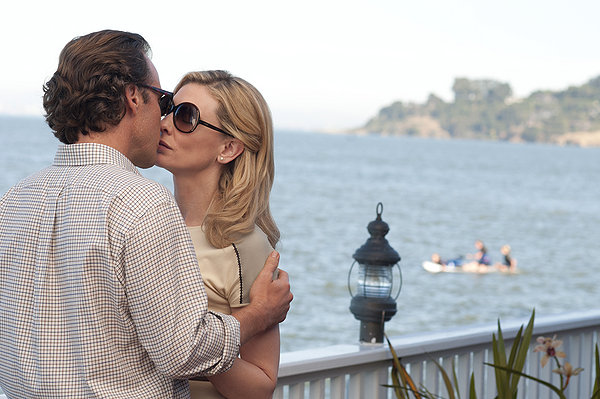
Blue Jasmine has one of the most inspired ensemble casts of any recent movie. Some of the most underrated actors currently working are used here to perfection, including Peter Sarsgaard as an aspiring politician who genuinely loves Jasmine, Bobby Cannavale as Ginger’s passionate boyfriend Chili (how our ideas about Chili shift throughout the movie is a testament to the genius of Allen’s writing), and Andrew Dice Clay, who gives the film an unexpected heart as Ginger’s ex-husband.

Jasmine may make mistakes and lie about her past, but the film isn’t afraid to acknowledge when she’s right, which makes her downfall even more tragic. What’s remarkable about Allen’s film is how it neither condemns nor endorses the moral failings of these complex characters. Blue Jasmine defies expectations at every turn, and my evaluation of every character was challenged with each new scene.

At the same time, Jasmine is responsible for nearly everything that ends up destroying her, and watching her lose her mind, muttering to herself and reenacting moments from her past, is pretty devastating – especially since Allen gives us such a vivid sense of the darkness that consumed her perfect life in Manhattan. In a film full of characters who delude themselves into happiness, Jasmine is the least successful of them all.

The Spectacular Now

The Spectacular Now features two of the most complex teenage characters I've ever seen in a film, played by Miles Teller and Shailene Woodley in two of the year's best and most natural performances. Filmed largely in unbroken two-shots, which allow for performances built by posture and body language as much as they are by close-ups, this is a film full of scene after scene that does everything right – there isn’t a moment in the film that rings false.

Sutter (Miles Teller) is a semi-alcoholic underachiever who is the life of every high school party. His longtime girlfriend, the beautiful and popular Cassidy (Brie Larson), breaks up with him near the beginning of the film, and, drinking his sorrows away, Sutter wakes up one morning on the front lawn of wallflower Aimee (Shailene Woodley). The two start spending time together, despite not being part of the same crowd.

There’s a scene early on in the film in which Sutter takes Aimee to an outdoor party, attended by what you might call the more popular crowd (when offered a beer, Aimee says she doesn’t drink, and it’s clear that she doesn’t feel entirely comfortable with this crowd at first).

As soon as they arrive at the party, Sutter looks across the crowd and sees Cassidy talking to her friends. As he instigates a conversation between Aimee and a few other people, his attention is focused squarely on Cassidy, who he still hopes to win back. Once Aimee is comfortably engaged in a conversation with the others, Sutter has done his job, so to speak, and he heads over to Cassidy, knowing from their online chat the previous evening that she’s still interested in him. Sutter and Cassidy talk and flirt a little bit, as Sutter seems certain that he is the master of his domain – he has not one but two potential romantic conquests at the party, and, for the time being, he can leave Aimee aside and focus on Cassidy.

Suddenly, Cassidy’s new boyfriend walks up to them, and asks her to leave the party. As Cassidy leaves with this new guy, Sutter is devastated. But he thinks, okay, no worries – I’ll just go to my back-up girl. But when he finds Aimee, she’s hitting it off with another young man! Sutter interrupts their conversation and asks Aimee to walk away with him.

His assumption – that Aimee is a fish out-of-water and will be lost at this party without him as her guide – backfires quickly. There is such an amazing power shift that occurs so naturally in this scene. Sutter feels that he has the power to pick and choose between his multiple romantic conquests, only to realize that he was deluding himself with his first option. So, he scrambles to the “back-up” girl – only to see that she has become engaged with someone else in the interim. I don’t know that I’ve ever seen scenes that understand the whims and anxieties of young people in ordinary but often overwhelmingly painful social settings so well.

There are many scenes in The Spectacular Now that similarly moved me. At their high-school graduation, Sutter and Cassidy have a conversation in the bleachers that evokes an indescribable kind of sadness. She’s not mad at him after their break-up and subsequent almost-getting-back-together – in fact, she jokes that he will always be her favorite ex-boyfriend. For Sutter, though, you almost get the sense that it would be less painful and easier for him to move on from Cassidy if she simply never wanted to speak to him again, and that would be it. But instead, it’s something a little more melancholy. She’ll remember him as kind of a joke – Oh, Sutter, that guy I once dated, he’s funny ­– and move forward with her life. As she leaves him standing alone in the bleachers, his graduation robe open, I felt an immense amount of sadness for these characters.

The film defies every expectation, never once following the expected path. In a lesser film, for instance, Aimee would try to get Sutter to stop drinking and perfect his behavior, but here, she actually starts drinking, too. She develops a dependency on alcohol and gets “worse,” in a sense (and, ultimately, Sutter realizes this and wants her to stay away from him, knowing that he’s bad news for her). 

There’s also the expectation that Sutter and Aimee’s relationship will be tested by Sutter cheating on Aimee with Cassidy. Wrong again. The film instead presents a real impulse – at first, maybe Sutter does want to get back together with Cassidy, and Aimee is simply a temporary rebound relationship. We aren’t meant to judge Sutter because of that – the film presents this in an honest and understanding way. If he had his way in the beginning of the movie, he probably would forget about Aimee entirely and get back together with Cassidy. But the fact of the matter is, he can’t win her back. And, once he accepts that, he ends up falling in love with Aimee. You can think what you want about him, but, like an actual human being, Sutter is complex and has contradictory feelings about multiple people (The Spectacular Now allows every one of its characters to exist with these kinds of contradictions, just like this year’s Frances Ha and Before Midnight).

In perhaps the most powerful scene of the film, Sutter’s boss – who loves him as dearly as anyone else and turns a blind eye to his drinking habit – meets with Sutter in his office. The boss says he can only keep one employee at his store, and he wants Sutter to be his main employee. However, he asks Sutter to promise that he will not come to work under the influence of alcohol ever again. Sutter honestly tells him that he cannot make that promise, and you watch as the boss, who cares and loves Sutter deeply, wants to tell him to get it together, but he can’t – he’s not the young man’s father, and ultimately, he almost admires Sutter for his honesty. This is a tough scene. My heart breaks for both of these characters.

What works so well about all of these scenes is that we’re able to read the intentions and desires of each of these young people so clearly, as they try so hard to appear cool and act natural. The not-always-obvious social violence and exclusion that happens right before our eyes is articulated with such grace and complexity, and the oversimplification of social ostracization that occurs in even the best recent coming-of-age films (The Perks of Being a Wallflower) is completely absent from this film.

I’m not mentioning the wonderful passages of the film that involve Sutter visiting his father (the great Kyle Chandler), but suffice to say that The Spectacular Now never missteps. The director is James Ponsoldt, and I'll be first in line for his next film. 

Sunday, January 15, 2012

The (Rest of the) Best Films of 2011

After listing The Ten Best Films of 2011 in an earlier post, I want to talk about the year's other great movies - and there were many. In fact, my second Top Ten are all films that would easily make the final ten in a weaker year. 2011 was a particularly strong year for movies, in my opinion, and all fifty-six of these titles are worth your time and consideration (and believe me - plenty of worthy films were left off the list entirely).

11. Shame (Steve McQueen)

Shame is an uncomfortably vivid and raw portrait of Brandon (Michael Fassbender), a sex addict in New York City. Oh, but the film is about so much more, touching on our fear of emotional intimacy in the twenty-first century and examining addiction and self-abuse more profoundly than any film since Mike Figgis’ Leaving Las Vegas (1995). Director Steve McQueen shoots most of the movie in long, unbroken takes that are extraordinarily uncomfortable and effective. Fassbender and Carey Mulligan, as Brandon’s sister, give two of the year’s best performances.

12. Midnight in Paris (Woody Allen)

In the midst of an almost unbearable summer full of superhero garbage and brainless sequels, Woody Allen released Midnight in Paris only seven months after the release of You Will Meet A Tall Dark Stranger, his 2010 offering (which, although critically maligned, I found every bit as profound and affecting as Midnight in Paris). Owen Wilson gives one of his best performances as Gil (the ‘Woody’ character), an American writer visiting Paris with his fiancé (Rachel McAdams) and her unbearably uppity parents. Gil, bored with his status as a hack Hollywood screenwriter, yearns for the Paris of the 1920s, when F. Scott Fitzgerald, Gertrude Stein, Ernest Hemingway and Pablo Picasso walked the streets and tossed ideas around in cafes. And so it happens that, while Gil is walking alone through the city after midnight, Paris magically morphs into that era, and Gil quite literally hangs out with the Fitzgeralds, Hemingway and the rest of the gang. Along the way, he falls in love with Picasso’s mistress Adriana, played by Marion Cotillard, who perfectly embodies all of the beauty of Paris in any era. With the playful and fantastical premise, Allen is free to wrestle with large ideas in a very funny manner (not dissimilar to his work in 1985’s wonderful The Purple Rose of Cairo).

Along the way, Allen takes playful jabs at the current state of Hollywood screenwriting, Tea Party dimwits, and pseudo-intellectuals alike (Michael Sheen is perfect as that guy – you’ll know the character once you see him). More importantly, it’s a wonderful movie about nostalgia, a force so strong and bittersweet that Allen has devoted an entire film to the subject. Gradually, our protagonist learns that all people feel disillusioned with their own time and place, and secretly yearn to live in the idealized past, no matter the current era. It’s Gil’s (and Allen’s) own discovery of this truth that lends Midnight in Paris its poignant insight. For this particular Woody Allen fan who holds Annie Hall (1977), Manhattan (1979), Hannah and Her Sisters (1986), Crimes and Misdemeanors (1989) and The Purple Rose of Cairo (1985) close to my heart, I mean it when I say that Midnight in Paris is as wonderfully poetic, sad, touching and funny as anything Woody Allen has ever made.

13. Beginners (Mike Mills)

Beginners is one of the most heartfelt movies I’ve seen in a long time, and it features two of the most touching love stories of the year – the first, between Ewan McGregor and his dying father, Christopher Plummer; and the other, between McGregor and Melanie Laurent. In any other year, Beginners would have easily placed very high on my top ten list. Plummer is deservedly winning many of this year’s Best Supporting Actor accolades.

14. Moneyball (Bennett Miller)

Expertly directed by Bennett Miller and featuring brilliant performances from Brad Pitt, Jonah Hill and Philip Seymour Hoffman, Moneyball opened exactly one year after the release of David Fincher's brilliant The Social Network - another talky, fact-based account of recent-year events written by Aaron Sorkin, who co-wrote Moneyball with Steve Zaillian. Both movies are relentlessly fascinating, and they serve as rare examples of high art and popular entertainment. If every major studio release were as smart and compelling as Moneyball, it would be a golden age for cinema. Pitt gives yet another outstanding performance (after his extraordinary work earlier this year in Terrence Malick's The Tree of Life) as Oakland A's general manager Billy Beane, who, in 2002, changed the game of baseball by using new and radical methods to select players for the team. Moneyball works as just about everything - a rousing sports movie, a powerful character study, an involving look inside the politics behind baseball and, most notably, superb entertainment for all audiences - baseball fans or not.

15. Young Adult (Jason Reitman)

For some people, high school is easily forgettable, a simple opening chapter to a larger and better life. But in Mercury, Minnesota, high school is the life experience that defines everyone and follows them to the end of their lives. Mavis (Charlize Theron), the heroine of Jason Reitman’s incendiary and brilliant Young Adult, escaped Mercury and fled to the big city – Minneapolis – at a young age, becoming a somewhat successful author of young adult novels. Divorced, unhappy and a bitter alcoholic, Mavis returns to Mercury at the opening of Young Adult to win back her now-married high school boyfriend Buddy Slade (Patrick Wilson), who she believes is unhappy in his marriage. Yes, Mavis suffers from delusions, and yet the film doesn’t ignore the delusions and imperfections of the small town people, as well. At one point, Mavis tells her parents that she thinks she’s an alcoholic. Both her mother and her father laugh it off, and we immediately understand a bit of the genesis of her problem. But Young Adult isn’t afraid to embrace Mavis’ delusions and even bypass that whole redemption nonsense by the film’s end, opting for a startlingly honest and bold closing chapter.

This is a sad film with characters who reek of desperation, and the result is a little uncomfortable (it shares a number of similarities, in fact, with Martin Scorsese’s masterpiece The King of Comedy). Diablo Cody wrote the screenplay, and for my money, she eclipses the work she did in Juno (2007). The movie is harsh and oftentimes a little bleak – but the film – and Theron’s character – are also right on the money. The last thirty minutes of Young Adult are as biting, risky and audacious as anything I’ve seen in a mainstream comedy in years.

16. We Bought A Zoo (Cameron Crowe)

I’m embarrassed to admit the number of times Cameron Crowe’s We Bought A Zoo brought tears to my eyes. A deeply personal filmmaker, Crowe ranks among my favorite directors, and his movies – from Jerry Maguire (1996) to Almost Famous (2000) – are full of heart, hope and absolute sincerity. We Bought A Zoo also features many perfect soundtrack moments (a signature of Crowe’s pictures) with Cat Stevens’ Don’t Be Shy, Bob Dylan’s Buckets of Rain and a powerful original score by Jonsi adding to the warm atmosphere. In the center of the picture is an honest and soulful lead performance from the endlessly talented Matt Damon that stands alongside the other moving portraits of single fathers this year (The Descendants, Moneyball). With a wonderful supporting cast (Thomas Haden Church! Peter Riegert! Scarlett Johansson!), We Bought A Zoo is a genuine movie about a family in grief moving forward. The human comedies of Cameron Crowe, Alexander Payne and Jason Reitman are the kind of pictures I want to make, and I'm overjoyed that all three of those filmmakers released new films this year.

17. Drive (Nicolas Winding Refn)

Ryan Gosling – who, if you recall, deserved last year’s Best Actor Academy Award for Blue Valentine (2010) – continues his streak of excellent performances with this thrilling neo-noir directed by Nicolas Winding Refn, who won Best Director at the Cannes Film Festival earlier this year. Drive is a rewarding, pulpy masterpiece – partially resembling both the Los Angeles noirs of Michael Mann and the 1980s romances of John Hughes (that Hughes comparison comes straight from Gosling himself, in fact). There’s nothing ironic about the film, though – it’s meant to be taken seriously, and it features one of the most fascinating and complex antiheroes of the year.

18. The Ides of March (George Clooney)

George Clooney’s The Ides of March is the sort of film that almost doesn’t exist anymore – a serious adult drama starring Hollywood’s finest working actors released by a major studio. Ryan Gosling undergoes a Michael Corleone-esque transformation as a naïve staff member for an inspiring presidential candidate (Clooney) battling to win the Ohio Democratic primary. It goes without saying that the performances from Gosling, Clooney, Philip Seymour Hoffman and Paul Giamatti are outstanding.

19. Warrior (Gavin O’Connor)

The personal drama among estranged brothers, Tommy (Tom Hardy) and Brendan (Joel Edgerton), and their alcoholic father, Paddy (Nick Nolte), paves the way for a rousing series of Mixed Martial Arts tournaments in Warrior. Brendan fights for his family’s survival (they are in desperate need of money), while war hero Tommy fights for the family of a fallen soldier. Paddy trains Tommy, while desperately seeking to regain the love of both of his sons. Warrior is a heart tugging, emotionally satisfying sports film that will easily resonate with audiences – I heard cheering and applause regularly in my theater during the second half of the movie. But while the film’s fighting scenes are wonderfully directed, it’s the human drama – the time that director Gavin O’Connor spends outside the ring with his characters – that makes Warrior such a powerhouse. Hardy and Edgerton, two excellent actors, are given the spotlight, and they are never anything less than brilliant. But Nolte’s performance is perhaps the best of his entire career. There’s an incredibly touching scene near the end of the picture in which Paddy has relapsed into his alcoholism, and Tommy finally breaks from his stone exterior and comforts his father. It’s more likely to make you weep than anything in the film’s stunning finale.

20. Rampart (Oren Moverman)

Woody Harrelson gives the performance of a lifetime as a corrupt Los Angeles police officer in Rampart, an outstanding film from Oren Moverman. “I’m not a racist,” Dave Brown (Harrelson) says. “I hate all people equally.” He may be telling the truth, and the most disturbing part of Rampart is watching Dave as he tries to do the right thing, in his own perverse and corrupt way. A decidedly different but equally powerful take on the Bad Lieutenant films, Rampart is its own modern-day Raging Bull (1980) or Taxi Driver (1976). Harrelson and Moverman previously collaborated on 2009's The Messenger, which established Moverman as one of the great new filmmakers.

21. The Artist (Michel Hazanavicius)

The Artist is a wonderfully charming film. Any hesitation on the part of audiences to see a silent, black-and-white film will hopefully be eradicated by the overwhelming critical praise the film has received since it premiered at the Cannes Film Festival earlier this year.

22. A Dangerous Method (David Cronenberg)

Viggo Mortensen, Keira Knightley and Michael Fassbender are absolutely wonderful in this involving and incredibly engaging film from director David Cronenberg. The deep focus shots are stunning.

23. Into the Abyss (Werner Herzog)

I saw Werner Herzog’s Into the Abyss at its Opening Night Gala presentation at the DOC NYC Festival. I was particularly excited for this Herzog film, as it explores the story of a death row inmate in Huntsville, Texas convicted of murdering three people, and his accomplice, who is serving a jail sentence of forty years. The film, which studies the impact of the murders on the surrounding community, is astonishingly powerful, and Herzog allows us to see the humanity of everyone involved in this tragedy – the victims, their family members and even the murderers themselves. There is so much sadness and regret in the film, and yet Herzog shows us that beyond this horrible tragedy, there is still life and love among the survivors. It's rare that I see a movie where I feel so strongly for so many characters - or subjects, I should say – all of them so honest and so human. In the live discussion after the film, Herzog spoke about his stance on the death penalty and the process behind making the film. After the discussion, my friends and I talked briefly with Mr. Herzog about Texas and his Rogue Film School, which I'm hoping he brings back to New York City in the near future.

24. Meek’s Cutoff (Kelly Reichardt)

To quote Roger Ebert, Kelly Reichardt's Meek's Cutoff is "the first film I've seen that evokes what must have been the reality of wagon trains to the West." A gorgeously filmed, immersive mood piece starring Michelle Williams (the best actress of her generation), Meek's Cutoff is destined to become an art-house classic.

25. 50/50 (Jonathan Levine)

How much did I love 50/50? When Joseph Gordon-Levitt tells Anna Kendrick, "I wish you were my girlfriend," my heart melted a little bit.

26. Everything Must Go (Dan Rush)

When I say I wish I had made this film, I mean that wholeheartedly. Everything Must Go is a wonderful, moving portrait of an alcoholic, with a lead performance from Will Ferrell that should do for him what Punch-Drunk Love (2002) did for Adam Sandler.

27. Margin Call (J.C. Chandor)

Everything about J.C. Chandor's debut feature film Margin Call is absolutely first-rate, particularly its brilliant screenplay and outstanding performances from Kevin Spacey and Jeremy Irons. When I saw the film at New York’s Angelika, Chandor spoke afterward about the challenges of making a movie about the “bad guys” on Wall Street. I eagerly anticipate his next work.

28. Martha Marcy May Marlene (Sean Durkin)

Sean Durkin's film Martha Marcy May Marlene is a major triumph not only for the filmmakers and stars Elizabeth Olsen and John Hawkes, but also for the Tisch School of the Arts, from which a wave of new talent has made its way into cinemas.

29. War Horse (Steven Spielberg)

After a three-year absence, it's nice to have Steven Spielberg back with a new directorial work. War Horse is a beautiful and crowd-pleasing picture, and the battle scenes are quite outstanding.

30. Carnage (Roman Polanski)

Roman Polanski's adaptation of God of Carnage is just as much fun as the Broadway stage version (performances from both are outstanding - I don't see a reason to compare). While the film lacks the immediacy of a live performance, we do get a claustrophobic sense of what house arrest must have been like for Polanski.

The Rest:

31. Another Earth (Mike Cahill)
32. Win Win (Thomas McCarthy)
33. Contagion (Steven Soderbergh)
34. Terri (Azazel Jacobs)
35. Submarine (Richard Ayoade)
36. Rango (Gore Verbinski)
37. Source Code (Duncan Jones)
38. The Guard (John Michael McDonagh)
39. Tabloid (Errol Morris)
40. The Beaver (Jodie Foster)
41. Mission: Impossible - Ghost Protocol (Brad Bird)
42. Crazy, Stupid, Love. (Glenn Ficarra)
43. My Week With Marilyn (Simon Curtis)
44. Melancholia (Lars von Trier)
45. Attack the Block (Joe Cornish)
46. Our Idiot Brother (Jesse Peretz)
47. Page One: A Year Inside The New York Times (Andrew Rossi)
48. Super 8 (J.J. Abrams)
49. Hanna (Joe Wright)
50. A Better Life (Chris Weitz)
51. The Muppets (James Bobin)
52. Cave of Forgotten Dreams (Werner Herzog)
53. The Future (Miranda July)
54. Horrible Bosses (Seth Gordon)
55. The Conspirator (Robert Redford)
56. Cedar Rapids (Miguel Arteta)

Tuesday, June 28, 2011

You May Say That We Ain't Free, But It Don't Worry Me

Starting in July, I have an internship with Troublemaker Studios in Austin, Texas - the creative home of filmmaker Robert Rodriguez, who I have long admired (particularly because of his ability to not only write, direct and produce his movies, but also to edit, shoot and score many of them, as well). Until my internship starts, I have been wrapping up post-production work on With Love, Marty (my friend Jonah Greenstein is writing the score to the film), as well as working on a new film project with my friends Brian Schwartz and Catherine Schwartz, two extremely talented people with whom I went to Austin High School (Brian and I were in quite a few plays together as Red Dragon Players). I've also been reminiscing about some of my great New York City experiences this past semester that I've neglected to mention in my earlier blog posts.

I wrote in length about my immense love for Terrence Malick's The Tree of Life and Woody Allen's Midnight in Paris in earlier posts - two films that I have no doubt will place very highly on my year-end top ten list (I'll add a third to that list - Mike Mills' wonderful Beginners, with Ewan McGregor, Christopher Plummer and Melanie Laurent giving memorable performances in a moving love story). In particular, The Tree of Life is a movie that continues to live with me - I mean it sincerely when I say that, watching the film, I felt inspired to someday attempt to make something as personal and philosophical as Malick's movie - that is, of course, if I have the benefit of being a filmmaker many years from now. The Tree of Life is such an artful piece of personal filmmaking, and it's the kind of movie that gives me the hope that, one day, I can make a film that furiously and passionately grasps at the lingering questions from my childhood, the death of my father and the story of my youth. Just don't expect a fraction of the cinematic poetry and grace that Malick brings to The Tree of Life.

As I'm slowly catching up with things after the whirlwind of last semester, I wanted to post some films made by my friends from over the past year. Below is a link to my good friend Alexander Fofonoff's third Sight and Sound: Film project The Sailor of Tomorrow, in which I appear as a disgruntled dock worker (Alex and I were in the same Sight and Sound: Film crew, which also included my great friends Jonah Greenstein and Benjamin Dewey). Here's the film:


In January, my roommate Bobb Barito and I saw Tennessee Williams' The Milk Train Doesn't Stop Here Anymore starring Olympia Dukakis on Broadway. This incredible production was directed by Michael Wilson, who, along with Tony-nominated actress Hallie Foote (daughter of the late playwright Horton Foote), will hopefully be speaking about the actor-director relationship at one of Tisch New Theatre's Master Classes in the fall (I have had the pleasure of getting to know Mrs. Foote over the years through my friend Bolton Eckert, starting back in 2006, when I attended Mr. Foote's 90th birthday party with Bolton and his family in New York City).

In March, my good friend and collaborator Benjamin Dewey and I saw the newly restored 35MM print of Martin Scorsese's Taxi Driver (1976) at New York's historic Film Forum, which was just a breathtaking experience. I've seen the film countless times (dating back to when I was eleven years old and just beginning my life-long obsession with Scorsese's work), but it's never looked as beautiful as it did at Film Forum. I've seen beautiful prints of Raging Bull (1980), Goodfellas (1990) and The Last Temptation of Christ (1988) before in theaters - not to mention seeing Scorsese's incredible output in the 2000s upon their original theatrical releases (Gangs of New York, The Aviator, The Departed, Shine A Light, Shutter Island) - but never Taxi Driver. And, I'll tell you, there's a haunting power in watching that film and living in New York City. I look at the picture a little differently now - it takes on an entirely different meaning and context (not that the New York City of the 1970s resembles the New York City in which I live in 2011 at all, really - but still, there's an added resonance).

The past few months - both in New York and in Austin - I've been able to watch some great new releases worth seeking out in cinemas, including Kelly Reichardt's Meek's Cutoff, a gorgeously filmed, immersive mood piece that seems destined to become an art-house classic; Dan Rush's Everything Must Go, a wonderful, moving portrait of an alcoholic, with a lead performance from Will Ferrell that should do for him what Punch-Drunk Love (2002) did for Adam Sandler; Submarine, a wonderful coming-of-age movie with the heart of Hal Ashby's Harold and Maude (1971) and the style of a French New Wave classic; Joe Wright's strangely hypnotic Hanna, which features one-take action sequences that put the heavily-edited, incomprehensible action scenes from most Hollywood movies to shame; Jodie Foster's The Beaver, worth seeking out for Mel Gibson's extraordinary performance; J.J. Abrams' Super 8, a wonderful throwback to a better kind of summer blockbuster; and Werner Herzog's Cave of Forgotten Dreams, a fascinating, meditative documentary exploring the inside of the Chauvet Cave in France, which features prehistoric cave drawings more than 30,000 years old. Did I mention that the film is in 3D? Leave it to Werner Herzog to make extraordinary use of 3D technology.

Since I've been in Austin, I've been catching up on re-watching some old favorites and some films I've overlooked through the years, including Niehls Mueller's
The Assassination of Richard Nixon (2004), a great film that proves that Sean Penn is unquestionably the best working actor today (together with his work in Mystic River and 21 Grams, his performance in this film represents the best output in the span of one year of any actor I can recall); Martin Scorsese's thrillingly entertaining The Color of Money (1986), where Paul Newman has never looked so cool; Robert Altman's revisionist western
McCabe and Mrs. Miller (1971), starring Warren Beatty as the kind of brash 1970s antihero that makes me love that decade's cinema so much; and Joel and Ethan Coen's debut film Blood Simple (1984), a movie that demonstrates that these brothers knew how to make a movie better than anyone else around right from the start.

I have to spotlight two recent Scorsese viewings that just left me floored. I re-watched his first feature film, Who's That Knocking at My Door (1969), which started out as his senior thesis film at New York University, and developed over the years until its theatrical release in 1969. The movie is full of the same raw energy and kinetic liveliness as Mean Streets (1973). Everything is here in his first feature - the thrilling use of pop music, the Catholicism, the guilt, the male awkwardness, the social discomfort, New York City, a wonderful performance from Harvey Keitel - in other words, it's the kind of movie I live for! It's full of the immediacy that has always drawn me to Scorsese - his uncontrollable need to tell you this story right now, because it's so personal, so close to his heart, and if he doesn't get it out there - well, then, how else can he get you to experience what he experiences?

The second Scorsese film is last year's documentary A Letter to Elia, Scorsese's loving tribute to Elia Kazan, the filmmaker who inspired Scorsese more than any other. The film is especially powerful because of Scorsese's close, personal connection to Kazan's pictures, if not Kazan the man. Watching the film, I couldn't help but recognize Scorsese's loving adoration and respect for Kazan as the same adoration and respect I feel so strongly for Scorsese. There are many quotes from the film that haunt me, particularly the following one, in which Scorsese describes his friendship with Kazan:

"There was a kind of understanding between us. I mean, I never tried to tell him how much his films meant to me -- I don't think it would've been fair. When somebody's work has touched you that deeply, you can never expect them to understand how much they mean to you. It had to stay between me and the pictures. Those pictures mean so much to me that I can't imagine where I'd be without them. And when the lights dimmed, I was standing in the wings and I looked at the images from his tribute reel. It was an overwhelming feeling. It was as if I was seeing layers of my own experience, my own life, unfolding right there up on the screen. So, Elia, it always had to stay between me and the movies, and the only way I could tell you how much you meant to me was by making movies.”

I may never know Martin Scorsese personally, but if I ever do have the chance to know him, I think I will feel the same way. Scorsese's work has touched me so deeply and defined every aspect of my life for as long as I can remember. I don't think he will ever understand how much he means to me - he is a sort-of father, a father I've never met, but one who understands me. And so, if I am lucky enough to make pictures for a living, it will be my way of telling Martin Scorsese how much he meant to me and how his films are like a piece of my own personal history, embedded in my mind like my own experiences. And perhaps, one day, I can make A Letter to Marty. But, you know, even an hour-long documentary of the sort couldn't ever really hint at how he's shaped my life and the way I look at the world.

In honor of Scorsese, here's my Vocalization sound project from my Fall 2009 Sound Image class at NYU's Tisch School of the Arts - in which I provide all of the voice work. After years of listening to Scorsese talk about his films, I've had time to work on a Scorsese impersonation:

Thursday, June 2, 2011

Film Review - Midnight in Paris

Thank God for Woody Allen. In the midst of an almost unbearable summer full of 3D superhero garbage and brainless sequels, he has given us his latest film Midnight in Paris only seven months after the release of his last film, You Will Meet A Tall Dark Stranger. The middling critical reception to You Will Meet A Tall Dark Stranger bewildered me – of that film, I wrote: “Allen’s characters face existential dread, find comfort in ridiculous paranormal spiritualism, destroy their relationships with one another and learn the hard way that, in terms of romantic relationships, the grass will always be greener on the other side.” Powerful stuff, but for some reason, American critics weren’t impressed. Perhaps it’s because Allen offers us, on average, one movie per year, and aside from Match Point (2005) and Vicky Cristina Barcelona (2008), most of them aren’t nearly as good as his masterworks from the 1970s and 1980s.

Well, so what? A middling Woody Allen film is better than ninety-nine percent of everything else out in current release. Not that I would consider You Will Meet A Tall Dark Stranger a middling film in the least, mind you.

Fortunately, there’s no getting around the fact that Midnight in Paris is the funniest and most endearing movie you’ll see this year – critics and audiences alike are recognizing the film as Woody Allen’s finest work in years. Owen Wilson gives one of his best performances as Gil (the ‘Woody’ character), an American writer visiting Paris with his fiancé (Rachel McAdams) and her unbearably uppity parents (Allen’s depiction of McAdams’ conservative family would seem harsh if it wasn’t so, I don’t know, spot-on).

Gil, bored with his status as a hack Hollywood screenwriter, yearns for the Paris of the 1920s, when F. Scott Fitzgerald, Gertrude Stein, Ernest Hemingway and Pablo Picasso walked the streets and tossed ideas around in cafes. And so it happens that, while Gil is walking alone through the city after midnight, Paris magically morphs into that era, and Gil quite literally hangs out with the Fitzgeralds, Hemingway and the rest of the gang. Along the way, he falls in love with Picasso’s mistress Adriana, played by Marion Cotillard, who perfectly embodies all of the beauty of Paris in any era.

The joy of this film is discovering all of this for yourself, and so I’ll refrain from saying anything else, except that Allen’s work with the Surrealists (including Adrien Brody as Salvador Dali) is brilliantly absurd. With the playful and fantastical premise, Allen is free to wrestle with large ideas in a very funny manner (not dissimilar to his work in 1985’s wonderful The Purple Rose of Cairo).

Along the way, Allen takes playful jabs at the current state of Hollywood screenwriting, Tea Party dimwits, and pseudo-intellectuals alike (Michael Sheen is perfect as that guy – you’ll know the character once you see him). This is a film that assumes you’ll catch the joke about Luis Bunuel and The Discreet Charm of the Bourgeoisie (1972), or the jokes about Hemingway’s speech pattern (he talks the way he writes). Allen doesn’t bother explaining them to you because he’s not interested in pandering to the lowest common denominator, and in today’s cinema of digestible fluff for the masses, that’s quite an achievement.

More importantly, it’s a wonderful movie about nostalgia, a force so strong and bittersweet that Allen has devoted an entire film to the subject. Gradually, our protagonist learns that all people feel disillusioned with their own time and place, and secretly yearn to live in the idealized past, no matter the current era. It’s Gil’s (and Allen’s) own discovery of this truth that lends Midnight in Paris its poignant insight.

For this particular Woody Allen fan who holds Annie Hall (1977), Manhattan (1979), Hannah and Her Sisters (1986), Crimes and Misdemeanors (1989) and The Purple Rose of Cairo (1985) close to my heart, I mean it when I say that Midnight in Paris is as wonderfully poetic, sad, touching and funny as anything Woody Allen has ever made.