Sophomore Jack Kyser is Edward Teller (James R. Burton Award Nominee - Best Supporting Actor 2006-2007). From The Red Dragon Players' production of "The Lovesong of J. Robert Oppenheimer" - October 2006.
Jack is a 2013 graduate of NYU’s Tisch School of the Arts, where he was a Dean's Scholar and film major. He is currently in pre-production on his first feature film. Jack’s previous seven short films have screened at film festivals nationwide over the last several years. He is the recipient of numerous awards from Tisch during both his enrollment and post-graduation, including the Richie Jackson Artist Fellowship, the Sony Electronics Scholarship and the Emerson Scholarship. He currently works as an editor at Comedy Central for The Daily Show with Trevor Noah. Previously, he was an associate producer and assistant editor for Emmy-winning filmmaker Nancy Buirski, and interned for a year-and-a-half at Martin Scorsese’s Sikelia Productions. He studied acting at Manhattan’s Herbert Berghof Studio under the direction of Austin Pendleton. During his four years at Austin High School, Jack performed in twenty-three plays and won fourteen Best Actor or All-Star Cast awards at all levels of UIL competition, and advanced to Nationals competition in Monologue, Duet Musical and Shakespeare performance. He has written a monthly film column for Austin Family Magazine since 2004.
It's been a little while since my last blog entry, but I'm back! Near the end of last year, I made an acting reel, mainly comprised of footage from Alex Fofonoff's Blood and Thunder (in which I starred) and my films Jack and Lucas Go To A Wedding, Jake the Cinephile and With Love, Marty. Take a look below if you're interested, and please share - I'd love to get more acting work (if anyone needs a Jack-like character in their movie, I'm your man!) Look for memorable appearances by excellent acting partners like Desi Domo, Alexis Gay, Bethany McHugh and Lucas Loredo. Thank you to Bobb Barito for his sound design and to Alex for so much great footage from Blood and Thunder.
Speaking of Blood and Thunder, we had a great first screening of the film back in December. It was truly an honor to share Alex's film on a big screen with a group of friends and collaborators. We're still in the process of getting the movie out there and submitting it to festivals, and I'm very excited for more people to see it.
My friend Marissa Rutka has a great new web series titled Coffee Catch-Ups that's online now, and it was a lot of fun to be a part of the production (and a subject in the series). You can find the two episodes where I'm featured before - in the first, Morgan Ingari and I recount the eye-watering events of Hurricane Sandy, and in the second, I go into Jake the Cinephile mode and offer out my rather obsessive-compulsive idea of perfection. Keep watching the series for more memorable guests and friends, like Charlotte Arnoux, Adam Boese, Nick Tanis and Emmy-winning guest star Jon Annunziata. The series was also nominated in the Documentary & Factual category of T.O. Webfest and will play at their festival later this month, so that's exciting!
In other news, my movie Jake the Cinephile is now available to watch online on Vimeo! I had a lot of fun screening this film at NewFilmmakers New York and The Beacon Film Festival (Freeze Frame) a few years ago, and I can't thank all of my extraordinary collaborators on the film enough. Here it is:
My senior thesis film You Can't Put Your Arms Around A Memory is winding down its festival run after screening at a number of festivals last year. We were proud to be nominated as a Finalist for Best Student Film at the Blow Up-Chicago International Arthouse Film Festival in December. And earlier, on Saturday, November 21st, I was thrilled to screen You Can't Put Your Arms Around A Memory at the Katra Film Series with some other great films. After the film screenings at Katra, there was a Q&A with the other filmmakers, where I was joined by my great lead actor Mike Wesolowski.
On Friday, April 22nd, By Sidney Lumet, the wonderful documentary on which I was an associate producer and assistant editor, had a special free screening at the Tribeca Film Festival at the SVA Theatre, followed by a lively Q&A with panelists Jonathan Demme, Treat Williams, Amy Ryan and Jenny Lumet moderated by director Nancy Buirski. It was a particularly exciting day because, before the screening, I was part of the production team on an excellent interview with Mr. Williams, where he discussed shooting Lumet's masterpiece Prince of the City (1981). From both that interview and the post-screening talkback, I learned so much great New York City filmmaking history in the span of a few hours.
The trailer for By Sidney Lumet is also now available for the world to see - you can watch it here. Earlier this year, the film screened at the Full Frame Documentary Film Festival in Durham. But, for me, the most exciting screening of By Sidney Lumet was at the Austin Film Festival last October, where it played at the historic Paramount Theatre. It was a great afternoon screening, and a good number of my friends and family members were able to come see the picture on the big screen. Nancy held an excellent Q&A after the film was over onstage (I was also able to see a number of other films at the festival, including Youth, Brooklyn, Legend and Coming Through the Rye, and meet one of my favorite actors, Chris Cooper, for the second time).
By Sidney Lumet spans Lumet's entire career, from 12 Angry Men (1957) to Dog Day Afternoon (1975) to Before the Devil Knows You're Dead (2007), and it's really been great to see the film and Lumet's work so justly celebrated over the last year.
Meanwhile, Loving, the narrative film adaptation of Nancy's first film, The Loving Story (2011), wrapped production last fall, and earlier this year Focus Features bought the film to release in the fall. Directed by the astounding Jeff Nichols (Take Shelter, Mud, Midnight Special) and starring Joel Edgerton, Ruth Negga and Michael Shannon, Loving recently made its world premiere at this year's Cannes Film Festival, and it was the talk of the festival. Loving is shaping up to be the second masterful film by Nichols this year (after Midnight Special, which I'll discuss below), and it's a very exciting time for Nancy's career.
The Cannes line-up this year, by the way, was particularly exciting - in addition to Loving, there were new films from Sean Penn (The Last Face), Woody Allen (Cafe Society), Paul Schrader (Dog Eat Dog, starring Nicolas Cage) and Jim Jarmusch (Paterson), along with a special screening of Jonathan Jakubowicz's Hands of Stone to honor star Robert De Niro, who is supposed to give another great performance in the film. And in the absolute best news of the festival, STX bought the international rights for Martin Scorsese's The Irishman, starring Robert De Niro, Al Pacino and Joe Pesci, which is the movie I've been waiting for my entire life. If The Irishman is indeed moving forward, it's the best news of the century.
By the way, I suspect Penn's The Last Face (which was received poorly) is a good film, and critics are simply making it difficult for the movie to find a distributor. Meanwhile, most studio crap gets a pass - I'll have a bit more to say on critics dismissing interesting cinema while giving bloated, uninteresting superhero films way too much leeway a little later.
On Saturday, April 23rd, ten years after the best concert of my life (seeing The Rolling Stones in Zilker Park in Austin), I went to the only concert that can ever top it - finally, after waiting for so long, I saw Bruce Springsteen in concert. That's right, I went down to The River to worship at the altar of The Boss. His two performances at Brooklyn's Barclays Center marked the end of The River Tour 2016, in which Springsteen and the E Street Band performed the entirety of their 1980 album The River (along with a large number of other Springsteen songs). As you might expect, I rocked out. From the homemade Springsteen t-shirts worn by fans congregating at the nearby Shake Shack to the power and majesty of the music itself, this concert was three and a half hours of joy. The River is such a beautiful, haunting album (here's a link to some of the videos I took on my phone during the concert).
And his live performances of these classic songs were as full of exuberance and passion as I've heard (though I feel quite familiar with his live work, having watched recordings of his concerts for years now). There was simply so much energy in songs like Tenth Avenue Freeze Out, Born to Run, Badlands, Out in the Street, I'm A Rocker, Cadillac Ranch, Crush On You, Two Hearts and You Can Look (But You Better Not Touch). He crowd-surfed, he threw multiple guitars off-stage (toward someone waiting to catch them), he got a married couple onstage to slow-dance, he danced like a madman, he busted through the crowd like The Boss.
And then there were the songs that nearly moved me to tears. He opened with Purple Rain, as this was two days after the tragic passing of Prince. And then The River stand-outs Fade Away, Stolen Car, The River and Independence Day broke my heart, along with two of his most emotional and triumphant songs, Lonesome Day and The Rising.
Earlier this year, my roommate Bobb got a vinyl record player for our apartment, and my used copy of The River I purchased from Other Music (which is unfortunately closing in June) has received more play than almost any other record in our collection. It's just a masterpiece, and as someone who considers Bruce Springsteen my favorite musician, I'm embarrassed I hadn't explored it and appreciated it the same way I have with Born to Run, Born in the U.S.A., The Rising, Magic, Darkness on the Edge of Town, Devils and Dust and so many other seminal Springsteen albums until this year.
April 29th was the fourteen year anniversary of my dear dad John Kyser leaving this earth - what a fun, loving man he was. He is deeply missed. To the right, you'll see some pictures taken by my great mom Gretchen Kyser.
Earlier in March, we held the Second Annual Lip Sync Battle Contest at my apartment, where friends attended and took turns performing sections (or the entirety of) songs that they chose (and rehearsed) before the competition. To commemorate the one year anniversary of our first party, I edited together a trailer of our performances from last year's inaugural contest. Take a look here and marvel at the talent on display.
Congratulations to our outrageously talented winners Mo Faramawy, Marissa Rutka, Taylor Frey and Alex Schaefer, as well as our Special Jury Prize winners Jon Annunziata and Emma Viles (traveling all the way from Boston!). There were magical performances by everyone and excellent judging all around.
We're not even half-way through the year, but there have already been several outstanding new film releases - although it's sometimes disturbingly difficult to find them when so many screens are devoted to the latest superhero monstrosity. In all seriousness, any self-proclaimed lover of film owes it to himself or herself to actively go out and see the new films from Richard Linklater, Terrence Malick, Jeff Nichols and Joel and Ethan Coen in a movie theater. It is more important than ever to support great cinema and choose wisely, particularly when nearly every screen in the city is dedicated to garbage (even when the garbage is supposedly "good," I simply find myself bored, desperately wanting to watch a real movie). Many, many worthy films open every Friday, and they're often lucky to survive even for two weeks in New York. I shudder to think how many films like Kenneth Lonergan's Margaret (2011) I've missed and have flown under the radar - and I'm someone who keeps up regularly with what's out there.
In my last post, I wrote in detail about my love for Linklater's flat-out amazing Everybody Wants Some!! Instead of making a top ten list this year, I might just list the ten best uses of music in the film. Linklater's new movie deserved a wide release, but Paramount Pictures didn't let that happen. Anyone who has seen the movie has fallen in love with it, but the studio simply didn't give the picture the chance it deserved and allow word-of-mouth to spread. Linklater is a national treasure, and actor Glen Powell delivers a star-making performance here (plus, my friend Jenna Marie Sab plays the mud wrestling champ, and Bernie Tiede served as the set cat wrangler).
It's a miracle that a movie as contemplative as Malick's Knight of Cups exists in this day and age. Richard Brody wrote a great piece on the film for The New Yorker (it's worth noting that Brody is one of the only film critics who actually seems to appreciate daring filmmaking anymore - some of the reviews for Knight of Cups would lead you to believe your money would be better spent seeing Batman v Superman: Dawn of Justice).
Malick finds real beauty in the decadence of Los Angeles, with locations as evocative as anything in his filmography (production designer Jack Fisk does amazing work, as always). Malick also benefits from having an incredibly strong, emotive lead actor in Christian Bale, who is fascinating to watch in every quiet moment of this film. He seems to relish Malick's style of filmmaking, inviting us to share his character's very real struggle without having anything close to a traditional scene of dialogue.
The scenes with Bale's father (Brian Dennehy) and his brother (Wes Bentley) are some of the best in the film. Cate Blanchett makes a memorable impression as Bale's ex-wife, in a sequence in which we come to understand so much about his character through his reactions to her work as a nurse.
It's interesting to see Malick film the modern-day emptiness of a heavily materialistic culture, partially because I'm so used to seeing the natural world represented in his films. This is only Malick's second non-period piece (after To the Wonder), and I love seeing him capture our world in a way that emphasizes both the beauty and the trappings of a decadent wasteland.
Structuring the film in sections named after tarot cards fits so well with this story of a man on a quest to find meaning in his life and world. The experience of a hard-partying Hollywood player has never been put onscreen quite like this before, with so much contemplation as to what it all means and what role he's playing. There's a very memorable scene in which Bale's apartment is robbed and he's held at gunpoint. One of the burglars asks why there isn't anything of value in his home, and Bale doesn't have an answer.
As always with Malick, I found myself lost in Knight of Cups in a beautiful way, and I was made a little less aware of the current time and space around me. There's no way in his pictures to really know where we are structurally in the story, and so our minds are free to wander and take in the beauty of each moment. We simply exist in the space of the movie, and that is a wonderful thing.
Midnight Special is really, really special. The films of Jeff Nichols take place in cheap roadside motels, gas stations, backwoods areas and on dark highways. The locations alone have more character than most other studio films out there. All of his films are about parental concern in some way or another, and about a kind of anxiety and longing at the heart of modern southern men.
Interestingly, both Mud (2013) and Midnight Special feature powerful late scenes that help unearth the themes of the film, followed immediately by a rousing shootout. These critical scenes – in Mud, the titular character giving our young protagonist advice on love, and in Midnight Special, a child comforting his parents about to lose him – have a beautiful romanticism to them. And then Nichols leaps immediately into the thick of an adventure. It’s exhilarating filmmaking.
I love how dark Nichols and cinematographer Adam Stone allow some of these scenes to get – we actually feel like nighttime is upon us. And the darkness only helps conceal the mystery, along with the beautiful score from David Wingo, who also scored Mud, Take Shelter (2011) and the films of David Gordon Green.
Edgerton is silent and strong, providing a subtle, effective presence in each scene, while Shannon is riveting as a father willing to do anything for his son.
Midnight Special is an emotional story about parents protecting and eventually letting go of their child, and how others along the way are deeply affected by the child's vision. Nichols is so good at making movies that are about so much more than they seem, and they always sneak up on you and reveal themselves in profound ways. The combination of supernatural imagery with ordinary life is even more prevalent here than in Take Shelter, but Nichols uses special effects only when necessary, and only in the interest of enhancing the story.
With these last few films, Nichols has created a new American South that feels real and heartfelt. Here, he embraces his inner Spielberg and makes a film full of haunting images, quiet characters whose inner lives speak volumes, and an atmosphere that lingers long after the credits are finished.
In February, Joel and Ethan Coen released their latest masterpiece, Hail Caesar! Josh Brolin, in his third collaboration with the Coens, leads a hilarious ensemble cast, and the picture is a treat for anyone who loves classic cinema. The Coens have a great time paying homage to classic studio films from the 1950s. They're also two of the only major American filmmakers to deal seriously with religion in their films. Hail, Caesar!, which begins and ends with Eddie Mannix (Brolin) in confessional, is fascinating when you consider the minor sins for which he atones, as opposed to the things he doesn't confess. He doesn't give a second thought to anything slightly immoral that involves running Capitol Pictures more effectively, whereas smaller things, like having an occasional cigarette, weigh on him heavily. This is a dense film, and worth seeing multiple times. Every film from the Coens is like a puzzle, and as you're watching it, you know the pieces are going to add up to something brilliant, but part of the fun is trying to determine how seemingly throwaway scenes contribute to the overall picture.
If you want brilliantly-written, Kiss Kiss Bang Bang-style fun, run to see Shane Black's The Nice Guys, in which Russell Crowe and Ryan Gosling make a hilarious pair of private eyes. This is precisely the kind of movie that deserves to be making loads of money - if only America wasn't so simultaneously force-fed and obsessed with superhero atrocities. Jodie Foster's Money Monster is also a great, tight thriller reminiscent of Sidney Lumet's work - and features a fantastic supporting performance from my friend and NYU peer Grant Rosenmeyer! He plays Tech Dave, who spends a great deal of time in the control room and later in a van with Julia Roberts.
A24 continues to release the most memorable films out there - The Lobster is amazingly inspired and strong, with an extraordinary performance by Colin Farrell. And earlier this year, The Witch unsettled me deeply. Talk about a production company on a winning streak - in the last year, they've released While We're Young, Ex Machina, Amy, The End of the Tour, Room and Green Room, in addition to the above titles. If I see their logo attached to a movie trailer, I'm seeing the movie without a doubt.
I was a little late to the game in seeing it (after it won the Academy Award for Best Foreign Language Film), but Son of Saul by László Nemes is a work of art. In short, it's important to go out there and see the original films. So please go support The Nice Guys, Money Monster, The Lobster, A Bigger Splash, Weiner, Maggie's Plan, Elvis and Nixon, Miles Ahead, The Family Fang, Green Room and - if it's still playing near you - Everybody Wants Some!!
Earlier this February, I attended the first screening of the Blackhat Director's Cut at BAM, with Michael Mann, one of my favorite directors of all time, introducing the film. I was a fan of this movie when it first opened a year ago, and I love this restructured version even more.
In this cut, the romance between Chris Hemsworth and Tang Wei's characters is much stronger, and the characters overall are more fully defined. You know you're watching the work of a master visual stylist when you can practically feel the locations while watching the picture, and Blackhat has no shortage of incredibly memorable set pieces.
The sheer urgency and immediacy of the shootouts are as gripping as anything in Mann's filmography. The hacking scenes are beautifully filmed and visualized, and Mann's hyper-digital aesthetic has rarely felt more appropriate and essential, given the subject material. It's hacker versus hacker at the end of this picture. The film feels like it takes place in two worlds - one made up of sprawling and confusing physical geography, the other an unknowable and far advanced world that leaves the physical one muddled in chaos. On a side note, I was thrilled to be quoted in an IndieWire story about the Blackhat screening.
In April, I saw the current revival of Fiddler on the Roof on Broadway, which was an incredible production. I hadn't seen the musical since the 1990s, when I went with my parents to a production at Austin's Paramount Theatre.
As for this year's Academy Awards, I thought the winners themselves were right on the money. The final three Oscars went to exactly the people who deserved them - they got it right. Let's finally say it - Academy Award Winner Leonardo DiCaprio. We all know it should have been Oscar #4, as he should have won for Martin Scorsese's The Aviator (2004), The Departed (2006) and The Wolf of Wall Street (2013), but no matter. The Academy awarded a magnificent actor and a truly kind person (from the few times I met him on The Wolf of Wall Street), not to mention an extraordinary performance.
In fact, I made the t-shirt to the right two years ago in the spirit of a possible DiCaprio win for The Wolf of Wall Street. That didn't happen. But I brought it back this year, and it happened.
The Best Director win for Alejandro Gonzalez Iñárritu and Best Picture win for Spotlight are, again, precisely the choices I would have made - not just among the nominees, but for the entire year, period. I loved whatever it was Michael Keaton mouthed when Spotlight won - that's two Best Picture winners in a row for Keaton, baby (and you can bet he's coming back for more this year with his excellent-looking performance in The Founder). The awards were enough to start a hashtag like #OscarsSoRight.
I was a little sad about Sylvester Stallone's loss for Creed, though my two picks for Best Supporting Actor (Harvey Keitel for Youth and Keaton for Spotlight) weren't even nominated. But it's cool that, before Lincoln (2012), Steven Spielberg had never directed an Oscar-winning performance - and now, with Mark Rylance's brilliant performance in Bridge of Spies, he's directed two. I was hoping to see the Best Song Oscar go to Youth, the actual best song nominated, by an artist apparently not famous enough to perform (don't even get me started on the exclusion of Brian Wilson's song from Love & Mercy).
To be honest, I hadn't been so excited for the Oscars since The Departed (2007) won it all nine years ago, mainly because of the prospect of a DiCaprio win. And the other winners were largely excellent (Ennio Morricone for The Hateful Eight! Tom McCarthy and Josh Singer for Spotlight! Brie Larson for Room! Adam McKay and Charles Randolph for The Big Short!). Still, the tone of the evening oftentimes left a bad taste in my mouth - there's a way to critique the politics of the entertainment industry without disrespecting the films and people who are nominated.
It was a good awards season, for the most part, as well - with The Revenantbecoming a worldwide hit, winning the major BAFTA awards and Alejandro González Iñárritu winning the DGA for the second year in a row - he could not be more deserving. Spotlight, meanwhile, won the WGA award. Here's a great Rolling Stone article on Iñárritu, which includes Scorsese's thoughts on The Revenant (he calls it a masterpiece).
There have been some tragic deaths since I last wrote here, including musical legends Glenn Frey, David Bowie and Prince; Gary Shandling, who gave us masterful comedy with The Larry Sanders Show; Kathryn Altman, who so lovingly kept her late husband Robert Altman's legacy alive and well, particularly with the magnificent book on his career; and brilliant author Harper Lee. I had the honor of briefly meeting Harper Lee ten years ago with my friend Bolton Eckert at Horton Foote's ninetieth birthday party - she was an extraordinary person, and her work and legacy will live on forever.
Spoiler warning for all three
films reviewed below.
Frances Ha
As soon as Noah Baumbach’s Frances Ha ended, my friend Mike Cheslik turned to me and said it
was his favorite film of the year. I have to agree, although Jeff Nichols’ Mud and Ramin Bahrani’s At Any Price are up there for me, too. I
saw this film at the perfect time in my life. It’s amazing to me how many
movies can inspire maybe only a few thoughts or feelings, and then one dense
eighty-six minute film like Frances Ha
can address so many of my anxieties and fears in such an artful and graceful
way. This is the loveliest and most delightful film I’ve seen in a long time. What follows are our collective thoughts on the film, including many aspects of the film Mike noticed and admired.
We both watched the movie nodding and smiling
throughout, recognizing our own behavior in Frances, the wonderful lead
character played by Greta Gerwig, an aimless and good-hearted post-graduate
young woman moving from address to address in New York City, dealing with the
changing nature of her relationship with her best friend Sophie (Mickey Sumner)
and struggling to make her way into a dance company.
Where to start with what this movie gets right? There’s not a central romance in Frances Ha - we’re not given a lead character who
is constantly successful in relationships. Frances is one of the
most refreshingly honest and unconfident characters in a long time, apologizing
for how she’s speaking while she’s still speaking and always openly critical of herself. Characters
in films rarely talk like this or behave this way.
When Frances goes out to dinner with another, more
successful dancer in her company, Rachel (Grace Gummer) and some of Rachel’s
friends, someone describes Sophie as incredibly smart and brilliant. Frances
laughs at this, pointing out that, having lived with Sophie, she isn’t really
smarter or more brilliant than anyone else. Immediately, Frances feels guilty
for saying this, and apologizes for talking poorly about her best friend. And
you get the sense that Frances – one of the sweetest and most genuine
characters in recent years – is going to spend the rest of the evening thinking
about how she badmouthed Sophie, when the others probably won’t give it a
second thought.
This moment is so wonderful because Baumbach and Gerwig let Frances
express a common annoyance – when perhaps you know a friend well and someone
starts going on and on about how “brilliant” and “smart” that friend is (when
you know that there’s not necessarily an extraordinary brilliance behind your
friend’s exterior) – and then immediately Frances becomes conscious of her own
badmouthing and apologizes.
Baumbach and Gerwig take it a step further, though. Although
we’re meant to see Frances as the awkward character at the dinner party making
constant social faux pas, the filmmakers later give room for Rachel to tell an
off-color joke that does not go over well at all with anyone. “Yes!” Mike shouted after the movie. The
film allows for all of its characters
to have social faux pas! How often do you see a movie that allows for so many
of its characters to be, you know, human
beings? Kenneth Lonergan’s Margaret
does it exceptionally well, but there aren’t many other great examples.
There’s a beautiful speech that Frances gives at the same
party, in which she explains that what she desperately wants from a
relationship is that feeling you have when you’re at a party, and you look
across the room at your significant other. As you make eye contact with your
partner, there’s a shared moment of contentment between both of you, the
knowledge that you’re together even when you’re on opposite sides of the room.
It’s the most moving and beautiful moment in the film. At the end, when the movie honestly
and realistically fulfills that wish for Frances in a way I didn’t expect,
tears came to my eyes. I felt as if Baumbach and Gerwig created a female
version of the lead character in my senior thesis film You Can't Put Your Arms Around A Memory.
The music in the film is something else, too – I can’t explain
why, but somehow Every 1’s a Winner
by Hot Chocolate perfectly captures that ephemeral feeling of visiting a
foreign place randomly and, instead of actually seeing the sights, just
sleeping in and being alone with oneself. The section of Frances Ha in which
Frances travels to Paris articulates that loneliness as well as any movie since Sofia Coppola's Lost in Translation (2003). David Bowie’s Modern
Love is also well-used in sections of the film.
Frances Ha is one of the funniest movies I’ve seen in some time, but the hurt that Frances experiences is still there beneath the humor – there’s a wonderful scene early
on in the film where Frances knows she is overstaying her welcome at her new friends Benji and Lev’s apartment, but she can’t bring herself to leave,
because the night isn’t over and she still hasn’t found the happiness she
wants.
As much as I love The Squid and the Whale (2005) and Greenberg (2010), I think Frances Ha might be Noah Baumbach's best work yet.
Stories We Tell
Sarah Polley’s Stories
We Tell is one of the most amazing movies of the year. The film asks so
many questions about how we document the past. For instance, by cutting
together several interviews with different people and offering varying
perspectives on an event or relationship, are you effectively getting a larger
picture of what really happened? Or are you building a watered-down,
generalized version of the story, when it might be more effective to simply
hear an unfiltered testimony from one person who experienced it firsthand?
I ask this question because, of all the fascinating characters
in this film, I was most intrigued by Harry Gulkin, who is revealed to be Polley’s
biological father midway through the picture. Polley’s late mother, Diane
Polley, had an affair with Harry while performing in a play, but the love affair
was kept a secret from Polley’s family.
In an attempt to shed light on the identity of her biological father and the mysteries
of her mother’s past, Polley asks Harry if he is comfortable participating in a
project that includes testimony from the surviving members of her family. Harry
says that he is not. He believes that his love affair with Diane is his and Diane’s story to tell, and because Diane has passed away, he
should tell it alone. His resistance to others telling pieces of the story
makes sense – he worries that by cutting up interviews with members of
Sarah’s family into a two-hour movie offering everyone’s varying perspectives,
Sarah will not be receiving a singular truth.
Instead, he worries she’s mashing up a general idea of the whole
affair, rather than giving one unfiltered testimony from someone who
experienced it firsthand. To really experience how it was, the story has to be told by the directly involved
parties – otherwise, you’re just grabbing bits from other people’s
testimonies, offering a kind of hodgepodge of the experience, watered down by
everyone's differing opinions.
Polley defends herself by saying that the film is about the
whole nature of storytelling, and she wants to capture the memory of her mother
and the contradictions that arise in everyone’s stories when trying to recall
the past. We’re all unreliable narrators, in one sense or another. Harry
replies that he may misremember some things, but he does not lie. It’s tough, because although I think the number of voices
and opinions in this picture gives me a greater understanding of this
fascinating story, I have to agree with Harry - but it's not a notion I had ever considered before seeing this film.
Watching Stories We
Tell, I again marveled at how Polley’s movie allows each person to be so
complex – even though I surely do not understand all there is to understand
about these people. One interviewee in the film says that she felt Diane
confessed everything to her and felt like she understood every
intimate detail of Diane's experience. But as it turns out, Diane was only
revealing half of what was really going on, never mentioning her affair with Harry.
There’s part of me that longs to make a documentary about my
own family in this vein, although I worry it wouldn’t be nearly as fascinating
as the story Polley presents here. Each of her family members are so open and
honest about their mistakes. Harry mentions at one point that when he was
younger, he wanted there to be witnesses to his relationship with Diane to confirm that it happened. By
watching Stories We Tell, we are all
now those witnesses.
To the Wonder
Everything I loved about The
Tree of Life (2011) is amplified in Terrence Malick’s new film To The Wonder. Don’t mistake the film
for having an absence of narrative – rather, there’s an absence of narrative
identification. We’re given access to beautifully private moments with
characters, and very little access to any kind of plot development that would
be the concern of most other filmmakers.
Both The Tree of Life
and To the Wonder offer the viewer a
rare creative opportunity to bring our own meaning and understanding to events
and encounters that are sometimes left unclarified by the filmmaker. Watching
the film, I felt more engaged than I have been with any movie in the past few
months, because I was constantly being presented with familiar imagery – the
suburbs of rural America, of fast-food drive-thrus, of grocery store aisles
that seem enormously large – and I felt the presence of these places, and felt
deeply what they might mean for the
characters.
Malick’s movies are treasures because he opens them up to
you. They are full of his theology and beliefs, but open enough for yours and
mine, too. Watching one of his films is such an individualistic experience. In
an age where most movies aim to have the same effect on mass audiences of
people, how cool is that?
I didn’t hear Ben Affleck speak very much in this film, but
that’s perfectly okay, because I felt so much watching him – not just his face,
but his body language. His Neil is such a strong, silent character, and yet I
felt I understood multitudes about him.
When Neil and Marina (Olga Kurylenko) fight with each other at a Sonic
drive-thru, I observed Neil’s quiet desperation and sensed Marina’s deep
sadness, and I found I didn’t need a word of dialogue. I needed the openness
Malick gave me to experience this scene in my own world, with his characters in
my mind, bringing to the scene a whole host of personal experiences at
fast-food drive-thrus. I believe, in the
end, you feel what Malick intends in a given scene (I feel Olga’s isolation
from the other neighbors in the small town, for instance). But Malick allows me to feel it in
my own way.
To the Wonder is
the first non-period Malick piece and, unsurprisingly, he finds the beauty in
small-town Oklahoma, on the sides of the road alongside shopping malls, inside
of Laundromats. When I visit the film for a second time, I’m interested to
pay closer attention to the sections of the film involving Javier Bardem’s
Father Quintana, who, like Marina, seems to wander alone in the American Midwest
while longing for his home in Europe.
Frances Ha, Stories We Tell and To the Wonder are three of the year's best films.
The Tree of Life is a miracle, a picture consumed by the wonder, amazement and beauty of life that surely feels as personal to its creator, writer and director Terrence Malick, as it does to so many of the people who have left the theatre moved and haunted by its power.
Watching the film on opening night in Austin with a packed audience (many of whom worked in some capacity on the film, which was shot in Smithville), it was not unlike taking in the grand spectacle of The Lion King on Broadway for the first time as a young child. It is an overwhelmingly emotional experience.
How many people will see this film and watch in awe as memories of their own childhood flash before their eyes? I know I did. The story concerns Jack, an eleven year-old boy raised in Texas in the 1950s whose wondrous and carefree childhood slowly gives way to a more troubling, complicated understanding of human nature as he loses his innocence. You can see where I might find some similarities (as long as we’re swapping the 1950s for the 1990s). As he grows into a disillusioned adult (Sean Penn), he struggles to come to terms with the two ways through life: the way of human nature, fierce will and determination, epitomized by his father (Brad Pitt, in a hauntingly understated performance); and the way of love, compassion and grace, epitomized by his mother (Jessica Chastain).
But Malick’s movie extends back to the beginning of time, offering us beautiful sequences depicting the creation of the world that call to mind similar scenes from Stanley Kubrick’s 2001: A Space Odyssey (1968). I’ve often wondered how audiences would respond to 2001 if that film were released in theaters today. The answer has come. Our generation now has our own 2001 – a mystifying, extraordinarily ambitious epic that forgoes narrative filmmaking almost entirely. But as film critic Roger Ebert notes in his review of the film, 2001: A Space Odyssey “[lacks] Malick’s fierce evocation of human feeling” present in The Tree of Life. Indeed, this is a film driven by small, powerful human moments. Pitt, Chastain and Penn’s performances are oftentimes completely wordless, but they linger in the mind days after having seen the picture. As much as I love Kubrick’s film, the same cannot be said for its characters.
This is a film that requires patience and respect for Malick’s vision. There were boos and hisses from some audiences when 2001 was first released in 1968, and The Tree of Life has received similar reactions (even at the Cannes Film Festival, where it won the Palme d’Or). But these are films that live beyond their audiences, masterpieces that aren’t easily digestible for the masses.
I’ve seen the film twice now, and both times the ending – a glimpse of everyone in Penn’s life coming together and journeying together to a sort of afterlife – is equal parts beguiling and soul-stirring. I left The Tree of Life full of hope – not just spiritual hope, or the hope of someday understanding all things – but hope for the future of cinema.


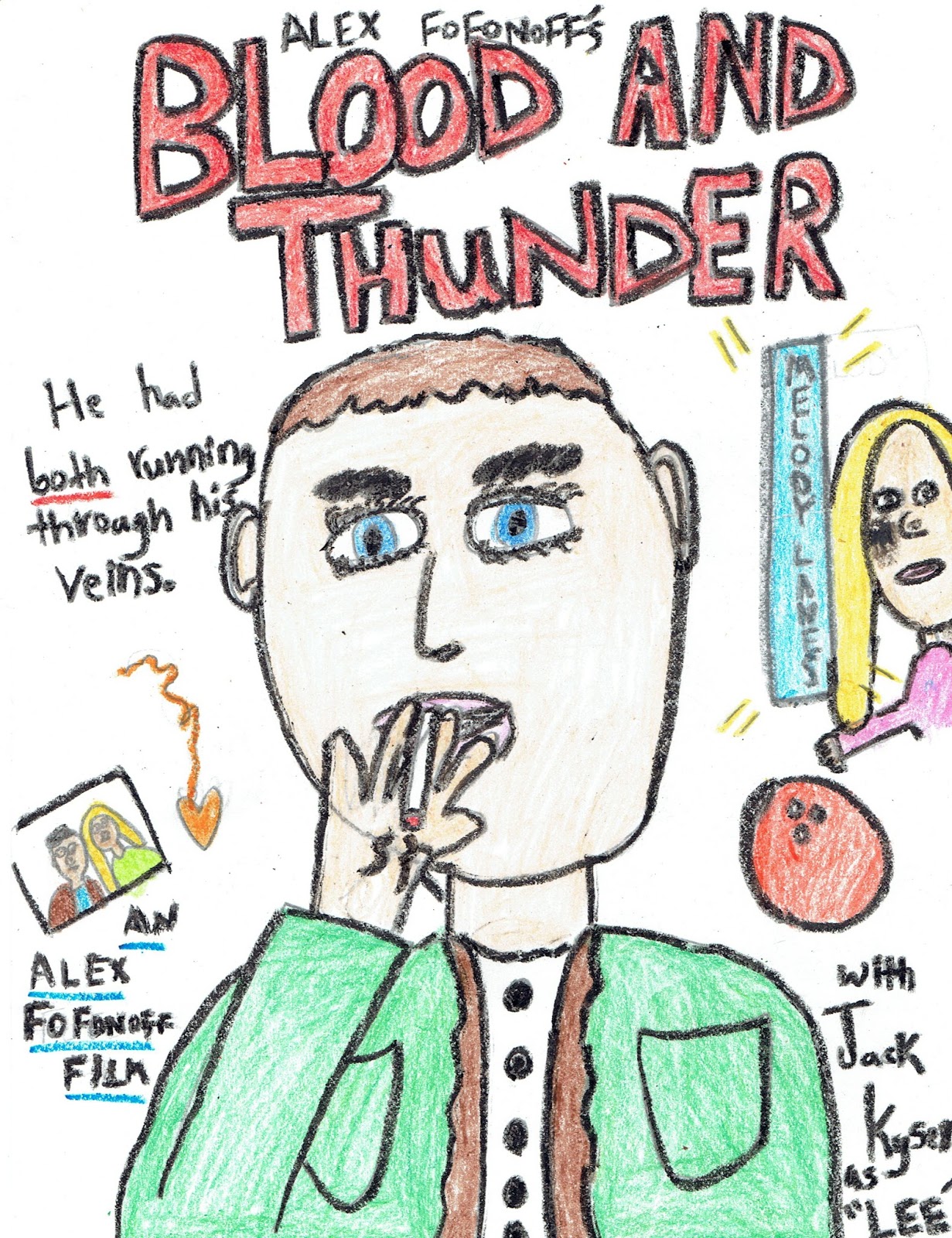 It's been a little while since my last blog entry, but I'm back! Near the end of last year, I made an acting reel, mainly comprised of footage from Alex Fofonoff's Blood and Thunder (in which I starred) and my films Jack and Lucas Go To A Wedding, Jake the Cinephile and With Love, Marty. Take a look below if you're interested, and please share - I'd love to get more acting work (if anyone needs a Jack-like character in their movie, I'm your man!) Look for memorable appearances by excellent acting partners like Desi Domo, Alexis Gay, Bethany McHugh and Lucas Loredo. Thank you to Bobb Barito for his sound design and to Alex for so much great footage from Blood and Thunder.
 My friend Marissa Rutka has a great new web series titled Coffee Catch-Ups that's online now, and it was a lot of fun to be a part of the production (and a subject in the series). You can find the two episodes where I'm featured before - in the first, Morgan Ingari and I recount the eye-watering events of Hurricane Sandy, and in the second, I go into Jake the Cinephile mode and offer out my rather obsessive-compulsive idea of perfection. Keep watching the series for more memorable guests and friends, like Charlotte Arnoux, Adam Boese, Nick Tanis and Emmy-winning guest star Jon Annunziata. The series was also nominated in the Documentary & Factual category of T.O. Webfest and will play at their festival later this month, so that's exciting!


 In February, Joel and Ethan Coen released their latest masterpiece, Hail Caesar! Josh Brolin, in his third collaboration with the Coens, leads a hilarious ensemble cast, and the picture is a treat for anyone who loves classic cinema. The Coens have a great time paying homage to classic studio films from the 1950s. They're also two of the only major American filmmakers to deal seriously with religion in their films. Hail, Caesar!, which begins and ends with Eddie Mannix (Brolin) in confessional, is fascinating when you consider the minor sins for which he atones, as opposed to the things he doesn't confess. He doesn't give a second thought to anything slightly immoral that involves running Capitol Pictures more effectively, whereas smaller things, like having an occasional cigarette, weigh on him heavily. This is a dense film, and worth seeing multiple times. Every film from the Coens is like a puzzle, and as you're watching it, you know the pieces are going to add up to something brilliant, but part of the fun is trying to determine how seemingly throwaway scenes contribute to the overall picture.


