Showing posts with label Mike Cheslik. Show all posts

Monday, February 3, 2025

My Favorite Films of 2024

2024 had a lot to live up to after the banner year for movies that was 2023 (which was led by two towering achievements, Martin Scorsese's Killers of the Flower Moon and Christopher Nolan's Oppenheimer). But while there were fewer stone-cold masterpieces than the year before, the depth of quality films may have been stronger in 2024. Beyond last year's outstanding Top 10, I struggled to find a slew of worthy near-misses. This year, there are at least fifteen additional feature films that were of considerable merit - along with two short films with personal significance, which receive a tongue-in-cheek Special Jury Prize.

1. The Brutalist (Brady Corbet)

"No matter what others try to sell you - it is the destination, not the journey." 

Watching the epilogue of The Brutalist, I thought of all the lifetime achievement awards shows I’ve seen over the years, and what horrors must get glossed over in the pomp and circumstance of celebrating an artist's life. Over the course of three and a half hours, we witness the harrowing journey of Hungarian architect László Tóth (Adrien Brody), and there is something truly powerful about intimately experiencing the warts and all portrait of this man's life, and then jumping ahead to a gaudy, chic Italian event that eschews the ugliness that came before. 

The First Venice Biennale, 1980 (as the film's epilogue is titled) shows us a gala in which it feels as if Tóth's masterworks of architecture were just inevitably going to happen, without much reflection on the torturous, decades-long process of making them. It's this dissonance between the painstaking process of becoming and the jubilant celebration of having made it that lends so much power to the ending of Brady Corbet's monumental film. And that final line of dialogue, which seems to have mystified some critics, is the key to what it's all about.

I saw The Brutalist on a beautiful 35mm print at the Austin Film Festival last year, and I knew immediately it was a film that demanded to be seen more than once, ideally with an architect by one's side (luckily, I married one last October, and it was a treat to see the film again with her when it opened). In terms of scope and style, it's tempting to compare The Brutalist to one of Paul Thomas Anderson's twin American epics, The Master (2012) or There Will Be Blood (2007), but ultimately this thing is its own, strange beast. Corbet has enormous confidence in his vision - the movie is characterized by long, unhurried scenes and an unrelenting conviction that the audience will stay with this decades-spanning, often grueling story until the very end. And they do.

The Brutalist is also, in part, a film about who gets credit or acknowledgment for what. The climactic point of the film is Tóth's wife Erzsébet (Felicity Jones) defending her husband’s honor - and then we jump ahead twenty years to an event honoring him with only a passing mention of her. I find it interesting that a husband and wife team (both of them filmmakers) wrote this movie together; in fact, in the film's opening titles, the credit reads "By Brady Corbet and Mona Fastvold," essentially giving authorship to both of them.

A testament to the power of artistry, both in its portrait of the fictional László Tóth and in its very miraculous existence, The Brutalist gives me hope that great American movies are still possible, against all odds.

2. A Complete Unknown (James Mangold)

Given that the best Bob Dylan biopic already exists (Todd Haynes's I’m Not There) and this genre was blown to shreds by Walk Hard: The Dewey Cox Story (2007), I was fairly skeptical of A Complete Unknown in the months leading up to its release. But I’ll be damned if James Mangold didn’t knock this one out of the park, sidestepping many of the musical biopic conventions he immortalized with Walk the Line (2005) nearly twenty years ago.

The first thing A Complete Unknown does right is refuse to explain away Dylan’s behavior and persona through some simplified backstory. Instead, the movie adopts the ethos of Dylan himself (brilliantly portrayed by Timothée Chalamet): “Life isn’t about finding yourself, or finding anything. Life is about creating yourself, creating things.”

While the film (correctly) doesn’t try to force a traditional character arc onto our protagonist, Dylan does undergo an evolution over the course of the movie. Mangold’s strongest choice is bookending the film with Dylan’s visits to Woody Guthrie (Scoot McNairy) in the hospital. Yes, our boy goes electric by the film’s end, and no, he won’t apologize for it - but he hasn’t abandoned his roots. He hasn’t forgotten the person who drew him to this profession in the first place. And the fact that the mostly nonverbal Guthrie is the only person not projecting anything onto Dylan makes theirs the purest relationship in the movie.

I was also delighted to find that this is a true ensemble piece. Yes, Dylan is front and center, but including Pete Seeger (Edward Norton) as a central character is critical to the audience understanding the divide between folk and electric. I felt great empathy for both sides of this debate - I want Dylan the artist to feel free to express himself and not be boxed in by the demands of his audience, and I also understand Seeger’s desire to preserve the integrity of his folk festival, which exists to champion a musical tradition in danger of disappearing.

More than anything, A Complete Unknown respects the music. Dylan has written many of the greatest songs of all time, and this movie allows us to hear them. The vinyl of this film's soundtrack has been playing on repeat in my apartment the last few weeks, and I suspect the eventual Blu-Ray release will do the same.

3. Hundreds of Beavers (Mike Cheslik)

It's a thrill to see one of my closest friends, Mike Cheslik, deliver the most original and acclaimed independent film of the year. Mike has been pushing the limits of narrative comedy for years, and all of his prior work comes to a head in his one-of-a-kind masterpiece Hundreds of Beavers

Human cartoon Ryland Brickson Cole Tews plays Jean Kayak, a 19th century applejack salesman and fur trapper mired in a never-ending battle against beavers (played by human actors in animal mascot costumes). Beavers is a black-and-white, dialogue-free film (though hardly silent, with its stupendous sound design by Bobb Barito) - an absolutely unhinged fusion of slapstick comedy, Saturday morning cartoons, and video games, topped with a splash of Guy Maddin and The Simpsons (at one point, Jean Kayak has the misfortune of getting the Lionel Hutz of beaver lawyers). 

Mike has said that micro-budget filmmakers can't compete with studio movies, so his films have to look and feel like something else entirely - in other words, the work has to be noticeably indie. Hundreds of Beavers has become a sensation precisely because there's absolutely nothing else that looks, sounds, or feels like it in the cinema climate today.

4. Juror #2 (Clint Eastwood)

In my view, Juror #2 is a film about the transference of guilt. The win-at-all-costs, morally compromised character at the film's beginning (Toni Collette's Faith) gains the backbone initially possessed by our protagonist (Nicholas Hoult's Justin), while the reverse is true of Justin. The film feels and looks like a top tier John Grisham courtroom drama from the 1990s (I mean that as a high compliment), but as we get closer to the end, we realize Eastwood's after something bigger than the film's subgenre would suggest.

Guillermo Del Toro described Juror #2 as Clint Eastwood's take on Woody Allen's Crimes and Misdemeanors (1989), and that feels apt. The final haunting shot of this film is something that will live in my brain for a long time. If this were the closing chapter to Eastwood's unparalleled career, it would be a stunning finale. Thank God the tireless 94-year-old workhorse is already preparing his next movie.

5. Hit Man (Richard Linklater)

Richard Linklater's latest film is a huge argument in favor of seeing a movie with a big audience. At Austin Film Society Cinema, the film played like gangbusters, the audience riding high on its comedic wavelength at every turn. It's too bad, then, that most people watched Hit Man in their living rooms after the film received one of Netflix's token week-long theatrical releases in a handful of theaters.

Listening to Linklater talk about Hit Man in a post-screening Q&A, it was astonishing to me that studios didn't see the inherent commerciality of this movie, particularly with Glen Powell in the lead. It's a frustrating and dispiriting cinematic landscape where Hit Man isn't considered a surefire wide release hit.

6. The Order (Justin Kurzel)

After driving to the outskirts of Austin to see the lone cinema showing Clint Eastwood's Juror #2 (don't get me started on how Warner Bros. has treated him this past year), I took another drive outside the Austin city limits to see another compelling adult drama starring Nicholas Hoult that was been banished from most theaters due to it not being a candy-colored piece of disposable IP.

In Justin Kurzel's The Order, Jude Law gives us a lead character straight from the Jake Gyllenhaal in Prisoners (2013) school of law enforcement protagonists. We don’t need this guy's entire backstory - the character is fascinating enough as he is that we’re hooked from the get-go, nosebleeds and all.

The most disturbing thing about The Order is how relatively normal the white supremacists are. When Law and Hoult come face to face mid-movie, Law doesn’t even peg the handsome young man as a potential suspect. These aren’t the bucktooth rednecks we’ve come to expect in these types of films - they’re organized, fully functional individuals who split their time between hosting backyard family barbecues and robbing armored cars to bankroll their fanatical cult.

7. Coup de Chance (Woody Allen)

For his 50th film as writer and director, Woody Allen decided to shoot an entire movie in the French language - and it's a damn good one. Although there are echoes of Crimes and Misdemeanors and Match Point (2005) here, Coup de Chance is a little lighter on its feet than those films. It's been a treat to see Allen's visual style evolve over the course of his working relationship with cinematographer Vittorio Storaro, which now spans five films. This is their strongest collaboration together since Wonder Wheel (2017), and, like other movies on this list, it's a shame the visual splendor wasn't widely available on the big screen.

8. The Apprentice (Ali Abbasi)

The Apprentice wasn't a movie many people wanted to see before last year's U.S. presidential election, and I'm not certain if many people want to see it now, either. But I have a feeling the film will age very well. Utterly horrifying without ever succumbing to moralization, The Apprentice is also remarkable for the shreds of humanity it manages to find in its lead characters. Both Sebastian Stan and Jeremy Strong are outstanding as Donald Trump and Roy Cohn. I left with an icky feeling that’s going to be hard to shake.

It was interesting to see how afraid people were of this movie. Nobody wanted to release it. One of the best things to happen this award season was Stan and Strong both receiving much-deserved Oscar nominations for their performances. Someone needed to make this movie, and in our current cinema climate - where to take a risk means alienating a shareholder - Ali Abbasi went out and made the movie everyone else was too scared to make. 

9. Conclave (Edward Berger)

A film so compelling, I watched it twice in one day! Conclave is a spirited debate on the future of the Catholic Church, with phenomenal performances by Ralph Fiennes, Stanley Tucci, Isabella Rossellini, and John Lithgow.

For a movie that alternates frequently between English and Latin, why would Prime Video not offer an option for English subtitles only when characters speak Latin (IE, the subtitles that are actually burned into every Conclave DCP that played in the U.S.)? There are a multitude of frustrations to be had with streaming (the inability to watch a film's end credits without being greeted by recommended titles, the dipping in and out of resolution no matter how strong an internet connection, the burial of older films), but weird subtitle inconsistencies is one that often gets overlooked.

10. Megalopolis (Francis Ford Coppola)

Five stars for the sheer audacity of this thing alone. There is simply never going to be anything this batshit crazy allowed in IMAX cinemas again, but boy am I glad it confounded unsuspecting audiences everywhere. Look, at this point, I’m hungry for any movie that doesn’t feel like it was vetted by a corporate board, for better or worse. And the only possible person who could’ve vetted this movie is the madman genius Francis Ford Coppola, and it feels like he got to make exactly the movie he wanted to make.

As for the content of Megalopolis, I was struck by the film’s earnestness and good faith attempts to start a conversation about the future of humanity, both between its characters and its audience. I think the movie could have benefitted from a more robust exploration of the characters’ competing visions for the future - I mean, I understand what they represent individually (Adam Driver = utopian dreamer, Giancarlo Esposito = status quo, Shia LaBeouf = populist fearmonger), but the movie doesn’t explore how and why they think their visions will provide a better future for generations to come.

But, ultimately, I was so damned entertained by Megalopolis that I didn’t mind. This is an insane anomaly of a movie, and I’m here to celebrate its existence.

Special Jury Prize #1


Rusty Lightnin' Kick Starts (Jack Kyser)

All right, I made this movie, and it's seven minutes long, and it's not really a movie at all - it's a proof-of-concept for my forthcoming feature film Rusty Lightnin'. But I've screened it quite a bit this past year, and as such it's my most viewed film of 2024. That has to count for something, right?

Special Jury Prize #2

De Niro, New York 
(Sam Gill, Luke Neher)

In order to explain what the dreamlike, kaleidoscopic De Niro, New York installation/ six-screen immersive short film is, exactly, I have to offer a mini-diary of my day at De Niro Con at last year's Tribeca Festival (which is exactly what it sounds like - Comic-Con for fans of Robert De Niro). I won’t bury the lede here. I had the opportunity to ask De Niro a question during his Q&A with artist JR, which I was not expecting (they don’t often open these things up to audience questions). But the talk became something of a group therapy session (it was billed as a discussion of “art, family and film” - but it went really hard on the “family” part, with De Niro speaking candidly about his relationship with his father and the legacy he’ll leave behind for his children). 

After watching a beautiful excerpt from a new film De Niro and JR are making together and listening to the two men touch on a number of personal matters, a line of people formed in front of a microphone close to the stage and, one by one, began sharing stories about their fathers (and yes, I was one of them) and asking De Niro to share memories of his own. He sat there patiently, gamely participating in this Father’s Day Emote-a-con, truly empathetic to each speaker, occasionally getting choked up himself. Hell, even Spike Lee got a turn at the mic, speaking about his late father Bill Lee. It was a surreal experience. 

My question for De Niro was about whether, in digging through his father’s archives and working on this new autobiographical project, he had been able to fill in any of the gaps in his understanding of his dad. I shared that I had held close to little things of my father’s - letters, home movies, mementos - to help me put together a more complete picture of a man I will never fully know. 

De Niro replied, “You’re right. I mean, that’s why I keep saying we should do it as long as we need to do it. Things happen, you discover things, you learn about this, you learn about that. You know, it’s a process. And it’s more important… to get as much out of that as you can. I don’t mean exhaust it, but yes, I mean, it’s never ending, it seems to me. So the least you can do is do it for as long as you can without saying, ‘Well, we’ve got a deadline.’ That’s normal, that’s okay, I understand that. But in this thing, this is how I feel. So there are helpful revelations in all of that, even the stuff that JR just showed of me, it’s moving. So, it’s just that… if that makes sense?” I gave him an “absolutely, thank you very much,” and walked away the happiest person on earth. 

Okay, De Niro, New York. Outstanding work by Little Cinema (shoutout to Harvey’s Last Night on the Avenue breakout Max Pava for his work on this massive project). De Niro’s extraordinary body of work is in conversation with itself here. I watched the piece three times (for one viewing, I just picked the center of the six screens and only watched it). I really loved how Pava and his team used a lot of material from underseen recent-ish films (Everybody’s Fine, Being Flynn, The Wizard of Lies, etc.) and some of De Niro’s early Brian De Palma movies, too. Perhaps the most striking moment is of Travis Bickle staring in his rear view mirror on the center screen. You do a quick 180 degree turn, and on the opposite screen is steely-eyed Frank Sheeran sitting in a passenger seat, staring right back at Travis. Two De Niros, 43 years apart, engaging across space and time with one another.

The Rest of the Best:

11. A Different Man (Aaron Schimberg)
12. Made in England: The Films of Powell and Pressburger (David Hinton)
13. The Bikeriders (Jeff Nichols)
14. A Real Pain (Jesse Eisenberg)
15. The Secret Art of Human Flight (H.P. Mendoza)
16. Asphalt City (Jean-Stéphane Sauvaire)
17. The Last Stop in Yuma County (Francis Galluppi)
18. Anora (Sean Baker)
19. Saturday Night (Jason Reitman)
20. Daddio (Christy Hall)
21. September 5 (Tim Fehlbaum)
22. Dune: Part Two (Denis Villeneuve) 
23. Knox Goes Away (Michael Keaton)
24. Horizon: An America Saga - Part One (Kevin Costner)
25. Evil Does Not Exist (Ryūsuke Hamaguchi)

Honorable Mention (a.k.a. My Wife's Favorite Movie of the Year):
The Fall Guy (David Leitch)

Saturday, July 13, 2019

A Trailer for Harvey's Last Night on the Avenue and More!

Since I last updated this blog, I have finally picture-locked the film that has consumed much of the last three years of my life, Harvey's Last Night on the Avenue. Production on the film wrapped two years ago, but various commitments - my job at Comedy Central, another (since-finished) film I directed for hire, development on a feature screenplay (see more details below) - have made for a lengthy post-production period. But no more! The film is edited and, once the color-correction and sound design are completed this summer, it will be a finished film - and I'm incredibly excited to share it with the world.

Last summer, I released the first trailer for the film. Here it is below, showcasing the work of the immensely talented ensemble cast. If you enjoy it, please feel free to share it far and wide!


Harvey's Last Night on the Avenue Trailer from Jack Kyser on Vimeo.

Where do I even begin with the folks who made this movie possible? Mike Wesolowski (who also co-wrote the film) leads an amazing cast which includes Justin Danforth, Allison Frasca, Max Pava, Taylor Marie Frey, Aubrey Elenz, Michael Galligan, Jamie Wolfe, Matt Davis, Connor Delves, Justine Magnusson, Matt Borruso and Zachary Gamble. Watch out for brilliant cinematography by Kevin Dynia, the impeccable sound design of Bobb Barito and the astonishing color stylings of Ben Dewey! And I can't begin to thank the rest of our crew - producer Alex Fofonoff, assistant director Matthew James Reilly, script supervisor Lain Kienzle, production sound mixer Nick Chirumbolo and so many more - for their hard work.

Last December, the other film I directed, Four Play, won the Audience Award at the Iron Mule Comedy Film Festival at New York City's Alamo Drafthouse. It was a great screening of comedy shorts, and honestly a bit surreal to see something I directed in the same cinema where I frequently watch first-run films. The film's writer, producer and star, Ben Krevalin, was also on hand to speak. On a side note, I have no idea who wrote my bio in the program, but bless them for including all of these great things I haven't done (see above).

Last fall, I started taking Advanced Scene Study classes at HB Studio in Manhattan, under the direction of Austin Pendleton. It's been a great way to keep active as a performer and work with a wide array of scene partners (since the fall, I've done scenes from Uncle Vanya, Hurlyburly, Days of Wine and Roses, American Buffalo and Summer and Smoke, among others). In particular, it's been a pleasure studying under Mr. Pendleton, whose career as an actor and director, both in film and theatre, is unparalleled (he was most recently on Broadway in this year's Tony-winning Choir Boy, which I saw in January).

All the while, I'm continuing to work on a feature screenplay with my dear friend Lucas Loredo about our experiences in high school theatre. We spent a week together last year in Austin, in a self-imposed writing "residency," outlining and structuring the screenplay (I wrote about our process in a blog post from last year). We made an extraordinary amount of headway last fall, when Lucas workshopped our script in his MFA screenwriting course at UT's Michener Center for Writers (Lucas just graduated in May from the prestigious three-year program). We held weekly phone conversations, in which Lucas relayed excellent notes from his class and professor, and passed drafts back and forth by email. The screenplay has come a long way, and it's my sincere belief that I'll be making this film in the near future.

I'm eager to cover more ground from the last several months, but I'll finish here with two highlights. In late September, Sophia and I spent a great weekend in Boston with some of the best folks I know. My college friends Jon Annunziata and Emma Viles were married in Danvers, Massachusetts at Glen Magna Farms, and the wedding was a delightful film school reunion. We stayed at a hotel in nearby Wakefield, and before the wedding, we toured the Rebecca Nurse Homestead, a colonial house and museum (Nurse was executed during the Salem Witch Trials in 1692). I also had a chance to eat at the equally historic Wahlburgers (a burger joint owned by Mark Wahlberg and his brothers) in a shopping center near our hotel.

The wedding itself was magnificent, featuring a live band (to my great delight, they played I'm Shipping Up to Boston) on a beautiful estate, and I was surrounded by a group of truly amazing people. The morning after the wedding, we attended a brunch at Emma's parents' house, and then Sophia and I headed into the city of Boston - to meet another one of the finest married couples in human history, Austin and Grace Kingsbery. Austin is one of my best friends from high school (we were in a number of plays together as Red Dragon Players at Austin High), and I was overjoyed to attend his wedding six years ago with Lucas and Cora in Milwaukee (a wedding that very, very loosely inspired my film Jack and Lucas Go To A Wedding). He and Grace now live in Winthrop, and Sophia and I stayed with them on Sunday evening in their lovely home. We also met their newborn baby, Elias, who was adorable. Austin gave us a walking tour through the heart of Boston in the afternoon (Sophia had never been to the city before), and then we met Grace and Elias for a lovely dinner in Winthrop.

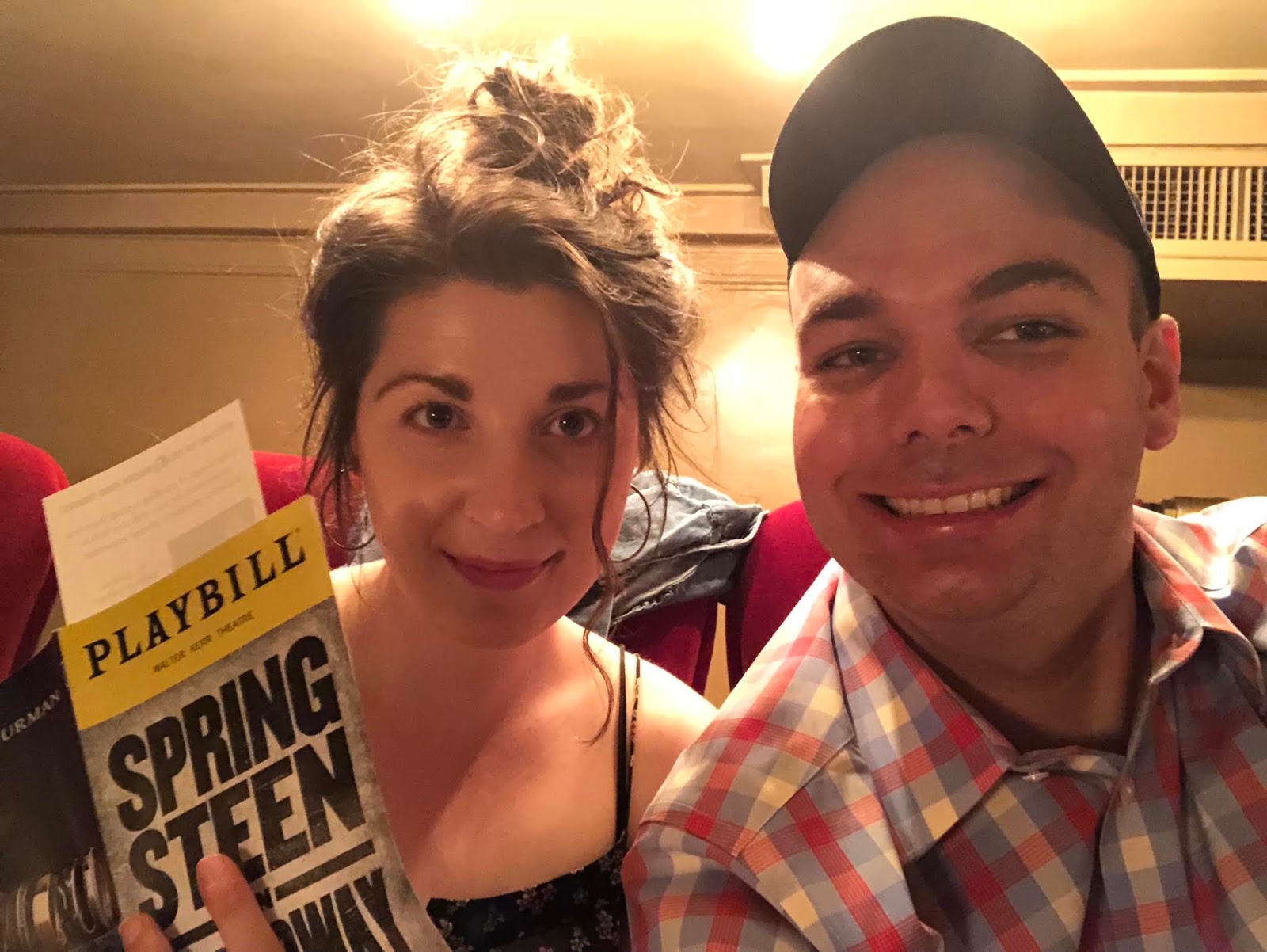
The other highlight comes from exactly one year ago today, when Sophia and I were able to see Springsteen on Broadway at the Walter Kerr Theatre. As soon as it was announced Bruce Springsteen was holding a residency on Broadway,  I had desperately been seeking tickets. It wasn't until the show was extended for a second time that I was finally able to secure seats, and we saw a glorious performance on Friday, July 13th, 2018.

The show was a near-religious experience – even from the back row, you could feel the power and resonance of Springsteen's every word. Songs I’ve known for what feels like my entire life are given new meaning and context, with added insight into the role they play in Springsteen’s life. I was hearing My Hometown, Thunder Road, My Father's House, Tenth Avenue Freeze Out and so many others in a whole new way - I was really listening to those lyrics like never before. The sections on his mother and father brought tears to my eyes - both his father’s quiet desperation and his mother’s strength and vitality spoke to me so strongly.

He also spoke to the fact that his most popular songs so rarely stemmed from his direct experience (he’s never stepped into a factory in his life, he says), but rather from observation and studying folks like his parents. 

Springsteen on Broadway is a self-biography concerned not with accomplishments, accolades and hit records, but with fleeting and powerful memories amassed over a lifetime. And with each new chapter of his life, I felt like I was there – the details and imagery in each story are as evocative as the song that accompanies them. This man has shaped the way I think, feel and relate, and his words and music will never leave me.

Before I depart, I'd love to mention a new film made by two of my friends, Ryland Brickson Cole Tews and Mike Cheslik. They're currently on the film festival circuit with Lake Michigan Monster, which is an explosion of creativity, some kind of cross between a Guy Maddin fever dream and Tews and Cheslik’s animated web-series L.I.P.S. (in which I admittedly appear as a relaxed man living inside an alien's eyeball) – and yet neither comparison does justice to this picture. There are sequences both hilarious and haunting, and an underwater third act that achieves a kind of poetic power in its abstraction and imagination.

Tews, as the erratic Captain Seafield, is a living and breathing cartoon (in the best possible sense of the word) – he supports the film’s manic energy from his very first entrance, inviting us along for the fun as he aims to avenge his father’s death by hunting down a mysterious sea creature. Cheslik’s effects work in this film is masterful – every frame is packed with extraordinary helpings of visual information, sight gags, and images both otherworldly and flat-out absurd.

You can feel when a film is made with love, and Lake Michigan Monster, with its immensely creative use of Milwaukee locales and a cast of amazing Wisconsin talent, practically brims with heart and soul. For all of its inspired lunacy (which had me in stitches for eighty minutes straight), I truly felt as if I had experienced some ancient Midwestern lore by the film’s end, as I hummed along to the elegiac original song “Dear Old Captain Seafield.” I am deeply, deeply proud to know the folks who made this film.

Thursday, September 14, 2017

The Rape of Recy Taylor, Mike Maynard, Four Play, Summer 2017 and More

Currently receiving rave reviews at the Venice Film Festival, my former boss Nancy Buirski's new documentary The Rape of Recy Taylor is soon being released, and it's sure to make quite an impression. Per Deadline's exclusive article on the film, the story is as follows: "This is the true story of a 24-year-old wife and mother who was gang raped in Alabama by six white men in 1944. The doc highlights the black women who waged war to take back their bodies and their dignity, and by speaking up helped inspire the civil rights movement that was to come." I had the honor of working on the extremely powerful film, both as one of the assistant editors and as the voice of one of the assailants. Despite the fact that I lent my voice to an unsavory human being, I'm thrilled to have a significant amount of voiceover material in the film (along with my friend and fellow actor Tommy Bernardi, who voices another of Ms. Taylor's perpetrators). The film was recently named by Variety as one of twelve hot titles likely to spark bidding wars. The Rape of Recy Taylor makes its North American premiere next month at the New York Film Festival, where I very much look forward to seeing the finished film. It just received a rave review from The Hollywood Reporter, and Nancy received the HRNS Special Prize for Human Rights at the Venice Film Festival. Nancy also had a great screening of her film The Loving Story this February on Valentine's Day, which was a particularly meaningful event for all involved.

Going back a little bit, Nancy's last film By Sidney Lumet (on which I was an associate producer and assistant editor) made its broadcast premiere on PBS/ American Masters on January 3rd. There was so much great press surrounding its broadcast, including this amazing review from the Wall Street Journal and New York Post interview with Treat Williams, star of Lumet's Prince of the City (1981), who participated in an interview after the broadcast with Buirski (I was part of the production team on the interview). The film is now available for purchase on Blu-Ray and DVD.

I want to tell you a little bit about Mike Maynard, who passed away on August 27th of this year. Mike was undoubtedly the most devoted supporter and champion of the Red Dragon Players at Austin High School, and, according to his obituary, attended 98 productions in total over his many years as our loyal friend. I say "our" because, although it's been eight years since I graduated from Austin High in 2009, there is a lifelong bond for many former students to this wonderful theatre department, and Mike was a major part of it all. I was in over twenty productions at Austin High, and I can guarantee you that Mike came to every single show, likely even more than once.

Billy and Annie Dragoo, our beloved theatre directors, would always tell our class the day after a performance what Mike thought of the production. I'm not sure I know the origins of his devotion to the department, but I know he and Dragoo became very close, and his opinion meant a great deal to everyone. I remember he was a particular fan of the play Someone Who'll Watch Over Me in 2008, in which I performed alongside the amazing Lucas Loredo and Ben Stelly. Mike continued to be a huge supporter for me personally after I graduated. Last year, when I was fundraising for my series Harvey's Last Night on the Avenue, Mike chipped in and helped make the film possible with a contribution. It was such a generous act, and I was profoundly moved. I last saw him when I was in Austin in May at a performance of Shrek at Austin High, and he was as ebullient and spirited as ever. I can't claim to have known him incredibly well, but his presence was always felt in the department, and he will be greatly missed. You can read his obituary here from the Austin American-Statesman.

I'd also like to mention my mother's godmother, Vera Lee Giles, who passed away earlier this year. She was a truly loving and vivacious woman, and I have such fond memories of various poker nights and Christmas celebrations at her house in Austin. I saw her earlier this year at her home, and as always, she was a force to be reckoned with.

I've travelled twice to Charlottesville this summer to visit my girlfriend Sophia's family, and it's a beautiful town. I stayed in colonial Williamsburg with my mom and dad several times when I was much younger, and also travelled near Marshall, Virginia to shoot some key scenes for Alex Fofonoff's feature Blood & Thunder, but I loved getting to experience another part of Virginia. The second time visiting Charlottesville over Labor Day weekend was considerably different than the first time, given the horrible tragedy that occurred in early August when a Neo-Nazi terrorist drove his car into a crowd of protestors, killing a young woman. I imagine the mood of the city has changed considerably after that terrifying act of violence, and I truly hope it is not a harbinger of any more violence in other cities in which these abysmal human beings choose to hold their white supremacist rallies.

Earlier this summer, I signed on to direct a new film that I did not write, which is a first for me. The writer (and producer, and lead actor) is Ben Krevalin, a talented guy who is a friend of a friend. I attended a reading of his piece, currently titled Four Play, and I was very excited by the prospect of directing the film. This cast includes a number of incredibly talented people, including Justin Danforth, who starred in Harvey's Last Night on the Avenue - I simply cannot wait to work with him again - and two amazing actresses, Lizzie Stewart and McLean Peterson. Ben successfully raised over $15,000.00 this summer through an IndieGoGo campaign, which you can see here, and we begin production the first weekend in October. It's a incredible opportunity to be in post-production on one film and simultaneously directing another new one.


On June 28th, there was a great screening of my film Jack and Lucas Go To A Wedding at Anthology Film Archives as part of NewFilmmakers New York. I screened my movie Jake the Cinephile there over three years ago, and it was great to be back. We had a nice-sized crowd with some folks who hadn't seen the movie before, so that was very gratifying.

At the end of May, I made a big apartment move - my first in four years - with my roommate Bobb, to another location in Brooklyn (which is not too far away from our old place). My mom, Gretchen, came up to New York, and we had a chance to do some fun things. We made our way to the Longacre Theatre to see the musical adaptation of A Bronx Tale. I was particularly interested in the production, as it was co-directed by my hero Robert De Niro, who directed the film on which the musical is based  (which, in turn, was based on an autobiographical, one-man play by Chazz Palminteri). Not only was I impressed by the musical, I was very impressed by the box seats we acquired (how that happened, I'm not sure - I picked up discounted rush tickets on the day of the performance). I also saw the musical Groundhog Day, which was a delight. The lead actor, Andy Karl, was pretty unbelievable, in a physically demanding and highly comedic performance. Sophia, her father and I also sweat Sweat by Lynn Nottage on Broadway earlier this year, which won the Pulitzer Prize for Drama - another excellent production.

I'm continuing the monthly meetings for my Fellowship with producer Richie Jackson, which is going very well. I had a great birthday last month - my twenty-seventh, which is hard to believe - and I was surrounded by dear friends. I caught a screening early in the day of Kathryn Bigelow's Detroit, which was masterfully directed and performed - I wouldn't expect anything less from Bigelow (and Annapurna Pictures, for that matter).

Last summer, I assistant-directed a short film entitled Mouse, written and directed by the very talented filmmakers Celine Held and Logan George. It was a wildly fun two-shoot that also presented some unsavory smells - as we had several real dead mice on set as props. This short film has been tremendously successful, premiering at SXSW in March (and following that premiere with several other major festivals) and then receiving a Vimeo Staff Pick in June. As I write this, it has been viewed by nearly 400,000 people on Vimeo. Here's the short below - I think you'll find it quite hilarious and disturbing in equal measures, and also masterfully made.


Mouse from ELO films on Vimeo.

Speaking of excellent films on which I worked, this year also saw the online premiere of Mike Cheslik's hilarious, wacko cartoon web series L.I.P.S. (or The League of Interplanetary Process Servers). I was the assistant director on this series three years ago, shortly before the production of Jack and Lucas Go To A Wedding (Mike was, in turn, my assistant director on that film, and his girlfriend Ani - who produced L.I.P.S. - was my producer). Filmed largely in a green screen studio, L.I.P.S. is another amazingly funny piece by Mike, and I was honored to play a small role in the series, as well, as a character with probably the most exciting name you can imagine - Relaxed Eyeball Dweller or [Indistinguishable Dissonant Noise]. I'll never get a better character name than that, period. Per Mike's synopsis, the series is about the League of Interplanetary Process Servers' finest agent attempting to deliver 30 subpoenas throughout the universe in ten minutes. Starring Ryland Brickson Cole Tews (a hysterical human being) and Allison Frasca (who is one of the leads in Harvey's Last Night on the Avenue), L.I.P.S. has screened at many film festivals around the country before premiering online. Here it is in its full glory:


L.I.P.S. from Mike Cheslik on Vimeo.

One major highlight from this past May was attending the 44th Chaplin Award Gala honoring Robert De Niro, organized by the Film Society of Lincoln Center. It was a great opportunity to celebrate the great man - from the nosebleeds, granted. Presenters and speakers included Martin Scorsese, Sean Penn, Harvey Keitel, Meryl Streep, Michael Douglas, Whoopi Goldberg, Barry Levinson and Ben Stiller. Afterward, in the lobby, I saw Michael Mann hanging around. It was that kind of night.

It's been quite a year for De Niro, who, in addition to the Lincoln Center tribute and the performances of A Bronx Tale, was a part of a Tribeca Film Festival talkback with the cast of The Godfather and The Godfather Part II as part of the film's 45th anniversary. This resulted in one of the greatest reunion pictures of all time, with De Niro, Al Pacino, Francis Ford Coppola, Robert Duvall, James Caan, Diane Keaton and Talia Shire. I can't believe I missed it. It's worth watching the full 90-minute talkback here. In February, his new film The Comedian, directed by Taylor Hackford, was released. The film overall has its problems, but De Niro is fully committed, and it's a joy to see him share scenes once again with Keitel. Then, in May, he gave his best performance since Silver Linings Playbook (2012) in Barry Levinson's The Wizard of Lies, the fascinating and absorbing true story of Bernie Madoff. The film was made for HBO, but it has more quality and substance than most theatrical releases. I don't understand how this wasn't a major studio film.

And then, the big news - Scorsese's mob epic The Irishman recently went into production. It's currently shooting in New York (including in front of my old Broome Street apartment, apparently), and as expected, the film stars De Niro, Pacino, Keitel, Joe Pesci, Bobby Cannavale, Ray Romano and Stephen Graham (Pesci was apparently a hold-out, but he came out of retirement). I feel quite certain that there is nobody on this planet more excited for The Irishman than me. And it's already rumored that, following The Irishman shoot, De Niro and Scorsese could make Killers of the Flower Moon next year with Leonardo DiCaprio (that's very speculative, though).

There were some recent deaths of artists who meant a great deal to me, chief among them Sam Shepard. One could organize the greatest theatre and film festival in the world with the written works and performances of Shepard. Start with The Curse of the Starving Class, A Lie of the Mind and Buried Child, then move on to Days of Heaven (1978), The Right Stuff (1983) and Mud (2013). Then, for the great supporting performances, go on to The Assassination of Jesse James by the Coward Robert Ford (2007), Baby Boom (1987), Black Hawk Down (2001), The Pledge (2001), Midnight Special (2016) and Out of the Furnace (2013). What a talent. I participated in a reading of The Curse of the Starving Class last December with my good friend and fellow Red Dragon Player Cora Walters, in which we played Weston and Ella. That text is absolutely incendiary from start to finish. And then there's Jerry Lewis. I just watched his brilliance performance again in Martin Scorsese's The King of Comedy (1983) in July. He was a genius in every film - the two I enjoyed most (at my grandmother's house in Hallsville, I remember distinctly) were The Nutty Professor (1963) and The Disorderly Orderly (1964), which has an ending so funny I remember nearly crying.

Earlier this year, there was another heartbreaking loss - one of the greatest of all directors, Jonathan Demme, passed away. I met Demme when I was twelve years old at the Austin premiere of The Truth About Charlie (2002) at the Paramount Theatre. I gave him a copy of my weekly film review article in the West Austin News, and I told him how much I loved The Silence of the Lambs (1991). He laughed and was surprised that someone my age had seen that film. I believe my mother must have interjected in there, saying she supervised my seeing it. I saw him again last year at the Tribeca Film Festival for the panel after the By Sidney Lumet screening - I remember giving him his badge and seeing that same smile that emanated generosity. He was such a great filmmaker - from the crazy energy and life of Something Wild (1986) to the haunting melancholy of Philadelphia (1993), from the reinvention of a film classic with The Manchurian Candidate (2004) to the reinvention of his own career with Rachel Getting Married (2008) - and that's not even getting to his music documentaries!

Then there was the cinematographer whose images have inspired me more than any other photographer - Michael Ballhaus. We shared a birthday, which I discovered rather recently, and that brings me great joy. He photographed many films by Rainer Werner Fassbinder (I'm ashamed to admit I haven't seen any of those films yet), and then moved on to American films, collaborating with Scorsese on seven pictures - After Hours (1985), The Color of Money (1986), The Last Temptation of Christ (1988), Goodfellas (1990), The Age of Innocence (1993), Gangs of New York (2002) and The Departed (2006). His cinematography was exhilarating, to say the least, and the fact that he never won an Academy Award is astounding. He shot many other films (I recently re-watched Robert Redford's Quiz Show, and there again was his energetic camerawork), and it's truly sad we won't see another Ballhaus-shot film again. Here's Scorsese on his frequent collaborator.

Another major Scorsese collaborator, Frank Vincent, passed away this past Wednesday. He gave iconic performances in three Scorsese pictures - as Billy Batts in Goodfellas (1990), Salvy in Raging Bull (1980) and Frankie in Casino (1995). His interactions in these films with Pesci were particularly memorable (the two actors had a long history together, even working as a comedy act in the 1970s). He starred in countless other films, including Do the Right Thing (1989) and Cop Land (1997). There aren't many actors who were in four of my top thirty favorite films, but Vincent was one of them. Now go home and get your f#$%ing shine box! 

Bill Paxton, a Texan, was a welcome presence in so many films, and a great director, too, as he proved with the under-seen Frailty (2002). Robert Osborne was the face of Turner Classic Movies and a trusted voice in cinema. John Hurt, the brilliant star of The Elephant Man (1980), passed away this year, as well. He had just given a great supporting performance last year in Jackie, and always was a pleasure to watch in films as varied as Alien (1979), Heaven's Gate (1980), Owning Mahowny (2003), V for Vendetta (2006), Tinker Tailor Soldier Spy (2011) and Snowpiercer (2014). Time Magazine film critic Richard Corliss died, too - in addition to being a great critic, he wrote a fascinating book titled Conversations with Scorsese, which is exactly that. The late Martin Landau was so memorable in, among many other films, Ed Wood (1994), North by Northwest (1959) and Crimes and Misdemeanors (1989).

Speaking of Scorsese, the Museum of the Moving Image held a career retrospective of his work this spring, and he was the subject of an incredible exhibit at the museum that was, quite simply, overwhelming in its thoroughness and one of the most extraordinary exhibits I've ever seen. Because I was heavily in the midst of pre-production on Harvey's Last Night on the Avenue, I only visited the exhibit twice (which seems sacrilegious to a die-hard Scorsese fan like me). In fact, there were both Scorsese and Robert De Niro retrospectives going on in New York at the time, and I had to be making a movie right during them. At the Scorsese exhibit, I found I couldn't possibly absorb everything it had to offer. I could have gone back five more times, at least. The first time I went, I followed it by attending a screening of Alice Doesn't Live Here Anymore (1974) in 35MM with Sophia and her friend Erin (who works at the museum), followed by a Q&A with its Oscar-winning star (and one of the greatest actresses of all time) Ellen Burstyn. The second time I went, I followed it by attending a screening of The Last Waltz (1978) in 35MM, which was introduced by Scorsese himself. I had never seen either of these masterful Scorsese films on the big screen, so that was a real treat. The film I wish I had seen in 35MM was Bringing out the Dead (1999), one of Scorsese's best and less talked-about films - it's not the kind of movie that screens often theatrically, so I may have missed my chance on that one.

For this post's final mention of a Scorsese screening, Sophia and I went to an outdoor screening of my favorite film, Goodfellas, earlier this month at a place called the Knockdown Center in Queens. I couldn't help but thinking - we weren't that far from where the events in the film took place. There was live music before the screening and during a brief intermission. All in all, it was a nice time.

It's been a particularly good summer at the cinema (aside from poor audiences, who simply can't stop talking during films), with several new pictures from auteurs that make going to the movies such a pleasure. The best of the best included Christopher Nolan's Dunkirk (look for my upcoming review); the aforementioned Detroit; the Safdie Brothers' Good Time (Robert Pattinson is on fire, starring in two of the year's best films - the other being The Lost City of Z); David Lowery's A Ghost Story, a profound meditation on the nature of time, with a wonderful Casey Affleck and Rooney Mara; Sofia Coppola's The Beguiled, which won her the Best Director prize at Cannes; Wind River, another winner from Taylor Sheridan, this time directing in addition to writing, and with a killer performance from Jeremy Renner; Ingrid Goes West, 2017's answer to The King of Comedy and the perfect use of Aubrey Plaza; Patti Cake$, a real surprise (after not connecting with the first twenty or so minutes, I did a huge 180 turn and was won over); Edgar Wright's Baby Driver, full of energy and music; Michael Showalter's The Big Sick, with a perfectly cast Ray Romano and Holly Hunter; the Netflix release of Bong Joon Ho's very entertaining Okja; and Ana Lily Amipour's batty and wild The Bad Batch. All in all, a pretty great bunch of films. And that's not even discussing the spring highlights, chief among them James Gray's exquisite The Lost City of Z (the best film of the year and one hell of an adventure - my full review is on its way, but for now, read this Vulture piece on Gray) and Terrence Malick's Song to Song, which I thought was even stronger than his Knight of Cups (2016) and To the Wonder (2013), both of which I loved.

But I haven't gotten to the two biggest surprises, for me, of the summer - Steven Soderbergh's Logan Lucky and Dave McCary's Brigsby Bear, both movies I now adore. I'll be posting full reviews of both in the near future, but let me just say that Logan Lucky, in particular, is an absolute pleasure. In fact, I think my favorite performance and movie character of 2017 so far is Daniel Craig as Joe Bang.

There are lots of movies I can't wait to see this fall, including new films from Paul Thomas Anderson, Steven Spielberg, Lynne Ramsay, Clint Eastwood and Woody Allen. Here are trailers for three films in particular I know I'll love - Alexander Payne's Downsizing, Richard Linklater's Last Flag Flying and Noah Baumbach's The Meyerowitz Stories (New and Selected).

The awards season this past year was a crazy one, but a lot of worthy films won well-deserved accolades in the process. I was overjoyed that Casey Affleck and Kenneth Lonergan both won Academy Awards for their monumental work on Manchester by the Sea, and Emma Stone and Viola Davis won Oscars for outstanding performances, as well (for La La Land and Fences, respectively). And although I would have personally picked Manchester by the Sea for Best Picture, Moonlight is a spectacular choice (the infamous botched announcement overshadowed the importance of the film's win - although I will continue to defend Warren Beatty, who had nothing to do with it so far as I can tell).

The major omission by nearly all awards bodies was the exclusion of Martin Scorsese's Silence, a film that deserved so much more. It was nominated for one Oscar - a well-deserved nomination for Best Cinematography - but should have easily received nominations for Best Picture, Best Director, Best Actor (Andrew Garfield, who was actually nominated for a different film, Hacksaw Ridge), Best Supporting Actor (Liam Neeson), Best Adapted Screenplay, Best Editing and Best Production Design. Glenn Kenny's piece on the strong simplicity of Silence is worth reading, as are many other articles on Scorsese and his process.

Until next time - and remember, as always, to shut the hell up during movies.

Friday, June 21, 2013

Film Reviews - Frances Ha, Stories We Tell and To the Wonder


Spoiler warning for all three films reviewed below.

Frances Ha

As soon as Noah Baumbach’s Frances Ha ended, my friend Mike Cheslik turned to me and said it was his favorite film of the year. I have to agree, although Jeff Nichols’ Mud and Ramin Bahrani’s At Any Price are up there for me, too. I saw this film at the perfect time in my life. It’s amazing to me how many movies can inspire maybe only a few thoughts or feelings, and then one dense eighty-six minute film like Frances Ha can address so many of my anxieties and fears in such an artful and graceful way. This is the loveliest and most delightful film I’ve seen in a long time. What follows are our collective thoughts on the film, including many aspects of the film Mike noticed and admired. 

We both watched the movie nodding and smiling throughout, recognizing our own behavior in Frances, the wonderful lead character played by Greta Gerwig, an aimless and good-hearted post-graduate young woman moving from address to address in New York City, dealing with the changing nature of her relationship with her best friend Sophie (Mickey Sumner) and struggling to make her way into a dance company.

Where to start with what this movie gets right? There’s not a central romance in Frances Ha - we’re not given a lead character who is constantly successful in relationships. Frances is one of the most refreshingly honest and unconfident characters in a long time, apologizing for how she’s speaking while she’s still speaking and always openly critical of herself. Characters in films rarely talk like this or behave this way.

When Frances goes out to dinner with another, more successful dancer in her company, Rachel (Grace Gummer) and some of Rachel’s friends, someone describes Sophie as incredibly smart and brilliant. Frances laughs at this, pointing out that, having lived with Sophie, she isn’t really smarter or more brilliant than anyone else. Immediately, Frances feels guilty for saying this, and apologizes for talking poorly about her best friend. And you get the sense that Frances – one of the sweetest and most genuine characters in recent years – is going to spend the rest of the evening thinking about how she badmouthed Sophie, when the others probably won’t give it a second thought.

This moment is so wonderful because Baumbach and Gerwig let Frances express a common annoyance – when perhaps you know a friend well and someone starts going on and on about how “brilliant” and “smart” that friend is (when you know that there’s not necessarily an extraordinary brilliance behind your friend’s exterior) – and then immediately Frances becomes conscious of her own badmouthing and apologizes.

Baumbach and Gerwig take it a step further, though. Although we’re meant to see Frances as the awkward character at the dinner party making constant social faux pas, the filmmakers later give room for Rachel to tell an off-color joke that does not go over well at all with anyone. “Yes!” Mike shouted after the movie. The film allows for all of its characters to have social faux pas! How often do you see a movie that allows for so many of its characters to be, you know, human beings? Kenneth Lonergan’s Margaret does it exceptionally well, but there aren’t many other great examples.

There’s a beautiful speech that Frances gives at the same party, in which she explains that what she desperately wants from a relationship is that feeling you have when you’re at a party, and you look across the room at your significant other. As you make eye contact with your partner, there’s a shared moment of contentment between both of you, the knowledge that you’re together even when you’re on opposite sides of the room. It’s the most moving and beautiful moment in the film. At the end, when the movie honestly and realistically fulfills that wish for Frances in a way I didn’t expect, tears came to my eyes. I felt as if Baumbach and Gerwig created a female version of the lead character in my senior thesis film You Can't Put Your Arms Around A Memory.

The music in the film is something else, too – I can’t explain why, but somehow Every 1’s a Winner by Hot Chocolate perfectly captures that ephemeral feeling of visiting a foreign place randomly and, instead of actually seeing the sights, just sleeping in and being alone with oneself. The section of Frances Ha in which Frances travels to Paris articulates that loneliness as well as any movie since Sofia Coppola's Lost in Translation (2003). David Bowie’s Modern Love is also well-used in sections of the film.

Frances Ha is one of the funniest movies I’ve seen in some time, but the hurt that Frances experiences is still there beneath the humor – there’s a wonderful scene early on in the film where Frances knows she is overstaying her welcome at her new friends Benji and Lev’s apartment, but she can’t bring herself to leave, because the night isn’t over and she still hasn’t found the happiness she wants.

As much as I love The Squid and the Whale (2005) and Greenberg (2010), I think Frances Ha might be Noah Baumbach's best work yet. 

Stories We Tell 

Sarah Polley’s Stories We Tell is one of the most amazing movies of the year. The film asks so many questions about how we document the past. For instance, by cutting together several interviews with different people and offering varying perspectives on an event or relationship, are you effectively getting a larger picture of what really happened? Or are you building a watered-down, generalized version of the story, when it might be more effective to simply hear an unfiltered testimony from one person who experienced it firsthand?

I ask this question because, of all the fascinating characters in this film, I was most intrigued by Harry Gulkin, who is revealed to be Polley’s biological father midway through the picture. Polley’s late mother, Diane Polley, had an affair with Harry while performing in a play, but the love affair was kept a secret from Polley’s family.

In an attempt to shed light on the identity of her biological father and the mysteries of her mother’s past, Polley asks Harry if he is comfortable participating in a project that includes testimony from the surviving members of her family. Harry says that he is not. He believes that his love affair with Diane is his and Diane’s story to tell, and because Diane has passed away, he should tell it alone. His resistance to others telling pieces of the story makes sense – he worries that by cutting up interviews with members of Sarah’s family into a two-hour movie offering everyone’s varying perspectives, Sarah will not be receiving a singular truth.

Instead, he worries she’s mashing up a general idea of the whole affair, rather than giving one unfiltered testimony from someone who experienced it firsthand. To really experience how it was, the story has to be told by the directly involved parties – otherwise, you’re just grabbing bits from other people’s testimonies, offering a kind of hodgepodge of the experience, watered down by everyone's differing opinions.

Polley defends herself by saying that the film is about the whole nature of storytelling, and she wants to capture the memory of her mother and the contradictions that arise in everyone’s stories when trying to recall the past. We’re all unreliable narrators, in one sense or another. Harry replies that he may misremember some things, but he does not lie. It’s tough, because although I think the number of voices and opinions in this picture gives me a greater understanding of this fascinating story, I have to agree with Harry - but it's not a notion I had ever considered before seeing this film. 

Watching Stories We Tell, I again marveled at how Polley’s movie allows each person to be so complex – even though I surely do not understand all there is to understand about these people. One interviewee in the film says that she felt Diane confessed everything to her and felt like she understood every intimate detail of Diane's experience. But as it turns out, Diane was only revealing half of what was really going on, never mentioning her affair with Harry.

There’s part of me that longs to make a documentary about my own family in this vein, although I worry it wouldn’t be nearly as fascinating as the story Polley presents here. Each of her family members are so open and honest about their mistakes. Harry mentions at one point that when he was younger, he wanted there to be witnesses to his relationship with Diane to confirm that it happened. By watching Stories We Tell, we are all now those witnesses.

To the Wonder

Everything I loved about The Tree of Life (2011) is amplified in Terrence Malick’s new film To The Wonder. Don’t mistake the film for having an absence of narrative – rather, there’s an absence of narrative identification. We’re given access to beautifully private moments with characters, and very little access to any kind of plot development that would be the concern of most other filmmakers.

Both The Tree of Life and To the Wonder offer the viewer a rare creative opportunity to bring our own meaning and understanding to events and encounters that are sometimes left unclarified by the filmmaker. Watching the film, I felt more engaged than I have been with any movie in the past few months, because I was constantly being presented with familiar imagery – the suburbs of rural America, of fast-food drive-thrus, of grocery store aisles that seem enormously large – and I felt the presence of these places, and felt deeply what they might mean for the characters.

Malick’s movies are treasures because he opens them up to you. They are full of his theology and beliefs, but open enough for yours and mine, too. Watching one of his films is such an individualistic experience. In an age where most movies aim to have the same effect on mass audiences of people, how cool is that?

I didn’t hear Ben Affleck speak very much in this film, but that’s perfectly okay, because I felt so much watching him – not just his face, but his body language. His Neil is such a strong, silent character, and yet I felt I understood multitudes about him.

When Neil and Marina (Olga Kurylenko) fight with each other at a Sonic drive-thru, I observed Neil’s quiet desperation and sensed Marina’s deep sadness, and I found I didn’t need a word of dialogue. I needed the openness Malick gave me to experience this scene in my own world, with his characters in my mind, bringing to the scene a whole host of personal experiences at fast-food drive-thrus. I believe, in the end, you feel what Malick intends in a given scene (I feel Olga’s isolation from the other neighbors in the small town, for instance). But Malick allows me to feel it in my own way.  

To the Wonder is the first non-period Malick piece and, unsurprisingly, he finds the beauty in small-town Oklahoma, on the sides of the road alongside shopping malls, inside of Laundromats. When I visit the film for a second time, I’m interested to pay closer attention to the sections of the film involving Javier Bardem’s Father Quintana, who, like Marina, seems to wander alone in the American Midwest while longing for his home in Europe.

Frances Ha, Stories We Tell and To the Wonder are three of the year's best films.