Sophomore Jack Kyser is Edward Teller (James R. Burton Award Nominee - Best Supporting Actor 2006-2007). From The Red Dragon Players' production of "The Lovesong of J. Robert Oppenheimer" - October 2006.
Jack is a 2013 graduate of NYU’s Tisch School of the Arts, where he was a Dean's Scholar and film major. He is currently in pre-production on his first feature film. Jack’s previous seven short films have screened at film festivals nationwide over the last several years. He is the recipient of numerous awards from Tisch during both his enrollment and post-graduation, including the Richie Jackson Artist Fellowship, the Sony Electronics Scholarship and the Emerson Scholarship. He currently works as an editor at Comedy Central for The Daily Show with Trevor Noah. Previously, he was an associate producer and assistant editor for Emmy-winning filmmaker Nancy Buirski, and interned for a year-and-a-half at Martin Scorsese’s Sikelia Productions. He studied acting at Manhattan’s Herbert Berghof Studio under the direction of Austin Pendleton. During his four years at Austin High School, Jack performed in twenty-three plays and won fourteen Best Actor or All-Star Cast awards at all levels of UIL competition, and advanced to Nationals competition in Monologue, Duet Musical and Shakespeare performance. He has written a monthly film column for Austin Family Magazine since 2004.
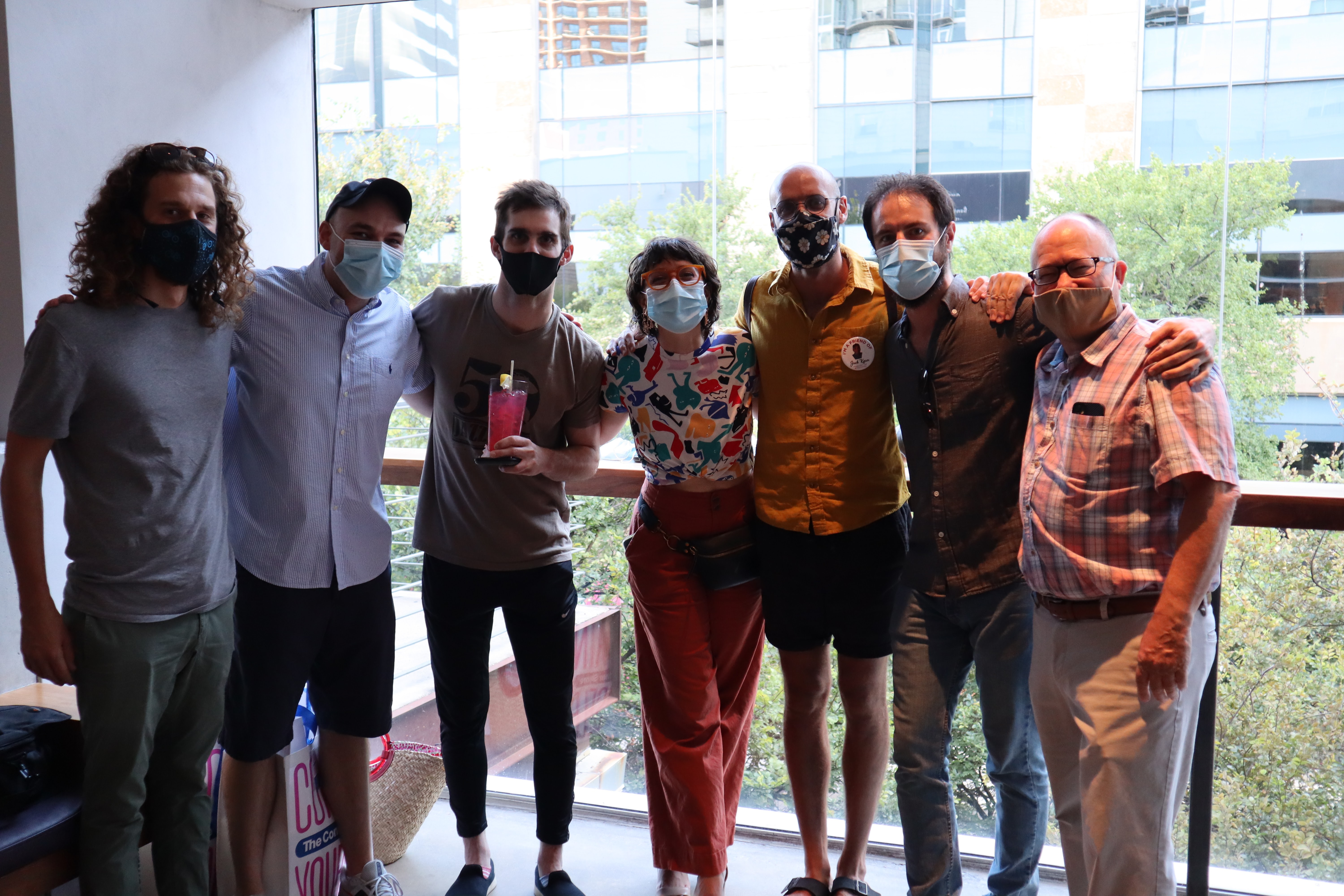
On Sunday, August 9th, I did something I've always wanted to do - screen a few of my short films for my friends in Austin. I've had a chance to show these movies on the big screen in New York over the years, but never in my hometown. I was honored to have a small gathering of dear friends join me at the Violet Crown Cinema for the screening, which also served as my belated 31st birthday party.
In preparation for the event, I wrote down a few thoughts about the films themselves, hoping to provide some insight into what I've been trying to accomplish with my film work. I thought I'd share those thoughts here on this blog.
Thank you all so much for being here, and I hope this isn’t too self-aggrandizing. This is something I had wanted to do last year for my 30th birthday, but that wasn’t possible due to COVID-19.
I thought I’d offer a little context for what you’re about to see. These are three short films I made, preceded by sort of a throwback joke trailer I made in high school. The first film, You Can't Put Your Arms Around a Memory, was my senior thesis film at NYU, which meant it was a script workshopped for a semester in our Advanced Production class. That semester ended with students pitching their films for an allotment from the school, as not everyone gets to make a thesis (at least not with the resources and equipment NYU has available). I was lucky enough to get the allotment, and as we were still students, I didn’t have to pay my cast and crew. Even still, the shoot was costly, and so many of you contributed in some way to make it possible. That's one of the primary reasons I wanted to do this, to thank you and also show you that we did actually make something. I don’t know if it’s good, but we didn’t go on vacation - your money was definitely spent on a movie.
The last two films, Jack and Lucas Go to a Wedding and Harvey's Last Night on the Avenue, are independent projects I wrote and directed after college. The main difference on these shoots was that most of our crew members were working professionally and we weren’t operating with the support of a university, so everyone had to be paid and all camera gear and equipment had to be rented. I did fundraising campaigns for both films, and again, so many of the people in this room helped out, for which I am forever grateful.
Of these two post-grad films, the first is a movie I made with my old friend Lucas Loredo, which we shot entirely in a hotel room. The second was a collaboration with the lead from my thesis, an excellent actor named Mike Wesolowski – so you’ll see him in two different movies.
Looking at these films now, I see a lot of things that I didn’t necessarily see at the time. The primary one being judgment – which is not to say the movies themselves are judgmental of the lead character, but rather the character is often very judgmental and critical of himself.
I can’t say that any of these films are autobiographical – despite the fact that the character I play in one of them is named Jack – but they do to a certain extent reflect versions of things I've felt over the years in an exaggerated way. But I see myself toeing the line here between trying to have an empathetic protagonist while also presenting a character with some pretty extreme qualities. Sometimes the challenge was - how far can I take it before the audience says, "This guy is out of his mind!" A film of mine I was going to include in tonight’s line-up but ultimately didn’t, Jake the Cinephile, was described by one of my professors as an empathy dare – as in, I dare you to empathize with this character. He’s so off-the-wall. And I don’t think he meant that in a positive way. With that particular short, though, I’m getting the chance to sort of get a do-over, as I’ve developed it into a feature film which we’ll be shooting at some point this decade (production isn't easy these days).
A question I got once when someone watched one of the films was, is this really how you see yourself? And the answer is no. But that comment stuck with me, and a progression I’ve noticed in the projects I’ve been developing since making these shorts is a kindness and – I hope - a more multi-dimensional quality to my lead characters that acknowledges their positive, engaging attributes alongside their less-desirable ones.
That being said, I’ll always be attracted to losers, for lack of a better term. They’re just more interesting than winners. And I am proud of the movies you’re about to see. Theoretically, they should get better with each one, but I can’t promise there won’t be some regression.
So thank you for letting me make films where I was able to refine my style and articulate what I was feeling at the time and learn a lot about how I want to make movies - which ultimately you can only do by making them.
It feels weird to say this at a screening of my own work, but if you have cell phones, it’d be pretty cool if you silenced them. My attitude toward talking during movies is sort of well-known at this point, too… but again, I feel weird saying this at my own screening. Thank you all so much.
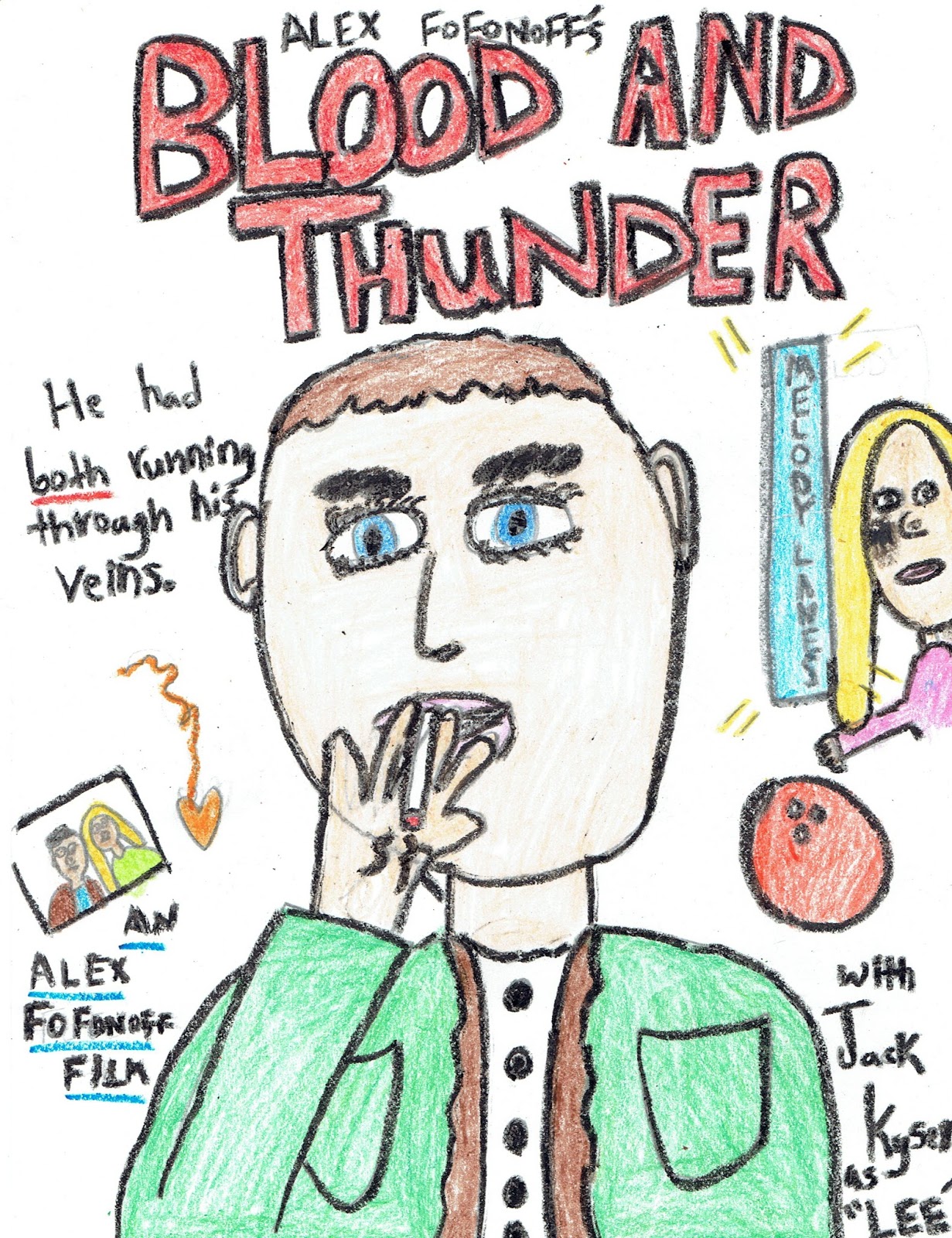
It's been a little while since my last blog entry, but I'm back! Near the end of last year, I made an acting reel, mainly comprised of footage from Alex Fofonoff's Blood and Thunder (in which I starred) and my films Jack and Lucas Go To A Wedding, Jake the Cinephile and With Love, Marty. Take a look below if you're interested, and please share - I'd love to get more acting work (if anyone needs a Jack-like character in their movie, I'm your man!) Look for memorable appearances by excellent acting partners like Desi Domo, Alexis Gay, Bethany McHugh and Lucas Loredo. Thank you to Bobb Barito for his sound design and to Alex for so much great footage from Blood and Thunder.
Speaking of Blood and Thunder, we had a great first screening of the film back in December. It was truly an honor to share Alex's film on a big screen with a group of friends and collaborators. We're still in the process of getting the movie out there and submitting it to festivals, and I'm very excited for more people to see it.
My friend Marissa Rutka has a great new web series titled Coffee Catch-Ups that's online now, and it was a lot of fun to be a part of the production (and a subject in the series). You can find the two episodes where I'm featured before - in the first, Morgan Ingari and I recount the eye-watering events of Hurricane Sandy, and in the second, I go into Jake the Cinephile mode and offer out my rather obsessive-compulsive idea of perfection. Keep watching the series for more memorable guests and friends, like Charlotte Arnoux, Adam Boese, Nick Tanis and Emmy-winning guest star Jon Annunziata. The series was also nominated in the Documentary & Factual category of T.O. Webfest and will play at their festival later this month, so that's exciting!
In other news, my movie Jake the Cinephile is now available to watch online on Vimeo! I had a lot of fun screening this film at NewFilmmakers New York and The Beacon Film Festival (Freeze Frame) a few years ago, and I can't thank all of my extraordinary collaborators on the film enough. Here it is:
My senior thesis film You Can't Put Your Arms Around A Memory is winding down its festival run after screening at a number of festivals last year. We were proud to be nominated as a Finalist for Best Student Film at the Blow Up-Chicago International Arthouse Film Festival in December. And earlier, on Saturday, November 21st, I was thrilled to screen You Can't Put Your Arms Around A Memory at the Katra Film Series with some other great films. After the film screenings at Katra, there was a Q&A with the other filmmakers, where I was joined by my great lead actor Mike Wesolowski.
On Friday, April 22nd, By Sidney Lumet, the wonderful documentary on which I was an associate producer and assistant editor, had a special free screening at the Tribeca Film Festival at the SVA Theatre, followed by a lively Q&A with panelists Jonathan Demme, Treat Williams, Amy Ryan and Jenny Lumet moderated by director Nancy Buirski. It was a particularly exciting day because, before the screening, I was part of the production team on an excellent interview with Mr. Williams, where he discussed shooting Lumet's masterpiece Prince of the City (1981). From both that interview and the post-screening talkback, I learned so much great New York City filmmaking history in the span of a few hours.
The trailer for By Sidney Lumet is also now available for the world to see - you can watch it here. Earlier this year, the film screened at the Full Frame Documentary Film Festival in Durham. But, for me, the most exciting screening of By Sidney Lumet was at the Austin Film Festival last October, where it played at the historic Paramount Theatre. It was a great afternoon screening, and a good number of my friends and family members were able to come see the picture on the big screen. Nancy held an excellent Q&A after the film was over onstage (I was also able to see a number of other films at the festival, including Youth, Brooklyn, Legend and Coming Through the Rye, and meet one of my favorite actors, Chris Cooper, for the second time).
By Sidney Lumet spans Lumet's entire career, from 12 Angry Men (1957) to Dog Day Afternoon (1975) to Before the Devil Knows You're Dead (2007), and it's really been great to see the film and Lumet's work so justly celebrated over the last year.
Meanwhile, Loving, the narrative film adaptation of Nancy's first film, The Loving Story (2011), wrapped production last fall, and earlier this year Focus Features bought the film to release in the fall. Directed by the astounding Jeff Nichols (Take Shelter, Mud, Midnight Special) and starring Joel Edgerton, Ruth Negga and Michael Shannon, Loving recently made its world premiere at this year's Cannes Film Festival, and it was the talk of the festival. Loving is shaping up to be the second masterful film by Nichols this year (after Midnight Special, which I'll discuss below), and it's a very exciting time for Nancy's career.
The Cannes line-up this year, by the way, was particularly exciting - in addition to Loving, there were new films from Sean Penn (The Last Face), Woody Allen (Cafe Society), Paul Schrader (Dog Eat Dog, starring Nicolas Cage) and Jim Jarmusch (Paterson), along with a special screening of Jonathan Jakubowicz's Hands of Stone to honor star Robert De Niro, who is supposed to give another great performance in the film. And in the absolute best news of the festival, STX bought the international rights for Martin Scorsese's The Irishman, starring Robert De Niro, Al Pacino and Joe Pesci, which is the movie I've been waiting for my entire life. If The Irishman is indeed moving forward, it's the best news of the century.
By the way, I suspect Penn's The Last Face (which was received poorly) is a good film, and critics are simply making it difficult for the movie to find a distributor. Meanwhile, most studio crap gets a pass - I'll have a bit more to say on critics dismissing interesting cinema while giving bloated, uninteresting superhero films way too much leeway a little later.
On Saturday, April 23rd, ten years after the best concert of my life (seeing The Rolling Stones in Zilker Park in Austin), I went to the only concert that can ever top it - finally, after waiting for so long, I saw Bruce Springsteen in concert. That's right, I went down to The River to worship at the altar of The Boss. His two performances at Brooklyn's Barclays Center marked the end of The River Tour 2016, in which Springsteen and the E Street Band performed the entirety of their 1980 album The River (along with a large number of other Springsteen songs). As you might expect, I rocked out. From the homemade Springsteen t-shirts worn by fans congregating at the nearby Shake Shack to the power and majesty of the music itself, this concert was three and a half hours of joy. The River is such a beautiful, haunting album (here's a link to some of the videos I took on my phone during the concert).
And his live performances of these classic songs were as full of exuberance and passion as I've heard (though I feel quite familiar with his live work, having watched recordings of his concerts for years now). There was simply so much energy in songs like Tenth Avenue Freeze Out, Born to Run, Badlands, Out in the Street, I'm A Rocker, Cadillac Ranch, Crush On You, Two Hearts and You Can Look (But You Better Not Touch). He crowd-surfed, he threw multiple guitars off-stage (toward someone waiting to catch them), he got a married couple onstage to slow-dance, he danced like a madman, he busted through the crowd like The Boss.
And then there were the songs that nearly moved me to tears. He opened with Purple Rain, as this was two days after the tragic passing of Prince. And then The River stand-outs Fade Away, Stolen Car, The River and Independence Day broke my heart, along with two of his most emotional and triumphant songs, Lonesome Day and The Rising.
Earlier this year, my roommate Bobb got a vinyl record player for our apartment, and my used copy of The River I purchased from Other Music (which is unfortunately closing in June) has received more play than almost any other record in our collection. It's just a masterpiece, and as someone who considers Bruce Springsteen my favorite musician, I'm embarrassed I hadn't explored it and appreciated it the same way I have with Born to Run, Born in the U.S.A., The Rising, Magic, Darkness on the Edge of Town, Devils and Dust and so many other seminal Springsteen albums until this year.
April 29th was the fourteen year anniversary of my dear dad John Kyser leaving this earth - what a fun, loving man he was. He is deeply missed. To the right, you'll see some pictures taken by my great mom Gretchen Kyser.
Earlier in March, we held the Second Annual Lip Sync Battle Contest at my apartment, where friends attended and took turns performing sections (or the entirety of) songs that they chose (and rehearsed) before the competition. To commemorate the one year anniversary of our first party, I edited together a trailer of our performances from last year's inaugural contest. Take a look here and marvel at the talent on display.
Congratulations to our outrageously talented winners Mo Faramawy, Marissa Rutka, Taylor Frey and Alex Schaefer, as well as our Special Jury Prize winners Jon Annunziata and Emma Viles (traveling all the way from Boston!). There were magical performances by everyone and excellent judging all around.
We're not even half-way through the year, but there have already been several outstanding new film releases - although it's sometimes disturbingly difficult to find them when so many screens are devoted to the latest superhero monstrosity. In all seriousness, any self-proclaimed lover of film owes it to himself or herself to actively go out and see the new films from Richard Linklater, Terrence Malick, Jeff Nichols and Joel and Ethan Coen in a movie theater. It is more important than ever to support great cinema and choose wisely, particularly when nearly every screen in the city is dedicated to garbage (even when the garbage is supposedly "good," I simply find myself bored, desperately wanting to watch a real movie). Many, many worthy films open every Friday, and they're often lucky to survive even for two weeks in New York. I shudder to think how many films like Kenneth Lonergan's Margaret (2011) I've missed and have flown under the radar - and I'm someone who keeps up regularly with what's out there.
In my last post, I wrote in detail about my love for Linklater's flat-out amazing Everybody Wants Some!! Instead of making a top ten list this year, I might just list the ten best uses of music in the film. Linklater's new movie deserved a wide release, but Paramount Pictures didn't let that happen. Anyone who has seen the movie has fallen in love with it, but the studio simply didn't give the picture the chance it deserved and allow word-of-mouth to spread. Linklater is a national treasure, and actor Glen Powell delivers a star-making performance here (plus, my friend Jenna Marie Sab plays the mud wrestling champ, and Bernie Tiede served as the set cat wrangler).
It's a miracle that a movie as contemplative as Malick's Knight of Cups exists in this day and age. Richard Brody wrote a great piece on the film for The New Yorker (it's worth noting that Brody is one of the only film critics who actually seems to appreciate daring filmmaking anymore - some of the reviews for Knight of Cups would lead you to believe your money would be better spent seeing Batman v Superman: Dawn of Justice).
Malick finds real beauty in the decadence of Los Angeles, with locations as evocative as anything in his filmography (production designer Jack Fisk does amazing work, as always). Malick also benefits from having an incredibly strong, emotive lead actor in Christian Bale, who is fascinating to watch in every quiet moment of this film. He seems to relish Malick's style of filmmaking, inviting us to share his character's very real struggle without having anything close to a traditional scene of dialogue.
The scenes with Bale's father (Brian Dennehy) and his brother (Wes Bentley) are some of the best in the film. Cate Blanchett makes a memorable impression as Bale's ex-wife, in a sequence in which we come to understand so much about his character through his reactions to her work as a nurse.
It's interesting to see Malick film the modern-day emptiness of a heavily materialistic culture, partially because I'm so used to seeing the natural world represented in his films. This is only Malick's second non-period piece (after To the Wonder), and I love seeing him capture our world in a way that emphasizes both the beauty and the trappings of a decadent wasteland.
Structuring the film in sections named after tarot cards fits so well with this story of a man on a quest to find meaning in his life and world. The experience of a hard-partying Hollywood player has never been put onscreen quite like this before, with so much contemplation as to what it all means and what role he's playing. There's a very memorable scene in which Bale's apartment is robbed and he's held at gunpoint. One of the burglars asks why there isn't anything of value in his home, and Bale doesn't have an answer.
As always with Malick, I found myself lost in Knight of Cups in a beautiful way, and I was made a little less aware of the current time and space around me. There's no way in his pictures to really know where we are structurally in the story, and so our minds are free to wander and take in the beauty of each moment. We simply exist in the space of the movie, and that is a wonderful thing.
Midnight Special is really, really special. The films of Jeff Nichols take place in cheap roadside motels, gas stations, backwoods areas and on dark highways. The locations alone have more character than most other studio films out there. All of his films are about parental concern in some way or another, and about a kind of anxiety and longing at the heart of modern southern men.
Interestingly, both Mud (2013) and Midnight Special feature powerful late scenes that help unearth the themes of the film, followed immediately by a rousing shootout. These critical scenes – in Mud, the titular character giving our young protagonist advice on love, and in Midnight Special, a child comforting his parents about to lose him – have a beautiful romanticism to them. And then Nichols leaps immediately into the thick of an adventure. It’s exhilarating filmmaking.
I love how dark Nichols and cinematographer Adam Stone allow some of these scenes to get – we actually feel like nighttime is upon us. And the darkness only helps conceal the mystery, along with the beautiful score from David Wingo, who also scored Mud, Take Shelter (2011) and the films of David Gordon Green.
Edgerton is silent and strong, providing a subtle, effective presence in each scene, while Shannon is riveting as a father willing to do anything for his son.
Midnight Special is an emotional story about parents protecting and eventually letting go of their child, and how others along the way are deeply affected by the child's vision. Nichols is so good at making movies that are about so much more than they seem, and they always sneak up on you and reveal themselves in profound ways. The combination of supernatural imagery with ordinary life is even more prevalent here than in Take Shelter, but Nichols uses special effects only when necessary, and only in the interest of enhancing the story.
With these last few films, Nichols has created a new American South that feels real and heartfelt. Here, he embraces his inner Spielberg and makes a film full of haunting images, quiet characters whose inner lives speak volumes, and an atmosphere that lingers long after the credits are finished.
In February, Joel and Ethan Coen released their latest masterpiece, Hail Caesar! Josh Brolin, in his third collaboration with the Coens, leads a hilarious ensemble cast, and the picture is a treat for anyone who loves classic cinema. The Coens have a great time paying homage to classic studio films from the 1950s. They're also two of the only major American filmmakers to deal seriously with religion in their films. Hail, Caesar!, which begins and ends with Eddie Mannix (Brolin) in confessional, is fascinating when you consider the minor sins for which he atones, as opposed to the things he doesn't confess. He doesn't give a second thought to anything slightly immoral that involves running Capitol Pictures more effectively, whereas smaller things, like having an occasional cigarette, weigh on him heavily. This is a dense film, and worth seeing multiple times. Every film from the Coens is like a puzzle, and as you're watching it, you know the pieces are going to add up to something brilliant, but part of the fun is trying to determine how seemingly throwaway scenes contribute to the overall picture.
If you want brilliantly-written, Kiss Kiss Bang Bang-style fun, run to see Shane Black's The Nice Guys, in which Russell Crowe and Ryan Gosling make a hilarious pair of private eyes. This is precisely the kind of movie that deserves to be making loads of money - if only America wasn't so simultaneously force-fed and obsessed with superhero atrocities. Jodie Foster's Money Monster is also a great, tight thriller reminiscent of Sidney Lumet's work - and features a fantastic supporting performance from my friend and NYU peer Grant Rosenmeyer! He plays Tech Dave, who spends a great deal of time in the control room and later in a van with Julia Roberts.
A24 continues to release the most memorable films out there - The Lobster is amazingly inspired and strong, with an extraordinary performance by Colin Farrell. And earlier this year, The Witch unsettled me deeply. Talk about a production company on a winning streak - in the last year, they've released While We're Young, Ex Machina, Amy, The End of the Tour, Room and Green Room, in addition to the above titles. If I see their logo attached to a movie trailer, I'm seeing the movie without a doubt.
I was a little late to the game in seeing it (after it won the Academy Award for Best Foreign Language Film), but Son of Saul by László Nemes is a work of art. In short, it's important to go out there and see the original films. So please go support The Nice Guys, Money Monster, The Lobster, A Bigger Splash, Weiner, Maggie's Plan, Elvis and Nixon, Miles Ahead, The Family Fang, Green Room and - if it's still playing near you - Everybody Wants Some!!
Earlier this February, I attended the first screening of the Blackhat Director's Cut at BAM, with Michael Mann, one of my favorite directors of all time, introducing the film. I was a fan of this movie when it first opened a year ago, and I love this restructured version even more.
In this cut, the romance between Chris Hemsworth and Tang Wei's characters is much stronger, and the characters overall are more fully defined. You know you're watching the work of a master visual stylist when you can practically feel the locations while watching the picture, and Blackhat has no shortage of incredibly memorable set pieces.
The sheer urgency and immediacy of the shootouts are as gripping as anything in Mann's filmography. The hacking scenes are beautifully filmed and visualized, and Mann's hyper-digital aesthetic has rarely felt more appropriate and essential, given the subject material. It's hacker versus hacker at the end of this picture. The film feels like it takes place in two worlds - one made up of sprawling and confusing physical geography, the other an unknowable and far advanced world that leaves the physical one muddled in chaos. On a side note, I was thrilled to be quoted in an IndieWire story about the Blackhat screening.
In April, I saw the current revival of Fiddler on the Roof on Broadway, which was an incredible production. I hadn't seen the musical since the 1990s, when I went with my parents to a production at Austin's Paramount Theatre.
As for this year's Academy Awards, I thought the winners themselves were right on the money. The final three Oscars went to exactly the people who deserved them - they got it right. Let's finally say it - Academy Award Winner Leonardo DiCaprio. We all know it should have been Oscar #4, as he should have won for Martin Scorsese's The Aviator (2004), The Departed (2006) and The Wolf of Wall Street (2013), but no matter. The Academy awarded a magnificent actor and a truly kind person (from the few times I met him on The Wolf of Wall Street), not to mention an extraordinary performance.
In fact, I made the t-shirt to the right two years ago in the spirit of a possible DiCaprio win for The Wolf of Wall Street. That didn't happen. But I brought it back this year, and it happened.
The Best Director win for Alejandro Gonzalez Iñárritu and Best Picture win for Spotlight are, again, precisely the choices I would have made - not just among the nominees, but for the entire year, period. I loved whatever it was Michael Keaton mouthed when Spotlight won - that's two Best Picture winners in a row for Keaton, baby (and you can bet he's coming back for more this year with his excellent-looking performance in The Founder). The awards were enough to start a hashtag like #OscarsSoRight.
I was a little sad about Sylvester Stallone's loss for Creed, though my two picks for Best Supporting Actor (Harvey Keitel for Youth and Keaton for Spotlight) weren't even nominated. But it's cool that, before Lincoln (2012), Steven Spielberg had never directed an Oscar-winning performance - and now, with Mark Rylance's brilliant performance in Bridge of Spies, he's directed two. I was hoping to see the Best Song Oscar go to Youth, the actual best song nominated, by an artist apparently not famous enough to perform (don't even get me started on the exclusion of Brian Wilson's song from Love & Mercy).
To be honest, I hadn't been so excited for the Oscars since The Departed (2007) won it all nine years ago, mainly because of the prospect of a DiCaprio win. And the other winners were largely excellent (Ennio Morricone for The Hateful Eight! Tom McCarthy and Josh Singer for Spotlight! Brie Larson for Room! Adam McKay and Charles Randolph for The Big Short!). Still, the tone of the evening oftentimes left a bad taste in my mouth - there's a way to critique the politics of the entertainment industry without disrespecting the films and people who are nominated.
It was a good awards season, for the most part, as well - with The Revenantbecoming a worldwide hit, winning the major BAFTA awards and Alejandro González Iñárritu winning the DGA for the second year in a row - he could not be more deserving. Spotlight, meanwhile, won the WGA award. Here's a great Rolling Stone article on Iñárritu, which includes Scorsese's thoughts on The Revenant (he calls it a masterpiece).
There have been some tragic deaths since I last wrote here, including musical legends Glenn Frey, David Bowie and Prince; Gary Shandling, who gave us masterful comedy with The Larry Sanders Show; Kathryn Altman, who so lovingly kept her late husband Robert Altman's legacy alive and well, particularly with the magnificent book on his career; and brilliant author Harper Lee. I had the honor of briefly meeting Harper Lee ten years ago with my friend Bolton Eckert at Horton Foote's ninetieth birthday party - she was an extraordinary person, and her work and legacy will live on forever.
On Thursday, May 29th, I screened my senior thesis film You Can't Put Your Arms Around A Memory for the first time, alongside the new movies from two other incredibly talented filmmakers and friends, Morgan Ingari and Catie Stickels. The event, which we held in one of Tisch's larger screening rooms, was outstanding. I was thrilled to have cast members Mike Wesolowski, Mary Goggin, Matthew Vitticore and Zachary Gamble attend the premiere.
I don't believe I've shared either of the two trailers for You Can't Put Your Arms Around A Memory on this blog. Thank you so much to Benjamin Dewey and Bobb Barito for their brilliant color and sound on both trailers. Here they are:
In the weeks leading up to the screening, I met with colorist and visual effects artist Benjamin Dewey for several final color and visual effects meetings. The movie received a masterful sound design by Bobb Barito in April, and after a few days of sound mixing and ADR re-recording, we recorded a great original score for the film by my classmate Ari Selinger in early May.
The movie now has its own IMDB page, and if you're interested in seeing stills from the film, please click here! The first DVDs of the movie have been sent out to our IndieGoGo contributors. Of course, the only drawback to have so many wonderful contributors is that I can't send the DVDs out to everyone at once. But be on the lookout for the final film in the mail, contributors!
Also, check out the acting reel of a great actress, Mary Goggin, who stars in You Can't Put Your Arms Around A Memory. I'm so proud to have the film featured in her reel.
In June, I screened the film for my professor Yemane Demissie's summer Sight and Sound: Film class, where I received some truly wonderful notes. They seemed very taken with the idea behind the movie and the lead character Charlie's ideas about memory and having a witness.
One student remarked that the character of Charlie seemed like it was written for actor Mike Wesolowski. Another asked if I had written Charlie's bizarre Jack Nicholson impression specifically for Mike, as it seemed like such a specific idea, and was so well-suited to Mike's personality. In fact, that impression was in the script from the very beginning, but they're correct that Mike is so convincing as the character that the impression seems like something something we might have developed in a rehearsal.
Many others praised the casting, the directing of the two lead actors and the use of music in the movie (particularly when Charlie rocks out to Bob Dylan in his room). We also discussed the use of New York as a setting. Even though we live in the city, the students felt New York is rarely used as well as it is here. More than a few people remarked that the apartment scenes, in addition to feeling very 'New York-y,' helped illustrate the closeness of this mother and son, living together cramped in their tiny apartment. Another person said they loved the way the movie began with quiet, dark city streets, and then ended with big and bright Times Square.
Yemane asked the class how I was able to generate empathy for a character who superficially does not 'deserve' to be liked. One person remarked that the character's confessions generate empathy for him. Charlie is very aware of what he's doing wrong, but the fact that he confesses his mistakes to his mother helps the audience empathize with him. Another said that we also understand him through the mother - her acceptance of him, even when she's telling him to leave, helps us have patience with him.
Yemane also asked the class to discuss the bravery involved in writing a screenplay like this, a piece that delves so deeply into seemingly personal territory. He also commented on the film's depiction of awkwardness. Most movies show awkwardness in a degrading or comical way, Yemane said, but my movie aims to show us awkwardness in a genuine and forthright way.
I went on to discuss the casting and script-writing processes with the class. Near the end of the discussion, Yemane asked his teaching assistant to replay one of my favorite moments from the movie, when Charlie stands alone in his apartment hallway calling out after his mother. Yemane pointed toward this moment as a great example of using off-screen sound to capture a character's loneliness. We hear the mother turn on the television in the other room, slam the door and then all sound goes out completely. Three small things, all added in post-production. Of course, a large amount of the credit here belongs to Bobb Barito. Someone else commented that they thought the sound of Charlie's voice was excellent, as he seemed so much louder than everyone else, which added to the idea that he's alone and reaching out. I was honored to get such great feedback from Yemane and his students.
In late March, I held a wonderful first reading of my feature screenplay at NYU. I was over the moon about the notes I received from my peers - it was a mammoth 166-page draft, and everyone was so generous to come out and stay for what ended up being nearly a three-hour reading. I finished the first (admittedly not great) draft of my feature screenplay earlier this year, and I can only hope it gets shorter and better from here. I certainly have a lot of fantastic notes with which to work.
In April, I'm simultaneously excited and disappointed to say that my film Jake the Cinephile was under close consideration by the Cinéfondation Selection Committee of the 67th Cannes Film Festival. The film made it to the final round of consideration to the Cinéfondation, but was unfortunately not selected for the festival. Although it would have been incredible to screen the film at Cannes, I'm still very proud that my wonderful crew and I were able to make a movie that got pretty darn close.
Jake the Cinephile screened on Wednesday, April 16th at Anthology Film Archives in New York City as part of the NewFilmmakers New York series. It was not only a great crowd and a very receptive audience at NewFilmmakers New York, but it was by far the largest screen on which I've ever had one of my films screen. Before the screening, I joined the other filmmakers in my section at the front of the theater for a brief introduction to the movies. To view pictures from the screening, please click here.
Additionally, here is an article from Broadway World about the New Filmmaker New York Short Film Series on April 16th with information about Jake the Cinephile.
In May, I had the honor of working on my friend Eliza McNitt's amazing short film for TEDMED as Assistant Director. The movie stars the incredible Adepero Oduye (12 Years A Slave, Pariah) and it's titled Play Is Not A Waste of Time. We had a great shoot on a soundstage in Brooklyn, and you can view the film online right here.
In June, I saw some excellent live stage performances, including Robert Wilson's surreal production of The Old Woman at BAM starring Willem Dafoe and Mikhail Baryshnikov, and a revival of Eugene Ionesco's The Killer at Theatre for a New Audience, which was one the most amazing stage productions I've seen in a long time. The extraordinary Michael Shannon starred in the production - it was my first time seeing him perform onstage, and he's just as electrifying as he is onscreen.
I also saw a performance of Alan Ayckbourn's A Small Family Business via National Theatre Live at NYU's Skirball Center for the Performing Arts, which was a wonderful opportunity to revisit the world of Ayckbourn (I've performed a monologue from A Small Family Business frequently in the past, including for my college acting auditions and for my performance in Third North's Ultra Violet Live talent competition, where I won second place my freshman year). I attended the event with two dear friends, both of whom acted with me in Austin High School's 2007 UIL One-Act Play production of Ayckbourn's Round and Round the Garden. It's still my favorite play in which I've performed (I've been in it on two different occasions - in high school, I played Norman, and then five years later, at NYU, I played Reg).
If you're interested in watching Tisch New Theatre's 2012 production of Round and Round the Garden, the whole show is now online:
Speaking of plays, I don't think I ever mentioned that in March of 2013, I saw two amazing Broadway productions. It was incredibly exciting to see Tom Hanks in Nora Ephron's Lucky Guy. in which he gave an incredible performance. I met Hanks after the show, which was beyond cool. He told me to make the picture I took with him my "prof pic," and I'm inclined to agree with the great man. As you may remember, Hanks and Paul Greengrass gave us one heck of a movie last October (not to mention Hanks's extraordinary work in John Lee Hancock's Saving Mr. Banks as Walt Disney last year).
I also had the chance to meet Lucky Guy costar Christopher McDonald (1996's Happy Gilmore, 2000's Requiem for a Dream, 2005's Broken Flowers) after the performance.
The same weekend, I saw Lyle Kessler's Orphans on Broadway, starring Alec Baldwin, Ben Foster and Tom Strurridge. They all gave outstanding performances in this very powerful play, which seemed like something in which I'd love to perform some day (perhaps with my high school theatre director Billy Dragoo, who visited New York a few months ago with his wife Annie Dragoo, who was also one of my wonderful theatre directors). We've long talked about doing a play together, and something like Orphans (with a third young actor) would be incredible.
At the Tony Awards last year, I'm still not sure how Baldwin and Al Pacino weren't nominated for Orphans and the revival of Glengarry Glen Ross, respectively. But it was very cool to see Cicely Tyson thank Hallie Foote, Van Ramsey and Michael Wilson in her acceptance speech for Horton Foote's The Trip to Bountiful. And it was excellent to watch the Tony Awards get handed out in the same space in which I graduated two weeks before the ceremony (Radio City Music Hall).
I posted my reviews of Richard Linklater's Boyhood and Steve James's Life Itself earlier this month, but they aren't the only great pictures that have come out this year.
Clint Eastwood's Jersey Boys, released back in June, is another riveting Eastwood picture that deserves a lot more praise than it's receiving (not unlike Eastwood's other recent films, all of which I think are very under-appreciated - J. Edgar, Hereafter and Invictus). Richard Brody wrote a fascinating article about Jersey Boys, and it's one of the few pieces that actually tries to understand what Eastwood is doing with the material. Here's another good article on Eastwood from Variety about both Jersey Boys and Eastwood's upcoming American Sniper, as well as an interview with Eastwood. Eastwood has long been one of my favorite filmmakers and biggest influences, and I feel people aren't taking notice of his risks as a director after his indisputably masterful run of Mystic River (2003), Million Dollar Baby (2004) and Letters from Iwo Jima (2006).
Doug Liman's Edge of Tomorrow is still the most fun and thrilling movie of the summer, with a real movie star giving a great performance in the lead. Remember when we got legitimately incredible summer movies like Minority Report (2002), Collateral (2004) and War of the Worlds (2005)? Tom Cruise is back to the rescue with Edge of Tomorrow. It's the only blockbuster of the summer (besides Dawn of the Planet of the Apes) that can claim to be a great movie.
Kelly Reichardt's Night Moves has more tension in any one of its scenes than most other thrillers have in their entire running length (there are now two masterful films titled Night Moves, after Arthur Penn's 1975 thriller starring Gene Hackman). Plus, the movie features another great performance from the brilliant Peter Sarsgaard. And I love that Jon Favreau's well-received Chef uses Austin as an actual location. Guero's, Franklin Barbecue and the 360 Bridge all make appearances, and that seems in keeping with the movie's low-key and inviting warmth. I'm thrilled it's become such a popular film.
I saw James Gray's masterpiece The Immigrant back in October at the New York Film Festival, though the movie was not released theatrically until May. It will undoubtedly be near the top of my end-of-the-year top ten list - it's one of the most extraordinary American films in many years. I saw the film again at a pre-screening at BAM, followed by a Q&A with Gray, and for a third time earlier this week, and the picture never fails to move me to tears. I think something about the movie's morals - perhaps Eva's sense of morality and struggle with whether or not she deserves happiness - touches me deeply.
David Gordon Green's Joe overflows with memorable characters and energy in every single scene, almost like a Robert Altman film. It's everything I love about Gordon Green's Prince Avalanche from last year, Jeff Nichols's Mud and Mike Figgis's Leaving Las Vegas (1995) rolled into one great film, with a masterful performance by Nicolas Cage. Here's an astonishing article from the Austin Chronicle about Gary Poulter, one of the stars of Joe, who tragically passed away shortly after shooting the movie.
Jonathan Glazer's Under the Skin, which I saw back in April, is out-of-this-world and unlike any movie I've ever seen. It's fantastic to see new movies like Under the Skin and Pawel Pawlikowski's Ida (also one of the best movies of the year) that know how to use silence. Bong Joon-ho's Snowpiercer is the summer action movie audiences deserve, and John Carney's Begin Again charmed me the same way his Once did seven years ago, with the always-outstanding Mark Ruffalo doing great work. Paul Haggis's Third Person trusts its audience to let it takes it time. With more movies for adults like it, we'll have better audiences.
It's not a new movie, but I saw William Friedkin's Sorcerer (1977) at Film Forum last month, and that picture is a sight to behold. I'm so glad this movie is being rediscovered, because it's a masterpiece.
Boyhood remains the greatest cinematic achievement of the year - Linklater is on fire. I saw his Before Midnight last year at the Angelika Film Center with Aziz Ansari sitting behind me. I don't know what was more beautiful - the film, or him. I saw that film three times theatrically, and it's astounding what Linklater achieves (as I'm about to embark on shooting a new movie that takes place entirely in a hotel room, I am particularly inspired by the second half of Before Midnight, which has ingenious blocking and use of space in a hotel room occupied by Jesse and Celine). Finally, here's a beautiful message from Jesse and Celine, courtesy of the Alamo Drafthouse.
There have been a number of great artists who have passed away this year, including Eli Wallach, one of the great film actors (from 1966's The Good, The Bad and The Ugly to 2010's The Ghost Writer); Gordon Willis, the cinematographer of many of the greatest films ever made (including 1972's The Godfather and 1979's Manhattan); actor Bob Hoskins, who was so brilliant in Mermaids (1990), Nixon (1995), Hollywoodland (2006), Michael (1996) and Brazil (1985) - and there are still so many of his performances I need to see; the great filmmakerPaul Mazursky (1978's An Unmarried Woman, 1986's Down and Out in Beverly Hills); singer Jerry Vale, who appeared in Goodfellas (1990) and Casino (1995); and film critic Jay Carr.
Until my next blog post, where I hope to continue playing catch-up on the past year-and-a-half!