My senior thesis film
You Can't Put Your Arms Around A Memory has had a great recent run at film festivals over the last few months. On Saturday, August 8th, my film screened at the 9th Athens International Short Film Festival Psarokokalo in Athens, Greece. Please take a look at
the festival's program here, which gives a nice run-down of the film.
On Saturday, August 15th, I drove up to Monroe, New York with lead actors Mike Wesolowski and Mary Goggin to attend the Hudson Valley International Film Festival, where
You Can't Put Your Arms Around A Memory screened at 10:35 AM in Theater 3. Here is
a link to the festival schedule, where you can see a nice write-up about the film. To the right, you'll see a picture of us on the festival's red carpet. We enjoyed a nice day of seeing the film in a lovely new theater, attending a few other films and enjoying the charm of small-town Monroe.
The next weekend, on Saturday, August 22nd, my film screened at the Black Cat Picture Show in Augusta, Georgia at 6:00 PM (here is
a link to their full schedule). Le Chat Noir, which hosted the event, did a wonderful job promoting the festival and championing the movies, including
posting about our film on Facebook with a great write-up - I truly wish I could have been there. You can see pictures from their excellent screening below (
here's a link to one of their posters they had up for the festival, which you'll see prominently features my crayon drawing poster for the film)!
And then, on Sunday,
You Can't Put Your Arms Around A Memory actually
won the Best Student Film prize at the Black Cat Picture Show at their award ceremony!
Here's
an article from Metro Spirit about the Black Cat Picture Show, and
a picture of their awards before the festival began.
On Thursday, October 1st,
You Can't Put Your Arms Around A Memory screened at the Santa Monica Independent Film Festival
at 7:30 PM at the Santa Monica Playhouse. Here is
a link to all of their Official Selections and their
screening schedule, as well as
our film's page on their website, where they posted an extremely kind write-up about our film:
"This delightful short hailing from Brooklyn, New York opens with a great little visual hook and just gets better from there. Director Jack Kyser pulls off some exceptional filmmaking while exploring the deeply flawed character of Charlie, expertly portrayed by actor Mike Wesolowski. Cinematographer Benjamin Dewey shows off his formidable camera skills and helps shape Kyser’s vision with some pretty cool stuff. An NYU Tisch School thesis film,
You Can’t Put Your Arms Around A Memory is a true cinematic achievement and we can’t wait to see what comes next from this talented director." Thank you so much, SaMo Indie!
I sadly wasn't able to be in Los Angeles for the screening, but my friends and loyal supporters Bolton Eckert and Laura Donney attended the opening of the Santa Monica Independent Film Festival, and they said
You Can't Put Your Arms Around A Memory played to an awesome, enthusiastic crowd. You can see some of Bolton's pictures from the festival to the left and above (and check out more of
the SaMo Indie website here).
By Sidney Lumet, the great film on which I'm honored to be an Associate Producer and Assistant Editor, continues to have an incredible film festival run. The film will screen at this year's
Austin Film Festival at the Paramount Theatre on Friday, October 30th at 2:00 PM. Director Nancy Buirski will be there for a Q&A. I'm thrilled to go back to Austin for the screening and see many of the other films at this year's festival, including Todd Haynes's
Carol, Paolo Sorrentino's
Youth, John Crowley's
Brooklyn and Brian Helgeland's
Legend. It will be particularly exciting to see
By Sidney Lumet at the Paramount, a theatre where I've seen countless films and enjoyed many of the seminal theatrical experiences of my life -
Lawrence of Arabia,
2001: A Space Odyssey and
The Godfather among them.
By Sidney Lumet also screened on Sunday, October 11th at the
Hamptons International Film Festival for its North American premiere, followed by a Q&A with Buirski, Jenny Lumet (Sidney Lumet's daughter and writer of
Rachel Getting Married) and the great actor Bob Balaban - all of this after
premiering at the Cannes Film Festival in May! Here's
a great write-up from the East Hampton Star about the film. It was a lot of fun to travel to the Hamptons, as I had never been, and see the picture there with a large audience.
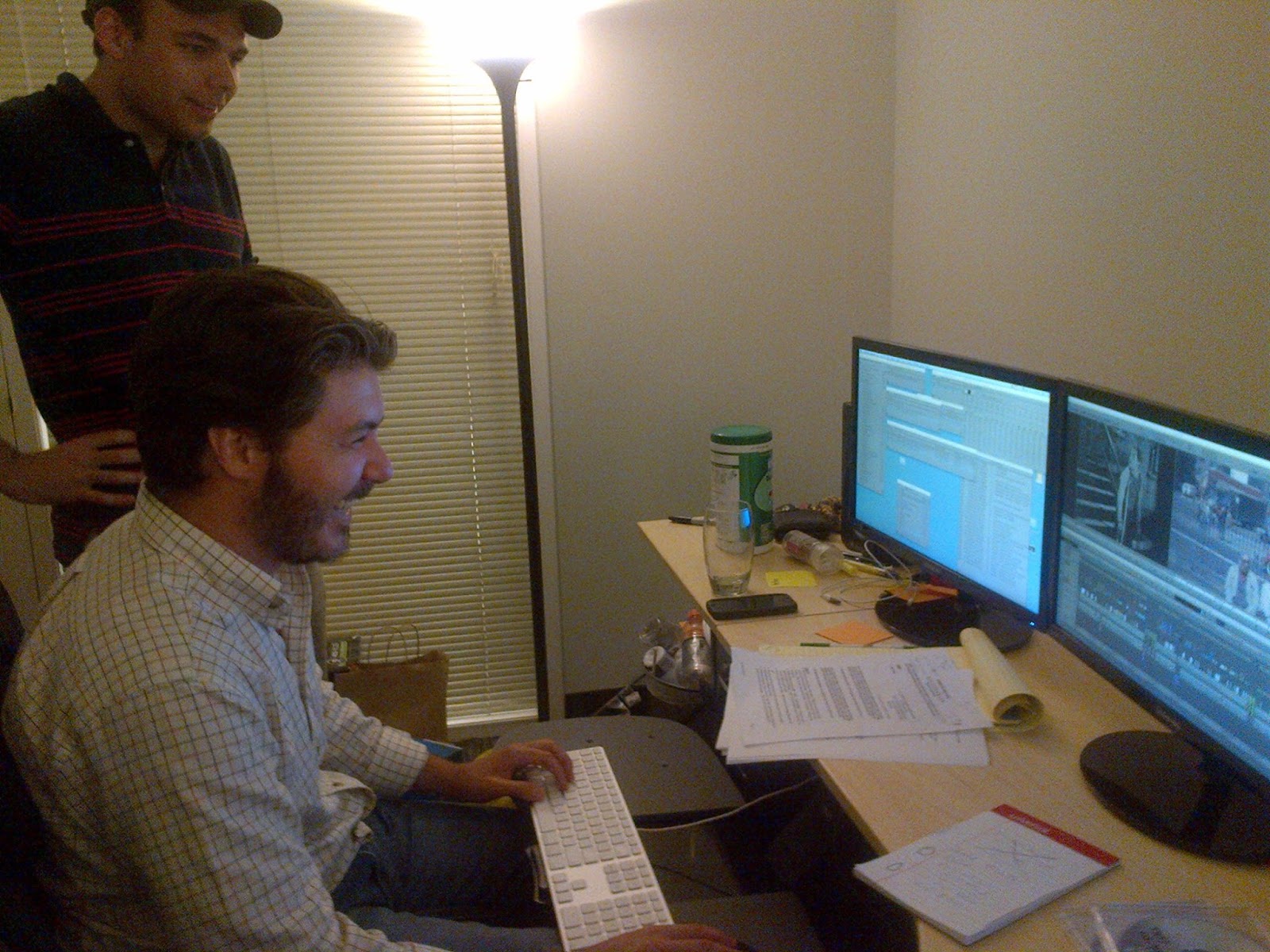
To the right, you'll see a picture of our editor Anthony Ripoli (
Margaret) and me in the edit room preparing the cut for our latest screenings. Like
our Facebook page for more information, and I'm excited for everyone to get to see this movie about one of the greatest filmmakers of all time, whose work - from
Dog Day Afternoon (1975) to
Network (1976) to
Prince of the City (1981) - has inspired me for years.
Throughout June and July, I put the finishing touches on my new film
Jack and Lucas Go To A Wedding. My wonderful collaborators Benjamin Dewey and Bobb Barito did a remarkable job, as they always do, with the color correction and sound design of the picture. We finished the film in late July after completing the color, sound, visual effects and titles - check
our IMDB page for the film!
On the evening of Friday, September 11th, my friend and collaborator Lucas Loredo and I
screened Jack and Lucas Go To A Wedding for the first time at NYU. Before the screening started, Alex Fofonoff premiered an exclusive trailer for his feature film
Blood and Thunder, in which I have the honor of starring. In that sense, it was a night showcasing some of my acting and directing. We had an incredible turn out, with almost every seat filled in the theater. Thank you so much to everyone who came out to see
Jack and Lucas Go To A Wedding - you are all the best! Lucas and I appreciate it so much.
Speaking of
Blood and Thunder, we had our final day of ADR in September (see the picture to the right). I've had the chance to watch the final film, and I am very proud of the work we've done - Alex has made a really extraordinary first feature, and I'm honored to be a part of it.
Near the end of July, I visited Los Angeles for the first time in seven years, and I had the chance to spend a lot of time with my lifelong friend Bolton Eckert, who now lives in Los Angeles and recently graduated from the Art Institute of Santa Monica. I started the trip off by meeting up with an awesome group of close friends from NYU, including Spencer Jezewski, Jeremy Keller, Lauren Ciaravalli, Stevo Dwyer and Auri Jackson at Bulgogi Hut, where we ate some Korean BBQ. After dinner, Spencer took Bolton and me on an excellent hike along hills overlooking Griffith Park and a truly incredible nighttime view of Los Angeles.
The next day, we had lunch with a friend from high school and then travelled with our moms down to the Hollywood area, taking a guided tour of the Dolby Theater (where the Oscars are held), walking along the Hollywood Walk of Fame and visiting the handprints outside the Grauman's Chinese Theatre. Though I visited this same area seven years ago, it was much more fun this time around, particularly having a guide who knew the area - not to mention the added tour of the Dolby.
That evening, Bolton showed me around the Art Institute of Santa Monica campus, and then we paid a late-night visit to The Piano Bar in Hollywood, where we heard some great live music (followed by some In-N-Out Burger). On Saturday, Bolton, his mother and my mother took a tour at Warner Bros. Studios, led by our high school friend Eden Gallagher, who is now an Official Tour Guide. It was fascinating not just to hear the history of the great studio (the home of Clint Eastwood, all of the
Batman films, as well as many of the greatest Scorsese and Kubrick pictures), but to hear it from an old friend as she drove us around the studio backlot with other guests.

After a mid-day visit to Venice Beach (and the chance to meet up with Spencer again at a nearby restaurant), we had dinner Saturday night with our friend from high school, Elizabeth Lefebvre, in West Hollywood.

On Sunday, Bolton and I drove out to Universal Studios and enjoyed an awesome day there. Because Bolton's wonderful grandmother, Myr, kindly bought us Front of Line passes for the day, we were able to ride almost all of the Universal rides without any wait, including the rides for
Jurassic Park,
The Simpsons,
Minions,
The Mummy and
Transformers - not to mention taking the official studio tour, where we went through the Universal backlot and were treated to recreations and tributes to films such as
Psycho,
Jaws and
King Kong. As with Warner Bros., Universal has such a rich cinema history, with Alfred Hitchcock and Steven Spielberg among the iconic filmmakers who help define the studio.
I was particularly enamored with one particular section at Universal Studios -
The Simpsons World, which was full of life-sized characters from
The Simpsons and classic Springfield establishments such as the Kwik-E-Mart, Krusty Burger and, of course, Moe's Tavern, where Bolton and I enjoyed some fine beverages (specifically, a Flaming Moe and a Duff). I truly felt like a kid here, and probably could have spent days in
The Simpsons World section alone.
On Sunday evening, Bolton and I met up with Stevo and Auri at the New Beverly Cinema, which is owned by Quentin Tarantino. The New Beverly was showing a beautiful film print (from Tarantino's own collection) of Sergio Leone's
The Good, The Bad and The Ugly (1966) that evening, and it was a joy to get to see Tarantino's all-time favorite movie in his own cinema. I've been hearing about the New Beverly for years, and I'm so glad I finally got to see a picture there.
In May, I took a weekend trip to Boston with my friends Ben, Sally, Morgan and Catie. We stayed at Morgan's beautiful house in Winchester, Massachusetts, which overlooks the Mystic River. Over the weekend, we played games, went swimming at Walden Pond and enjoyed the beginning of summer - it was a blast.
I turned twenty-five in August, and to commemorate it, here's a throwback video to my first birthday party in 1991, a now-1990s-period-piece at Waterloo Ice House in Austin with memorable appearances from the late, great John Kyser, Richie Donnelly, Hazel Smith and Cathy McElroy.
Jack's 1st Birthday - August 5th, 1991 from
Jack Kyser on
Vimeo.
Also, here's a video of the Kyser family in New York in 1996, including my father, mother and me on top of the World Trade Center.
The Kyser Family in New York - 1996 from
Jack Kyser on
Vimeo.
Shortly before my trip to Los Angeles, I attended
a conversation at Videology between film critic Matt Zoller Seitz and the great filmmaker Ramin Bahrani, where they discussed the films of Oliver Stone, followed by a screening of Stone's
Natural Born Killers. I was fascinated by the discussion, as Stone is one of my all-time favorite filmmakers and someone whose work I haven't heard critically discussed as much as some of his contemporaries. I was excited to see the reverence both Seitz and Bahrani have for Stone's work, and their analysis of some of his greatest films.
Back in June, I very much enjoyed attending
the High School Film Film Festival, organized and curated by
Blood and Thunder cinematographer Oliver Anderson. It featured a lot of early films made in high school by NYU graduates, including a fun short I directed called
Brokeback Santa.
Here's the link to the full slate of shorts - you can see
Brokeback Santa at 3:55.
Although I'm sure I'll write about many of these films more in depth in my end-of-year top ten list, I've seen several outstanding movies over the last few months worth mentioning. Ridley Scott's
The Martian is an electric piece of cinema. It's one of the best Scott films and Matt Damon performances, and that's saying a lot. Damon has starred in many of the best films of the last twenty years, and his performance in
The Martian is up there with his best work in
The Departed (2006),
True Grit (2010),
Margaret (2011),
Syriana (2005),
The Good Shepherd (2006),
Saving Private Ryan (1998) and
Good Will Hunting (1997).
On Saturday, October 3rd, I attended one of the centerpiece screenings of Danny Boyle's
Steve Jobs at the 53rd New York Film Festival at Lincoln Center. The film is masterful, and in a strange way, it almost feels like
Birdman in terms of its energy and pacing. With Boyle's stunning direction and Aaron Sorkin's breathless dialogue, the film is almost sensory overload - there's no way to see this film once and fully absorb everything that's happening. It does so well what many biopics fail to even attempt -
Steve Jobs give us the experience of being inside the mind of its subject, and the result is a frenetic masterpiece.
On Thursday, October 8th, my friend Jess Mills and I attended an early screening of Steven Spielberg's excellent new film
Bridge of Spies, which was followed by a Q&A with Spielberg and Tom Hanks. I have never had the opportunity to see Spielberg live before this event, and it was a thrill to see one of the greatest filmmakers and actors discuss their excellent new film.
Last week, Lucas invited me to a secret early screening of Charlie Kaufman's
Anomolisa, his highly anticipated stop-motion animated picture. Lucas contributed to Kaufman's Kickstarter campaign for the film back in 2012, and the screening was held at Village East Cinema exclusively for its Kickstarter backers.
Anomolisa is Kaufman's first film since
Synecdoche, New York (2008), one of the best films of the last ten years, and his new picture has remained with me ever since I saw it - it's an extraordinary work of art that feels like something I might have dreamed. I suspect I'll be seeing
Anomolisa again and hopefully become more articulate about its effect.
Scott Cooper's gangster picture
Black Mass is stuffed with masterful performances, particularly from Johnny Depp, Joel Edgerton, Peter Sarsgaard, Rory Cochrane, Kevin Bacon and Julianne Nicholson. Depp's performance in this film might be the best of his career, right alongside Tim Burton's
Ed Wood (1994) and Mike Newell's
Donnie Brasco (1997). This is a great, bleak and haunting film that only gains in power upon multiple viewings - and as someone who loves their gangster movies, this is a really great one.
Noah Baumbach's
Mistress America is one of my favorite films of the year and absolutely guaranteed to rank high on my end-of-year top ten list. In August, I saw an early screening of the film at the Film Society of Lincoln Center, followed by a Q&A with Baumbach and star and co-writer Greta Gerwig moderated by Kent Jones.
Mistress America does everything right - it has masterful staging of actors, it is shot precisely how a comedy should be filmed, and it's every bit as funny and moving as Baumbach and Gerwig's previous collaboration (and masterpiece)
Frances Ha (2013). Man, I would love to be friends with them. They are making the kinds of movies I want to make.
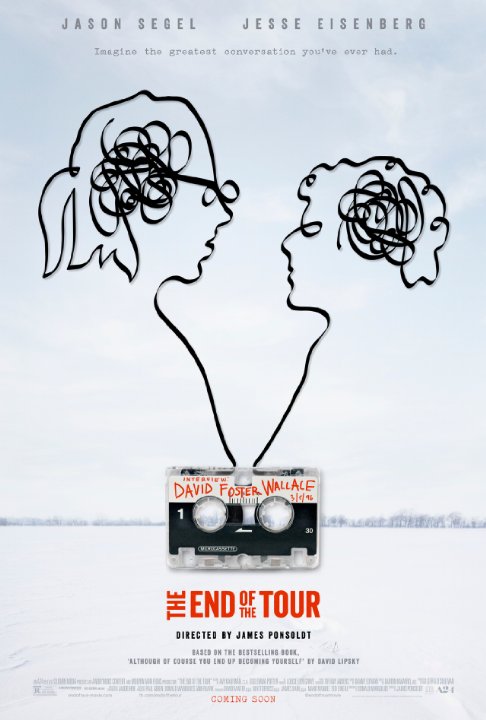
James Ponsoldt's
The End of the Tour is as moving and perceptive as movies come. As someone who has never read any of David Foster Wallace's work, I didn't know how I would respond to the film. While watching the movie, I found myself constantly identifying with Jason Segel's Wallace, but in retrospect, I of course recognize that I'm much closer (in terms of the way I live my life) to journalist David Lipsky (Jesse Eisenberg). There's that moment in the film when Lipsky goes into Wallace's bathroom and starts writing down the names of every pill bottle in his cabinet. And we don't realize the beauty of that moment until the end, when we see Wallace alone with the tape recorder. While Lipsky was trying to get the story - obsessively detailing the small things - Wallace was living in the moment. We want to be Wallace, but I think most of us are living our lives as the Lipsky character.

I connected deeply with Lipsky's need to document everything about his experience near the end - scrambling around Wallace's house with his tape recorder and describing every detail. Even if he didn't fully realize it at the time, the weekend meant something profound to him, and he was frantically trying to capture it before it was over.

Wallace is a deeply lonely character, and it seems to me that if Lipsky wasn’t trying so hard to get the story, the two of them could have been good friends, without any other journalistic objective in the way. When they’re spending time with the two women they meet in Minneapolis, Julie (Mamie Gummer) and Betsy (Mickey Sumner), simply hanging out and enjoying their company is enough for Wallace. When Lipsky tries to turn it into something else, it makes Wallace uncomfortable. Just be a good guy, he says to Lipsky. Even though Lipsky thinks Wallace is just putting on an act to appear like one of the "regular" people, Wallace really does feel that way - he's trying his best to remain uncorrupted. Eventually, he says, the technology will be good enough that we can be alone all the time and never have to experience anything authentic with other people.

Talking with Lipsky late at night in his bedroom, Wallace gives him a brief, honest look at his depression, which really isn’t a salacious Rolling Stone story at all - it doesn't involve heroin, as Lipsky seems to think. The next morning, when Lipsky says he doesn’t want to leave, Wallace says he knows how he feels.
The End of the Tour is so perceptive in these small moments, and it has the richness and feeling of a memory pulled from one's own life. Without any real context for the film and its subject, I walked away as moved and enlightened from a film as I have in some time.
I am happy to report that Nancy Meyers's
The Intern features Robert De Niro talking to himself in the mirror and Anne Hathaway making a
Rachel Getting Married joke. But seriously, I loved this movie - show me De Niro in a leading role and I'm there. Speaking of De Niro, he turned seventy-two this August. With this year marking the twentieth anniversary of Michael Mann's
Heat, there have been some excellent pieces written about one of the greatest of all films, including
one from Variety about how the film should have been a major Oscar contender, and another with
Mann speaking about the film. Mann released his first film in six years earlier this year,
the masterful Blackhat, which was as artful an action film as you'll find and criminally overlooked by audiences.
Also worth checking from this fall and this summer are Woody Allen's
Irrational Man, with great performances from Joaquin Phoenix and Emma Stone (I don't think I've written about how much I liked this film, as well as Allen's picture from last year,
Magic in the Moonlight, with Stone and Colin Firth as charming as they've ever been
- here's
an excellent interview with Allen from the The Wall Street Journal); Maya Forbes's very moving
Infinitely Polar Bear, featuring another wonderful performance from one of the best actors alive, Mark Ruffalo;
Mission: Impossible - Rogue Nation, which may surpass all other
Mission Impossible movies as the best one yet, and, for my money, the best action movie of the summer;
The Wolfpack, a documentary that made want to compare 30-best lists with the Angulo brothers (I love that multiple brothers agree that Oliver Stone's
JFK is #2) - here's
an excellent article from The New Yorker on The Wolfpack,
a piece on watching Goodfellas with the Angulo brothers, and
a video of the brothers meeting their hero, Robert De Niro; Joel Edgerton's
The Gift, which scared me enough that I let out a loud yelp in the cinema;
Inside Out, which may very well be my favorite Pixar movie and brought me such joy that I now own a Bing Bong action figure; Colin Trevorrow's
Jurassic World, which has hilarious Vincent D'Onofrio hovering and iconic Chris Pratt riding with his Velociraptors (the only thing
Jurassic World is missing is Jeff Goldblum emerging from the darkness in the old Jurassic Park bunker, channeling Tim Robbins in
War of the Worlds or something - "So you kids want to learn about the original Jurassic Park, eh? Follow me."); Thomas Vinterberg's beautiful
Far from the Madding Crowd; Shira Piven's darkly hilarious
Welcome to Me, with a great performance from Kristen Wiig; Stevan Riley's extraordinary documentary
Listen to Me Marlon; and, lastly, David Wain and Michael Showalter's
Wet Hot American Summer: First Day of Camp, which, as its own four-hour movie, is one of the funniest comedies ever made.
On a side note, after four consecutive film experiences earlier this summer without anyone talking or being an annoying-ass moviegoer, the Alamo Drafthouse in Austin has my heart. Particularly in New York, there are fewer and fewer cinemas where you can find a respectful and quiet audience serious about watching cinema (or theatre managers even remotely willing to police their audiences), so I'm grateful to the Alamo for doing what they're doing at a time when audiences only seem to intensify in their disrespect.
It's been a great year for one of my heroes, Al Pacino. He turned seventy-five this year, and you should celebrate it by seeing one of his three masterful recent performances: Dan Fogelman's
Danny Collins, which I saw twice in cinemas, has beautiful performances not only from Pacino but also Bobby Cannavale and Annette Bening; Barry Levinson's
The Humbling, an unheralded treat from 2014 written by Buck Henry and featuring excellent work from Pacino, Greta Gerwig, Charles Grodin and Dianne Wiest (I can't believe this film didn't get a huge theatrical release); and David Gordon Green's
Manglehorn, shot in Austin and a truly remarkable triumph of mood and feeling.
Here's
an article from Film Comment on the greatness of Pacino's recent work, and here's
my ranking of Pacino's performances on MUBI. John Lahr wrote
a great New Yorker article on Pacino last year, and here's
an excellent video accompaniment to Lahr's article. In
an interview with The Talks earlier this year, Pacino said, "You can't let your skin get too thick." It's a welcome return to the screen for Pacino, who I last saw onscreen in 2013's
Stand Up Guys, a very enjoyable hang-out movie with Pacino, Christopher Walken and Alan Arkin.
I haven't written about my reaction to this year's Academy Awards yet, but I was truly hoping to see Richard Linklater onstage winning Best Director.
Boyhood was almost unbelievably overlooked by the Academy. It's a strange feeling, because on my original end-of-the-year top ten list, I ranked Alejandro Gonzalez Iñárritu's
Birdman as my favorite film of last year - and it walked away with Best Picture, Best Director, Best Original Screenplay and Best Cinematography Oscars (but, infuriatingly, not with the Oscar it deserved above all others - Best Actor for Michael Keaton). However, upon watching
Boyhood again, I cannot help but feel that time will reveal it to be my favorite film of 2015 over
Birdman. I cannot complain, though, because
Birdman is easily the finest and most inspired choice, in my mind, for Best Picture since
No Country for Old Men (2007). Still, a
Birdman-
Boyhood Best Picture-Best Director split would have made me very happy.
In a perfect world, Linklater, Iñárritu and Wes Anderson all would walked away with Oscars this year, and a truly inspired script would have won Best Adapted Screenplay, such as Paul Thomas Anderson's
Inherent Vice, Damian Chazelle's
Whiplash or Gillian Flynn's not-even-nominated
Gone Girl.
But, as always, the best way to enjoy the Oscars is to just not visit the internet, where everything is an outrage and people actually don't like movies. And to anyone claiming that the Oscar winners this year didn't have enough box office appeal, remember,
as Sam Adams wrote in this great IndieWire article, "the Oscars haven't abandoned movies with mass-audience appeal... it's theatrical audiences who, with rare exceptions, have abandoned anything but big-budget spectacle."


 My senior thesis film You Can't Put Your Arms Around A Memory has had a great recent run at film festivals over the last few months. On Saturday, August 8th, my film screened at the 9th Athens International Short Film Festival Psarokokalo in Athens, Greece. Please take a look at the festival's program here, which gives a nice run-down of the film.




 After a mid-day visit to Venice Beach (and the chance to meet up with Spencer again at a nearby restaurant), we had dinner Saturday night with our friend from high school, Elizabeth Lefebvre, in West Hollywood.
 On Sunday, Bolton and I drove out to Universal Studios and enjoyed an awesome day there. Because Bolton's wonderful grandmother, Myr, kindly bought us Front of Line passes for the day, we were able to ride almost all of the Universal rides without any wait, including the rides for Jurassic Park, The Simpsons, Minions, The Mummy and Transformers - not to mention taking the official studio tour, where we went through the Universal backlot and were treated to recreations and tributes to films such as Psycho, Jaws and King Kong. As with Warner Bros., Universal has such a rich cinema history, with Alfred Hitchcock and Steven Spielberg among the iconic filmmakers who help define the studio.