Showing posts with label Grant Rosenmeyer. Show all posts

Tuesday, March 11, 2025

Gene Hackman, 1930 - 2025

There are six performers who I consider the titans of modern American acting, all of whom emerged in the New Hollywood films of the 1960s and 1970s - Robert De Niro, Al Pacino, Jack Nicholson, Dustin Hoffman, Robert Duvall, and the late, great Gene Hackman. It's been hard watching my heroes get old, particularly when their performances are among the most alive and energetic ever put on film. I knew it was only a matter of time before these legends began to leave us, and in February, Gene Hackman and his wife Betsy Hackman tragically passed away in their New Mexico home.

Truth be told, my earliest memories of Hackman are from the 1998 DreamWorks Animation film Antz (where he voiced the villain, Mandible) and The Replacements (2000), a football comedy co-starring Keanu Reeves. It wasn't until 2001 that I became exposed to the full range of what the great man could do onscreen: in David Mamet's Heist, he was the essence of cool alongside Danny DeVito and Delroy Lindo; in Behind Enemy Lines, he was rock solid as a commanding officer opposite Owen Wilson; in Heartbreakers, he was the wily comic relief; in The Mexican, his one scene was the high point of the film; and in Wes Anderson's The Royal Tenenbaums, he gave (in my opinion) the best performance of his entire career. I saw each of these films in cinemas in 2001, and Hackman made a strong impression - one that was about to be expanded when I started watching his earlier work.

The Royal Tenenbaums holds a particular significance for me. In the months leading up to its release, I was anxiously awaiting the film after reading about it in Entertainment Weekly's fall movie preview issue (I ended up cutting out the film's poster from the magazine and putting it on my mom's fridge - where it remains to this day). I remember adoring Tenenbaums when I saw it opening weekend in Austin (at the original Arbor Cinema location, which became a Cheesecake Factory not long after) - but it was my second viewing experience that remains among my most cherished.

I spent some time in late 2001 and early 2002 at my grandmother's house in East Texas, where my father, a struggling alcoholic, was also staying at the time. After numerous stints in rehabs over the prior few years, he was attempting to start over, working as a clerk at a local courthouse. I hadn't seen much of him that year, as he wasn't living in Austin, but we got to be with each other for a little while over the winter break. That trip turned out to be the last time I ever saw him, as he passed away on April 29th, 2002 from a heart attack brought on by excessive drinking.

Having already seen The Royal Tenenbaums and knowing my father's affinity for Wes Anderson's prior movie, Rushmore (1998), I was insistent that he and I see the film together. The only problem is that it wasn't playing anywhere in East Texas. The closest cinema playing Tenenbaums was in Shreveport, Louisiana, which is about an hour drive from Hallsville. That didn't deter us - we took a father-son road trip to see the movie, listening to a newly-purchased Bryan Adams cassette tape on the way.

As we watched The Royal Tenenbaums in that Shreveport cinema, I'd like to think it wasn't lost on me that this film I so desperately wanted my dad to see was itself about a neglectful father trying to make amends with his children before his death. It wasn't an exact parallel to our relationship, but the film touched on enough resonant themes that it felt like the right movie to see at that particular moment. I wish I remembered my dad's full reaction to the film, but I do remember he found one of Hackman's lines very funny: "Well, we'll have to swing by her grave, too."

With Royal Tenenbaum, Gene Hackman gave us a character with a wicked sense of humor and a self-destructive bent - but one who also genuinely desires to make amends to those he's hurt. The character felt real, particularly in the heightened world for which Wes Anderson has become so well known. I don't know if my dad saw anything of himself in Hackman's performance, but it's a character I've held close ever since his death. And it's partly why I consider it the most moving, full-bodied performance Gene Hackman ever gave.

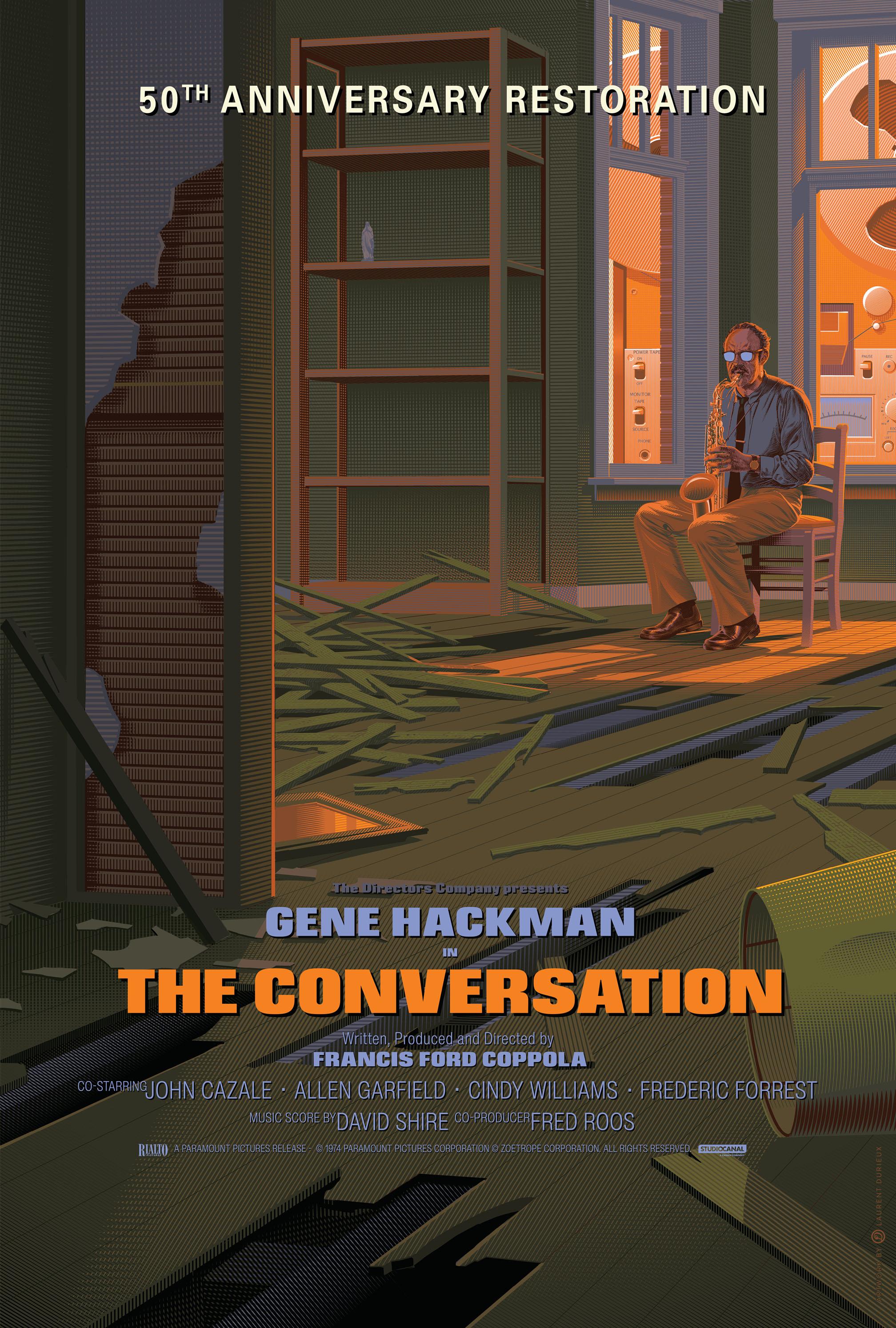
In the years following my dad's passing, I dove headfirst into movies as a necessary distraction, with a particular interest in the films of the 60s, 70s and 80s. This sent me on a collision course with many of Hackman's seminal films, including Arthur Penn's Bonnie and Clyde (1967), William Friedkin's The French Connection (1971), Francis Ford Coppola's The Conversation (1974), Alan Parker's Mississippi Burning (1988), and Clint Eastwood's Unforgiven (1992). These were movies that I cherished, and I count all of them among my favorite films. It was clear that not only was Gene Hackman still giving powerhouse performances in new releases (as evidenced by his five screen performances in 2001 alone), but that he was at the forefront of many of the great American films of the 20th century.

During my early teenage years, I saw a number of grief counselors, and I remember one of them told me his favorite movie was Jerry Schatzberg's Scarecrow (1973), starring Hackman and Al Pacino as two vagabonds. Hackman himself considered this his best performance, and it's a remarkably moving buddy comedy that remains underseen (despite having won the Palme d'Or at the Cannes Film Festival). Another unheralded gem from this era is Arthur Penn's Night Moves (1975), which is about to get a 4K release from The Criterion Collection. I always cite this movie as having one of my favorite taglines: "Maybe he would find the girl... maybe he would find himself."

In 2010, while studying at NYU, I became friends with Grant Rosenmeyer, who played Ari Tenenbaum in The Royal Tenenbaums. I was (and still am) in awe of him - here is somebody who went toe-to-toe with Gene Hackman at ten years old (and in his first movie, no less)! Needless to say, I relished the behind-the-scenes stories Grant told me about working on that film. It's heartwarming to hear how gentle Hackman was with the child actors on set, making sure they were safe during stunts, had enough to eat at lunch, and were treated as equals to their adult counterparts by the cast and crew.

In writing this admittedly meandering tribute, I haven't even touched on Hackman's extraordinary work in films as varied as Reds (1981), Hoosiers (1986), The Firm (1993), Get Shorty (1995), The Birdcage (1996), Young Frankenstein (1974), Superman (1978), and Runaway Jury (2003). I'm grateful that there are still dozens of Hackman films I've never seen - it feels like there's a treasure trove of great performances awaiting me. Gene Hackman's warm, familiar screen presence and mirthless chuckle will live on forever through his tremendous body of work. We're lucky to have had him as long as we did.

Sunday, June 30, 2013

Screening Jake the Cinephile

On Friday, June 14th, I premiered the final cut of my new film Jake the Cinephile to my friends and professors at the Tisch School of the Arts, alongside Jordan Fein's film White Carpet and Nicole Cobb's film Athanasia's Waltz, both of which I worked on as Assistant Director. It was such an honor to screen my movies alongside two great films by two of my friends, and we were very lucky to have a large crowd come out to see the pictures. By the way, check out the second trailer for Jake the Cinephile below.

Jake the Cinephile Trailer #2 from Jack Kyser on Vimeo.

The feedback on Jake the Cinephile has been overwhelmingly positive, and I have been so moved to hear that many people are connecting with this character. My professor Laszlo Santha, who has always been a champion of my work, wrote that the film had "way above average confidence in every department," and he truly enjoyed the film, complementing my acting and directing. He found some faults with the second half of the film, but still felt "the first ten minutes [were] delightful," and the casting of my "love interest worked very well."

Professor John Belton, Professor of English and Film at Rutgers University, the respected author of five books including Widescreen Cinema and American Cinema/American Culture, and the recipient of a 2005-2006 Guggenheim Fellowship, wrote the following:

"The film got to me because it looks at the borderline between the pleasure of a purely private experience and the innate desire to share that experience with another. There is love of the movies that can be utopian and perfect (Mystic River) and we'd like our other relationships to be that perfect too. You are not afraid to take your character to painful places - to push utopian ideals of perfection to a messy space of lived experience. (I recall the elation I've often felt after watching a film and then walking out into the street and becoming overwhelmed by depression.) So, yes, you did take yourself to where the wild things are."

In addition, Professor Belton invited me to screen Jake the Cinephile for his Introduction to Film class at Rutgers University in the fall.

My friend Grant Rosenmeyer (The Royal Tenenbaums) wrote that he loved the film - that "it was even better than the script," and "Ben's cinematography was gorgeous, the story was clear, [the] direction spot on" and "the Scorsese references bled through with such affection and passion, and yet it was so unflinchingly you." Grant also wrote that he believes that there is a feature film to be made with this character, something even more along the lines of Taxi Driver.

"Cinema for Jake is not even a love anymore, it's an addiction," Grant wrote. "And like an addict, he's chasing the high he can't achieve. That high - the perfect moviegoing experience - is just a mirage, a placeholder for something more in his life: love, acceptance, a sense of belonging or intimacy that can finally defeat his fear of abandonment. We can see he needs love, but can he see it? By the end of the movie does he find love, or does he fuck it up the way he does in the short, but worse?" 

Additionally, my Advanced Production professor Yemane Demissie invited me to screen Jake the Cinephile for his Sight and Sound: Film class at NYU last week, and it was such a fulfilling and rewarding experience. His students really empathized strongly with the character and the material, connecting with Jake throughout the entire film - even when he is yelling angrily at Elizabeth, as they felt his pain and frustration so deeply. It was very exciting sharing the film with them. 

Many students remarked that they knew someone exactly like Jake - in fact, one student said she had seen people in the Cinema Studies department at NYU behave like Jake when trying to watch a movie in their theater. As film students, they remarked that they particularly enjoyed and understood the material. One student said that he knows a film is doing its job if it can make him feel every bit as uncomfortable as the character in the film, and this movie made him feel incredibly uncomfortable throughout. Another student told me he felt so strongly about everything Jake said, especially when he puts his heart out there to Elizabeth on her apartment stoop. 

The students had many different interpretations of the ending - one student said she thought the last shot, in which Jake stares at his reflection in the television screen, was hopeful, as he's finally watching a movie at home and not blowing up or starting the movie over again. She felt that the character did change over the course of the film - the climatic blow-up is probably the event that makes Jake finally examine his behavior and change. Another student interpreted the ending very differently - he felt that Jake was more imprisoned and alone than ever by the picture's end, and all of his horrible experiences and frustrations are represented by this small, crappy television in his bedroom, where he's forced to stare at him own reflection. This student realized, after Elizabeth points it out, that Jake has likely never had a "perfect experience" at a movie before, and that becomes clear at the end when he watches a movie alone on his crappy TV, which is the source of all of his frustration. 

Yemane asked me to address to use of popular music in the film, particularly the meaning of "I Am A Rock" by Simon & Garfunkel at the end of the movie. The song, Yemane believed, is meant to be taken literally, but also perhaps ironically, too. We discussed some of the other music in the film, as well, including "Sweet Dreams (Of You)" by Patsy Cline.

We discussed how you make a rather unlikeable or difficult character likable or relatable (the key, Yemane thinks, is to show their vulnerability). One student said it was difficult to dislike Jake because there's never anything malicious about his behavior - he is simply fighting for the things he loves, even when Jake berates Elizabeth and yells at her. We have these private moments in the film with Jake, such as when he's walking on the city streets, or alone in his bedroom at the end, and we get a profound sense of his deep loneliness and vulnerability. 

I was also happy to hear that my film incorporated elements of nearly every exercise the students are given in the Sight and Sound: Film course, including music, voiceover, three-point lighting, offscreen sound, parallel action and special effects lighting. 

More than anything, Yemane commended me for making such a bold movie that revealed so much about me, and it was a joy screening the film for his class.

I have received so many other kind comments from friends and professors who enjoyed the film (including one of my fellow Advanced Production students, the great filmmaker Eduardo Lecuona, who gave me the very kind shout-out on Twitter to the right). My friend and former Austin High School administrator Dan Fuchs also wrote that Jake the Cinephile is "both funny and troubling; Kyser is not afraid to laugh at himself, while simultaneously shining a light on the alienation many feel as we search for perfection in an imperfect world." The film "speaks to that part of all film lovers that longs for that mythical bygone time when going to movies could be a 'perfect experience.'"

Aside from my article on the passing of Roger Ebert and writing about some outstanding new films, I have not updated this blog in some time, and I am eager to share details about my final semester at NYU, shooting my senior thesis film You Can't Put Your Arms Around A Memory in April and many other events from the past few months. Before I close this article, however, I want to pay tribute to the wonderful Professor Geoff Erb, who passed away earlier this month. He was a champion of my work, inviting my crew and me to screen The Wheels for his freshman class last year, and asking me to be a part of his Advanced Television Production class my senior year. He was a great person and teacher, and I am so sad to hear of his passing. Professor Erb was the Cinematographer for Law and Order: Special Victims Unit, shooting over 130 episodes of the series. 

I was also very devastated to read of James Gandolfini's passing. What an extraordinary actor, who just last year delivered three of his best performances in Zero Dark Thirty, Not Fade Away and Killing Them Softly. He blew me away onstage in God of Carnage on Broadway in 2009, and I was lucky enough to meet him after the show. With his mesmerizing and natural performances in The Man Who Wasn't There, Where the Wild Things Are, Get Shorty, In the Loop and, of course, The Sopranos, he was one of the finest actors around. Just a few days after his death, Bruce Springsteen performed a beautiful tribute to Gandolfini by playing the entire Born to Run album live

The beginning to this summer involved a great deal of preparation for Jake the Cinephile, as Bobb finished his brilliant sound design for the movie, and we worked on mix sessions for the film at Tisch in the days leading up to the screening. Earlier in the semester, Bobb held an ADR session with Bethany McHugh, who plays Elizabeth in the film, and me, where we re-recorded some of our lines. 

In February, my film The Wheels opened Screening #2 of NYU's New Visions and Voices Intermediate Film Festival, screening at the Tisch School of the Arts along with several other films. I did not get to attend the screening, as I was heading out for the second weekend of my friend Morgan Ingari's senior thesis film shoot in Boston. I also took some time to finally mail out the beautiful poster Ben Dewey designed for The Wheels to IndieGoGo contributors. That film was completed more than one year ago, but better to send the posters out late than never! 

Finally, my film With Love, Marty - from my sophomore year of college - is now public on Vimeo, having screened at the 2011 Big Apple Film Festival, the Emerging Filmmakers Series in Rochester, New York and the 2012 World Music and Independent Film Festival in Washington D.C. You can watch it now!